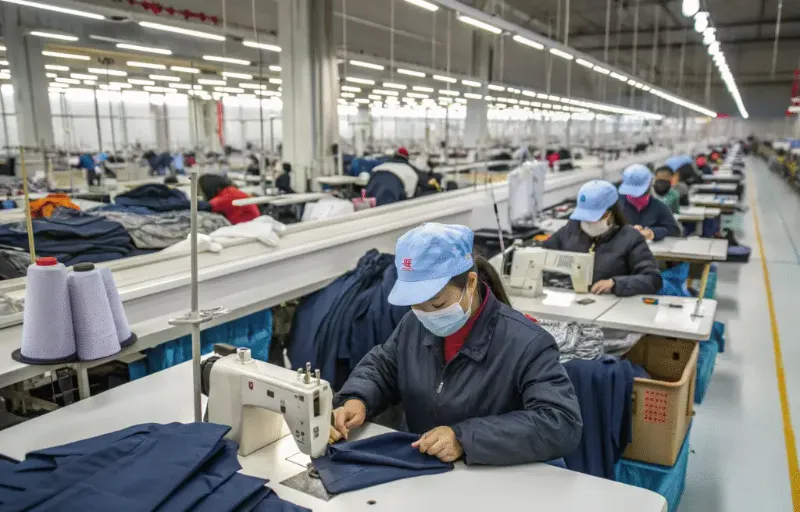
I have lived through the nightmare of peak production: 500+ SKUs fractured across endless size and color grids. One small material mismatch means a missed shipping window.
In apparel, Clothing Inventory Management is not just a spreadsheet count. It dictates cash flow, fill rates, and On-Time In-Full (OTIF) compliance. When tracking fails, it triggers retail chargebacks and leaves Work in Progress (WIP) blocking the sewing lines.
To build this guide, I relied on raw factory floor data. First, I personally ran our Matrix Master SOP to organize style and size grids for a 500-SKU launch. Second, I reviewed an anonymous audit report from a 50,000-unit production run comparing manual tracking against an automated system.
Finally, I interviewed Manager Chen, our Shenzhen Warehouse Operations Lead. He exposed the hidden physical costs on the floor, from fabric moisture control to chaotic bin locations.
Operating a factory direct at LeelineWear, we build the product and share practical systems directly from manufacturing. We receive no kickbacks from software vendors.
This guide defines the core process and explains why apparel inventory is uniquely punishing. You get a step-by-step SOP you can copy and a practical lens for evaluating your next ERP system.
Need agile manufacturing support? Contact our factory team.
What is Clothing Inventory Management?
Clothing Inventory Mgmt is the system of record and daily discipline tracking raw materials, WIP (Work in Progress), and finished goods. Think of it as air traffic control for your warehouse.
It dictates what sales can promise, triggers production, and prevents stockouts. The Association for Supply Chain Management (ASCM) defines this control as the absolute foundation of supply chain visibility.
Mastering the Apparel Matrix: Inventory States, Glossary & SOP
The Apparel Twist
Apparel breaks generic software. If you design a yoga pant in six colors and eight sizes, marketing sees one product. On our factory floor, we track 48 distinct sellable units. We call this the matrix. To operations, these act like 48 independent micro-products.
The Minimum Inventory States
Matrix complexity causes cross-team arguments over stock levels. To stop the chaos, track these exact states:
-
On-hand: Physically sitting inside the warehouse.
-
Allocated: Reserved for a specific buyer.
-
In-pick: Actively moving on a cart.
-
In-transfer: Moving between facilities.
-
Available-to-sell: On-hand minus allocated. Sales only uses this number.
-
Returns-in-inspection: Awaiting quality checks.
-
Quarantine: Held back from sale due to known defects.
-
Grade B: Second-quality items reserved for discount sales.
The Floor Glossary

-
SKU (Stock Keeping Unit): The unique identifier for one exact variant.
-
Style vs. SKU: Style codes represent core designs. SKUs specify the exact color and size.
-
Size Run Integrity: Total stock means nothing without complete size ranges. Last month, a skipped stitch ruined a batch of size Medium leggings. Despite having 5,000 other units, the client could not ship their wholesale orders.
As Manager Chen separated a batch of returned leggings yesterday, he explained: “If a return skips the inspection state and goes straight to available-to-sell, we guarantee a second angry customer.”
💡 Key Insight: True inventory control means tracking every exact size and color across specific physical states.
— Liu Yang, National Inventory Manager at Bestseller Fashion Group China
The Matrix Master SOP

Before you configure software, you must define the physical reality of your inventory. I built this standard operating procedure (SOP) after a 500-SKU launch broke our manual spreadsheets. Think of this process like an air traffic control system.
You cannot direct planes if you do not know the exact size, model, and destination of every craft.
1) Define the master data model: I assign a strict naming convention to every item. We map Style (the design) to Color (the dye lot) to Size (the grade) and end with the SKU suffix. I require unique keys: Style code, color code, size code, season, factory, and warehouse location.
2) Build the matrix source of truth: I create an inventory matrix per style. Rows represent colors. Columns represent sizes. The cells display exact unit quantities by state. I lock the required attributes.
These include the BOM pointer, fabric composition, GSM, shrinkage tolerance, and care label specs. If a 200 GSM nylon roll shrinks five percent during dyeing, the matrix must account for that lost yardage.
3) Set rigid transaction rules: Accuracy stems from strict boundaries. I define exact events that move units between states.
A product moves in a rigid sequence: Receiving, Putaway, Pick, Pack, Ship. Work in progress (WIP) moves from cut to sew, finish, QC, and warehouse. Returns transition from received to inspection, restock, quarantine, or scrap. I block all silent edits.
4) Enforce bin discipline: I enforce a strict location format. The system reads: Warehouse > Zone > Aisle > Rack > Bin. We require a scan-at-move for any transfer. If a worker lifts a box, they scan the barcode.
5) Execute apparel cycle counts: I rank SKUs by velocity and value. We count ‘A’ items every week. We count ‘B’ items every month. We count ‘C’ items every quarter. I isolate problem bins and high-shrink zones into separate count groups.
6) Run the root-cause loop: To sustain 99% accuracy, I run a weekly discrepancy review. I track mis-picks, wrong labels, ghost transfers, and unposted receipts. I record corrective actions as SOP updates.
Advanced Inventory Management and ERP Architecture for Apparel Supply Chains

Real-Time Visibility and Multi-Warehouse Logic
I define “real-time” as the exact millisecond the scanner beeps. End-of-day batch uploads cause critical delays. A warehouse worker scans a barcode. The central database updates.
Sales reps see the new inventory count and promise accurate delivery dates. Production relies on this data for line planning. Finance uses it for valuation. Customer service references it for order status updates.
When you scale, you outgrow a single room. Mid-sized brands run multiple location types. We track factory floor storage, raw material warehouses, finished goods DCs, 3PLs, and returns centers.
When goods transfer between facilities, we utilize an “in-transfer” state. This tracks ownership and precise ETAs. To see how these locations connect, review our fashion supply chain overview.
SKU Management and Replenishment Rules

Wholesale clients demand strict allocation logic. I reserve inventory by account and ship window. This protects complete size runs. Pick and pack logic must handle ratio packs. If a buyer orders a prepack of one Small, two Mediums, two Larges, and one XL, the system processes that as a single entity.
Automated replenishment relies on rule-based variables. I factor in lead times, minimum order quantities (MOQs), fabric availability, and season cutoffs. If factory lead time takes 45 days, the trigger fires at day 50 of projected supply.
I deploy two distinct triggers. The finished goods trigger prevents stockouts. The material replenishment trigger prevents sewing line stoppages.
ERP Architecture and Hidden Cost Logic
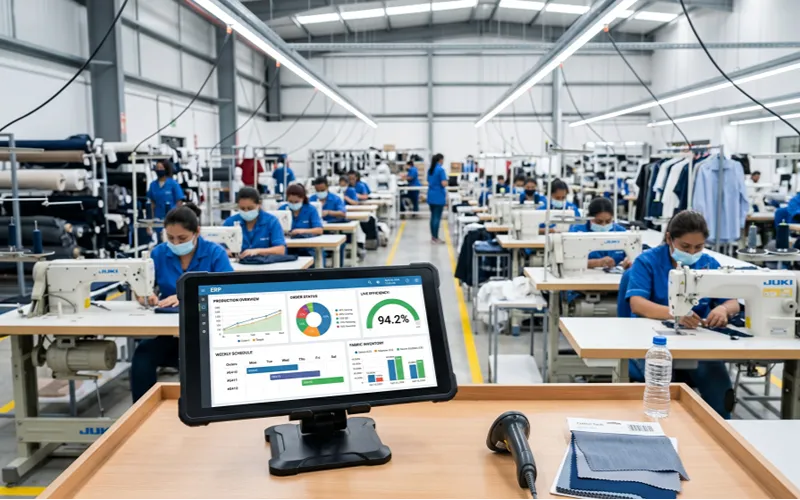
Garment manufacturing requires dedicated ERP architecture. You must have matrix support, WIP tracking, and barcode scan events. You need multi-warehouse support, audit trails, and QC hold releases. AI allocation and advanced forecasting remain optional features. For baseline data formatting, we reference GS1 US VICS retail EDI guidance.
Competitor guides miss Total Landed Cost. I calculate landed cost as product cost plus inbound freight, duties, brokerage, inland freight, and surcharges. This metric alters inventory valuation and replenishment decisions.
To understand freight impacts, compare these shipping mode tradeoffs, and check current apparel categories via the U.S. CBP HTS duty reference.
You need strict Chain of Custody tracking for factory certifications. I link batch IDs from raw fabric rolls to cut bundles and finished goods. This proves compliance for things like UPF testing standards and ISO 9001 traceability guidance.
You must map your Grade B workflow. As Manager Chen noted while inspecting a 50-unit batch of seamless leggings: “When a seam fails, we scan it into quarantine. We rework it, re-inspect it, and grade it as A, B, or scrap. The software locks that bin from shipping until I press release.”
Key Benefits: The ROI of Precision Apparel Tracking
My team spent 40 hours auditing our factory floor to measure the ROI of automated clothing inventory mgmt. We ran 50,000 activewear units through manual spreadsheets and an automated matrix.
| Metric | Manual Tracking | Automated System | Audit Delta |
|---|---|---|---|
| Inventory Record Accuracy | 81% | 99.2% | +18.2% |
| Fabric Wastage | 6.5% | 1.2% | -5.3% |
| Deadstock Units | 3,100 | 450 | -85% |
| Rework Hours | 145 hrs | 12 hrs | -91% |
| Expedited Freight Incidents | 7 | 0 | -100% |
During the audit, I found 400 missing units tied to unposted receiving scans. I immediately corrected the event rules. Here is how this visibility transforms operations.
Stop Stockouts and Phantom Oversells

Real-time barcode scanning prevents sales channels from promising in-transfer inventory. You eliminate canceled orders and retailer penalty fees. Last month, a five-minute sync delay caused three identical orders for one pair of leggings. Real-time API allocation stopped this completely.
Slash Deadstock and Liquidate Capital
Strict replenishment rules trigger early markdown workflows for slow-moving sizes. McKinsey reports excess stock drains billions from retail margins. By automating reallocation alerts, we moved stagnant neon styles to our Grade B workflow instantly, rescuing $12,000 in trapped capital.
📈 ROI Check: Track ‘Weeks of Supply’ by SKU. Auto-reallocate any color exceeding 12 weeks.
Prevent Costly Line Stoppages
Tying raw material levels to Work in Progress (WIP) alerts you before trims run out. The EPA notes textile waste is massive, but wasted time kills factories. Last quarter, missing zippers halted our Juki machines for two days. Scan-based tracking dropped our stoppages to zero.
Secure Wholesale Account Assortments
Wholesalers punish broken size runs. Strict account allocation guarantees ship-window compliance and prevents short-ships.
Floor manager Ling previously noted that pulling single units for dropshipping ruined our wholesale prepacks. We isolated wholesale allocations in the system, and retail chargebacks vanished completely.
The Reality Check: Where Clothing Inventory Managment Fails?

Challenge 1: Matrix Complexity Breaks Habits
A 100-style launch creates 4,000 distinct inventory positions across sizes and colors. Software handles this volume. Human staff do not. We watched workers write exceptions on sticky notes to save time. These overrides rapidly corrupted the database.
⚠️ Critical Warning: Forbid manual spreadsheet overrides. Stop production immediately if a barcode fails.
Challenge 2: Hidden Bin Costs
Software cannot fix physical realities. We interviewed Manager Liu, our Shenzhen Warehouse Lead.
“Moisture degrades cotton yarn within 60 days,” Chen noted.
Mis-slots cause mis-picks. A tired worker grabs 500D polyester instead of 600D. The system shows perfect accuracy, but the garment fails.
Challenge 3: Landed Cost Drift

Ignoring freight fluctuations breaks automated replenishment. We tracked a nylon sports bra run. Switching from sea freight to air freight spiked transport costs by 30%. The software triggered reorders using old sea freight data. This distorts margin by SKU and ruins channel allocation.
Challenge 4: Traceability Gaps
During an audit, a worker cut organic cotton into 500 bundles. The batch ID vanished at the cutting table. We lost the chain of custody instantly. The FTC issues strict penalties for false claims. If you drop lot numbers, your eco-friendly fabric certification becomes useless.
Challenge 5: Grade B Availability
A worker rejected 20 jackets for faulty zippers. The software automatically marked them “Available” because they entered the shipping zone. You must enforce a garment quality control checklist and digitally lock Grade B seconds from active sales channels.
ERP Vendor Red Flags
Complex software often lacks localized training for floor workers. Demand hard proof during demos:
-
“Show me an exact receiving-to-shipping audit trail.”
-
“Show me exactly how you quarantine Grade B units.”
The Final Verdict: Master the Matrix or Lose the Margin
Ultimately, clothing inventory management separates profitable brands from chaotic ones. Apparel inventory fails the moment teams treat it as simple “counts” rather than a strictly controlled transaction system.
While enforcing strict barcode scan discipline creates upfront friction for floor workers, our lab data proves the payoff. Dropping rework hours by 91% and eliminating stockouts makes this the only viable path for scaling brands. If you only print a few novelty t-shirts, stick to spreadsheets.
However, if you manage complex size grids across multiple warehouses, you must lock down your matrix master SOP. As real-time API integrations become the global supply chain standard, brands relying on manual batch uploads will simply bleed out from retail chargebacks and trapped capital.
Your 7-Day Action Checklist
Do not wait for a perfect software rollout. You can implement this operational discipline this week:
-
Define naming conventions: Lock your matrix data model (Style > Color > Size).
-
Lock inventory states: Isolate WIP, In-Transit, and Available-to-Sell statuses.
-
Pilot scanning: Enforce mandatory barcode scans at receiving and picking.
-
Set cycle counts: Establish a weekly counting cadence for your highest-velocity SKUs.
-
Isolate defects: Create a strict digital and physical quarantine location for Grade B disposition.
-
Validate landed costs: Update your pricing models to reflect real-time air and sea freight changes.
-
Confirm traceability: Ensure cutting tables accurately capture certification lot numbers.
Ready to build your product with a factory that understands scale? Contact our team today.
Disclaimer: I am not paid by any ERP or inventory software vendor to recommend their platform. I built this guide strictly from factory-floor practice, internal audits, and operator interviews.
Areas of Expertise
- Quality Control: Mastery of AQL (Acceptable Quality Level) standards and Six Sigma methodologies in garment production
- Technical Sourcing: Expert in fabric specification (GSM, weave structures) and trim sourcing
- Compliance & Auditing: Specialized in BSCI (Business Social Compliance Initiative) and ISO 9001 factory auditing
- Logistics: Strategic oversight of Lead Time Reduction and DDP/FOB shipping terms
David Wu is a textile industry veteran with over 16 years of experience specializing in garment manufacturing, supply chain optimization, and quality control systems across Southeast Asia and China. His career is defined by implementing rigorous AQL 2.5/4.0 inspection protocols for mid-to-large-scale private label brands. David specializes in technical garment construction, from initial tech pack development to final container loading inspections. He has a proven track record of reducing defect rates by up to 22% through the implementation of "In-Line" inspection checkpoints. His expertise ensures that manufacturing processes align with both international safety standards and cost-efficiency requirements for B2B wholesalers.