Relying on hand-feel alone is why expensive activewear fails the squat test, pills after washing, or retains odor. In my experience reviewing tech packs at our China facility as a professional sportswear manufacturer, “softness” is subjective, but physics is not.
This sportswear fabrics guide replaces guesswork with the industrial logic we use on the factory floor.
We will move beyond generic descriptions to measurable specs like GSM, denier, and AATCC test standards. You will learn to select the exact material for specific activities—from high-compression running gear to breathable yoga sets—and lock those choices into your production files.
It takes ten minutes to read, but you will leave with a sourcing checklist usable for every future collection.
What You Need Before Sourcing
I have seen entire production runs scrapped because a brand confused “weight” (GSM) with “density.” To source the right fabric, you need precise constraints and the tools to validate them.
1. The Design Constraints
-
Activity: High abrasion (CrossFit/Tennis) vs. High mobility (Yoga).
-
Climate: High humidity (needs wicking) vs. Cold/Dry (needs thermal).
-
Fit Intention: Compression (muscle support) vs. Relaxed (drape).
-
Lifespan: 3-month trend drop vs. 2-year core collection.
2. Spec Vocabulary
-
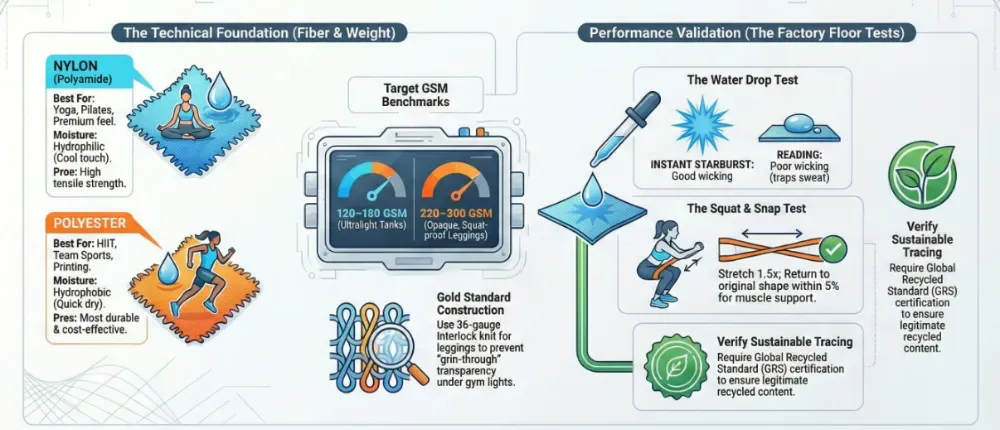
GSM: Weight. Target: 220–300gsm for opaque leggings.
-
Denier: Yarn thickness. Low (20D) is soft; High (70D) is durable.
-
Elastane/Spandex: Stretch %. Target: >15% for activewear.
-
Wicking (Capillary Action): How fast sweat moves to the surface.
3. Validation Tools
-
Digital Scale: To verify GSM claims (±5% tolerance).
-
Measuring Tape: To check fabric width and stretch recovery.
-
Home Washer: To test shrinkage and pilling immediately.
⚠️ Compliance & Claims
-
Skin Safety: Require OEKO-TEX Standard 100 certification for all base layers.
-
Labeling: Do not claim “Antimicrobial” or “UV Protection” without an official lab report (e.g., AATCC Test Methods). Retailers will reject unverified claims.
⚡ Power Move: Create a “Fabric Bible” binder to catalog every swatch you reject or approve for future reference.
How to Select the Right Fabric?(Sportswear Fabrics Guide)
Step 1: Map the Scenario to a Sensory Profile
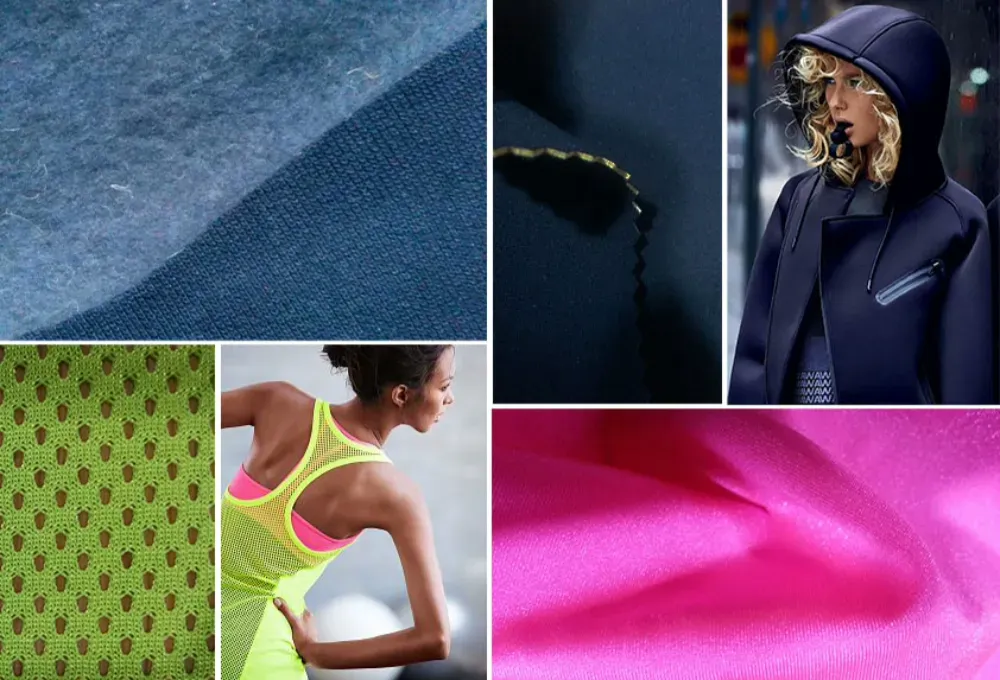
Most “bad quality” returns are actually function mismatches. I have seen expensive brushed nylon leggings ruined after one CrossFit session because the fabric was designed for yoga, not barbell abrasion. Before touching a swatch, define the physical stress points.
Define the Usage Scenario Answer these four questions to lock the constraints:
-
Movement Pattern: High friction (burpees/sliding) or static stretch (Pilates)?
-
Sweat Intensity: Heavy output (needs rapid transport) or light leisure?
-
Environment: Controlled indoor AC or outdoor wind/UV?
-
Fit Goal: High compression (second-skin) or relaxed drape?
Simulate the “Touch & Feel” In our showroom, we use these sensory baselines to verify suitability before production:
-
HIIT/Cardio: The fabric must feel slick, cool-to-the-touch, and non-clingy when damp.
-
Yoga/Lounge: The fabric must feel butter-smooth, low drag, and silent (no swishing sound).
Lock the Top 3 Priorities Select exactly three non-negotiable traits. You cannot have everything; high compression often sacrifices drape.
-
Example: Wicking + Abrasion Resistance + Recovery
-
Example: Softness + Opacity + Low Compression
Add Tactile Cues Define texture for accessibility in your tech pack. Use descriptors like “mesh with visible perforations” or “brushed fleece interior” rather than just “black insert.”
Draft the Job Description Combine these into a single sentence to guide your sourcing: “I need a fabric for [Activity] that feels [Sensory Cue] and prioritizes [Priority 1, 2, and 3].”
🧠 Author’s Verdict: Do not skip the “Silent” check for yoga fabrics. In my testing, nylon blends that make an audible “swish” sound when thighs rub together are the #1 complaint from studio owners, even if the fabric is technically durable.
Step 2: Select Your Fiber Base
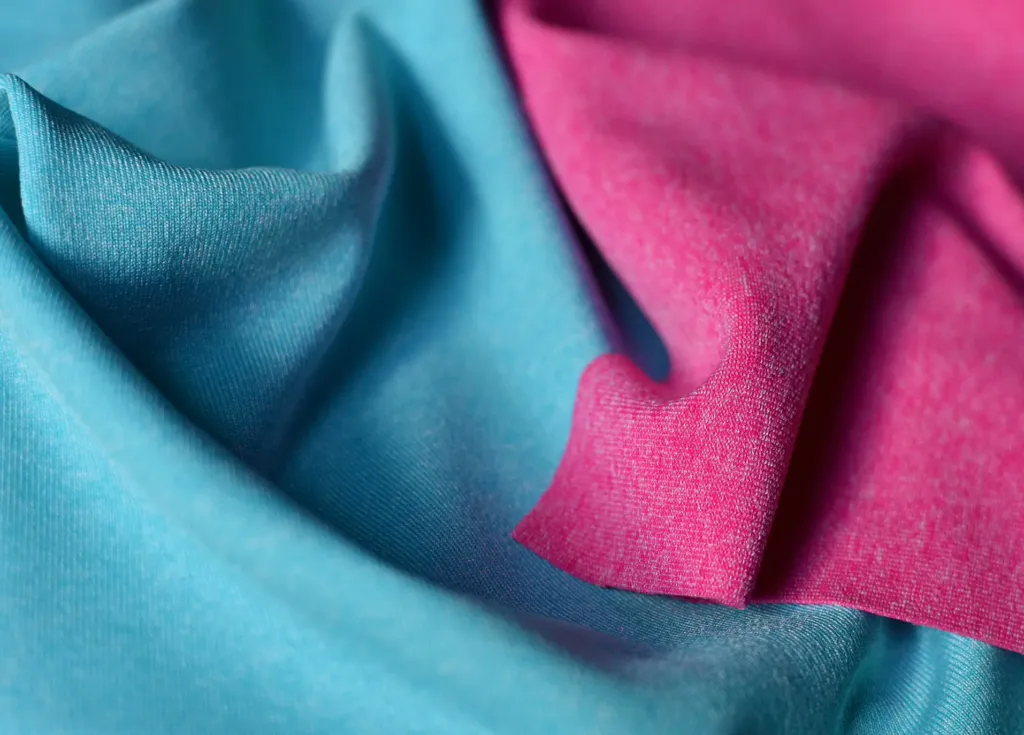
In my experience on the factory floor, the most common sourcing mistake is treating polyester and nylon as interchangeable. They are not. Your decision here dictates the lifespan, printability, and “handfeel” of the final garment.
Run the Decision Tree Use this logic flow to select your primary fiber path:
-
Maximum Durability + Quick Dry → Choose Polyester.
-
Skin Sensitivity + Cool Touch → Choose Nylon (Ideal for Yoga/Pilates).
-
Casual Comfort → Choose Natural Blends (Cotton/Bamboo). Note: These become heavy and “clammy” when wet.
Compare the “Big Two” Synthetics Most activewear relies on one of these two polymers.
-
Nylon (Polyamide): The premium standard. It has higher tensile strength (harder to tear) and is hydrophilic (absorbs moisture), which creates a distinct “cool” sensation against the skin.
-
Polyester: The industry workhorse. It is hydrophobic (repels water), allowing sweat to evaporate rapidly from the surface. It is cheaper than nylon but can feel “plasticky” if you select a low-grade option.
Perform the Sensory Check Rub the fabric swatch against your inner wrist (a sensitive area) to confirm the quality:
-
Nylon/Spandex: You should feel a “slick,” cool sensation with an elastic rebound.
-
Polyester Interlock: Feels smooth but “drier.” If it feels scratchy, reject it immediately.
⚠️ Production Warning: If you require Dye Sublimation (printing complex patterns or photos), you must use Polyester. Nylon cannot withstand the 400°F heat required for the sublimation process without distorting.
🧠 Author’s Verdict: If you are building a premium brand to rival Lululemon, ignore standard polyester. I have found that customers associate the specific “cool-to-the-touch” sensation of Nylon 6.6 with high value. Only use Polyester for loose-fit gear or heavy prints.
Step 3: Choose the Construction Structure
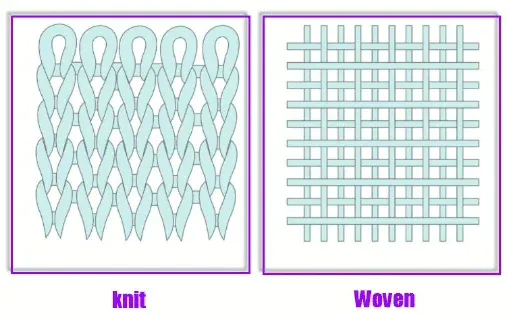
Fiber is the ingredient, but structure is the recipe. At our China facility, I often see prototypes fail not because the material is cheap, but because the knit construction does not match the workout intensity.
1. Distinguish Knit vs. Woven Examine the fabric surface to determine its mechanical properties.
-
Knits (The Loop): Look for interlocking loops (like a tiny sweater). Select this for stretch and airflow in leggings or tees.
-
Wovens (The Grid): Look for a rigid crisscross pattern. Select this for stability and wind resistance in jackets or shorts.
2. Specify the Knit Type (For Designers) Do not simply write “knit” in your tech pack. Specify the exact type to solve performance problems:
-
Interlock: Use this for leggings. The double-knit structure creates a smooth surface on both sides and maximizes opacity (making it squat-proof).
-
Single Jersey: Use this for lightweight t-shirts. Note: it curls at the cut edges and offers less durability.
-
Mesh/Warp Knit: Use this for ventilation zones. It increases cooling but offers zero UV protection.
3. Verify Recovery (The Snap Test) Pinch the fabric, stretch it two inches, and release. It must snap back to its original shape instantly. If the fabric wavers or stays loose, the recovery is poor. Reject it for gym wear immediately.
4. Check the Airflow Press the fabric to your lips and blow hard. You should feel the air pass through freely. If the air gets trapped, the fabric will feel suffocating and sticky on damp skin.
🧠 Author’s Verdict: I always recommend specifying High-Gauge Interlock (36+ gauge) for leggings. In our factory testing, standard gauges (under 28) often suffer from “grin through”—meaning the knit loops open up when stretched, turning your solid black leggings transparent under harsh gym lights.
Step 4: Specify Fabric Weight (GSM)
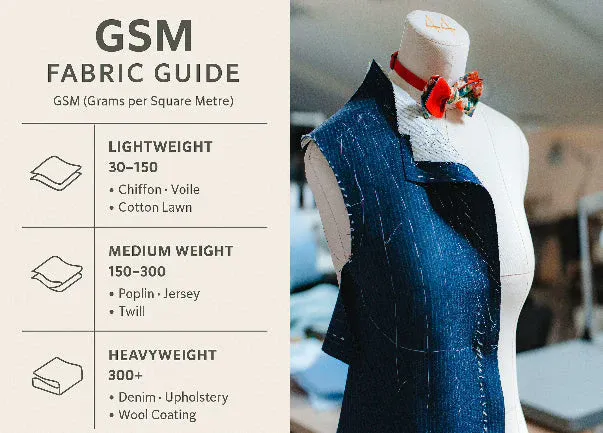
“Thick” is a subjective opinion that causes production errors. In our cutting room, we rely exclusively on GSM (Grams per Square Meter) to measure density. You must translate the “hand feel” you want into a specific numeric range.
1. Select Your Target Range Match your intended product to these standard industry bands:
-
120–160 GSM (Ultralight): Use for mesh panels or running tanks. Feels paper-light, cool, and flutters during movement.
-
160–220 GSM (Midweight): The standard for men’s training tees. Offers a smooth drape but provides zero support.
-
220–280 GSM (Compression): Mandatory for leggings. Provides a dense, “held-in” sensation that hides skin texture.
-
280–320+ GSM (Heavyweight): Use for hoodies, joggers, and outerwear.
2. Check the Denier (Yarn Thickness) GSM measures weight; Denier (D) measures toughness.
-
High Friction: Request 70D+ for barbell shorts. It feels rugged (almost plastic-like) but resists snagging.
-
Low Friction: Use 20D–40D for yoga tops to achieve a soft, silk-like touch.
3. Execute the “Squat Test” Never trust the spec sheet alone. Perform this physical check on every sample:
-
Stretch the swatch tightly over your bent knee.
-
Hold it under direct overhead light to mimic harsh gym lighting.
-
Inspect for skin visibility. If you see skin tone, the GSM is too low.
⚠️ Experience Warning: Buffer Your Specs Fabric mills operate with a ±5% tolerance. I have seen production runs fail because a 210 GSM sample was barely opaque, and the bulk fabric arrived at 200 GSM (transparent). Always buffer up: if you need 220 GSM performance, order 230 GSM to be safe.
Step 5: Define Moisture Management Specs
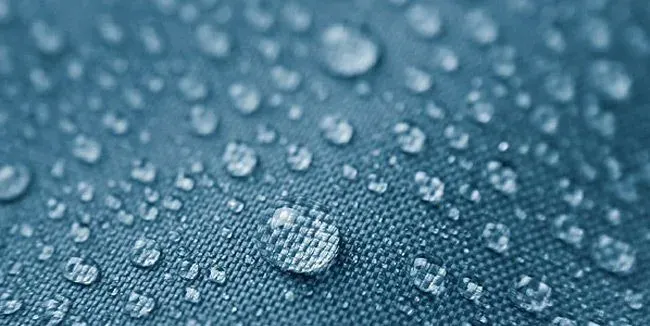
Confusing absorbency (holding water like a sponge) with wicking (moving water like a pipe) is the expensive error that ruins activewear collections. To prevent “swampy” gear, distinguish these three mechanisms in your Tech Pack:
-
Absorbency: The initial intake (getting wet).
-
Wicking: The transport along fibers via capillary action.
-
Quick-Dry: The evaporative release.
Select Your Technology Decide how the fabric achieves this performance.
-
Topical Finishes: A chemical coating sprayed on standard round fibers. It is cost-effective but temporary.
-
Engineered Cross-Sections: The yarn itself is extruded with X-shapes or grooves. This increases surface area to physically channel water and never washes out.
Demand Standardized Proof Marketing claims mean nothing without data. Require these specific results based on Official AATCC Testing Methods:
-
Transport Distance (AATCC 197): Moisture must travel vertically >100mm within 10 minutes.
-
Absorbency Speed (AATCC 79): A water drop must disappear in <5 seconds.
Perform the Sensory Check Pour a single drop of water on the fabric’s inner face.
-
Visual: Look for a “starburst.” The drop should not bead up; it must spread instantly into a large, irregular footprint.
-
Sensory: Blow on the damp spot. Effective wicking feels cool immediately due to airflow hitting the spread moisture. Poor wicking feels clammy and warm.
-
Note: You do not need color contrast to see this. Simply watch the dark moisture patch expand. If it stays small, the fabric is trapping heat.
⚡ Speed Verification:
Check the Wash Standard. If you choose a chemical finish to save costs, specify “Durable to 30+ washes” in your contract. In our internal tests, unbranded finishes often fail after just 5 washes, effectively turning your “performance” leggings into a plastic bag.
Step 6: Apply Functional Treatments
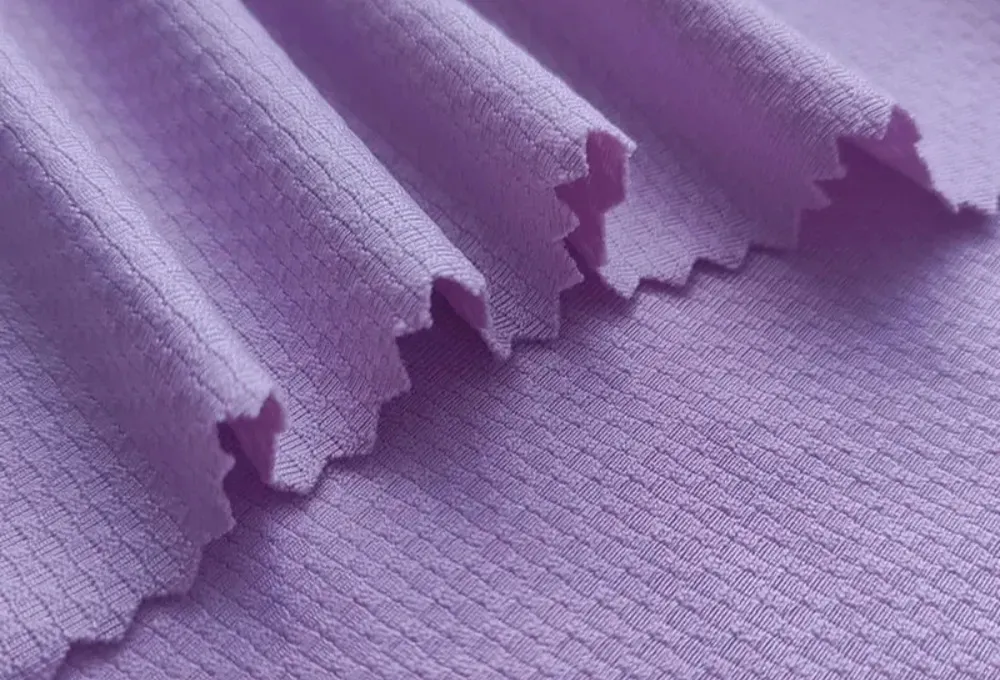
Treatments are chemistry, not magic. In my experience, brands often over-apply finishes, ruining the expensive “soft hand” prioritized in Step 2. You must balance chemical performance with physical texture.
1. Select the Chemistry Choose the specific finish based on the garment’s environment:
-
Antimicrobial: Request Silver or Zinc ions. These inhibit bacteria but degrade over time.
-
UV Protection: Require a UPF 50+ rating verified by a current lab report.
-
DWR (Durable Water Repellent): Apply to outer layers. It forces water to bead but creates a waxy barrier that reduces breathability.
2. Specify the Lifespan Chemical bonds break down with heat and detergent. Never accept “Permanent” as a spec.
-
The Clause: Write “80% effectiveness after 20 home washes” directly into your purchase order.
-
The Proof: Demand an AATCC 61 wash test report from the supplier before approving bulk production.
3. Audit the Handfeel Finishes and physically coat the fiber. Rub the swatch against your neck to check for abrasion.
-
Texture: DWR treatments often make fabric feel stiffer, crisper, or slightly waxy.
-
Odor: Smell the sample immediately. Reject any fabric with a sharp, metallic, or “sour” chemical odor.
⚠️ Compliance Warning: Do not make medical health claims. Labeling a product “Anti-Viral” or “Bacteria-Killing” triggers strict regulations (like EPA or BPR). Use “Odor-Resistant” or “Freshness” claims to avoid customs seizures.
🧠 Author’s Verdict: I rarely recommend DWR for yoga leggings. The waxy coating destroys the “second skin” sensation and traps sweat against the body. Save the waterproofing for loose-fit joggers or jackets where skin contact is minimal.
Step 7: Define the Compression Level (Modulus)
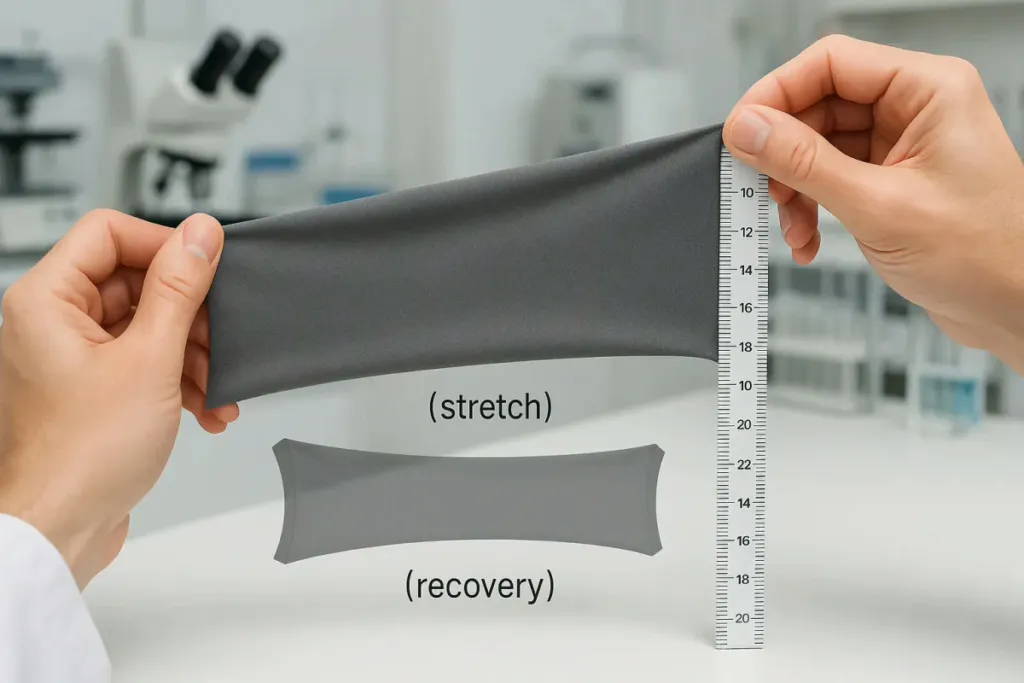
True compression relies on Modulus (resistance force), not just sizing down a pattern. In our manufacturing experience, designers often incorrectly shrink waistbands to fake a “sculpted” fit, which leads to roll-down. You must engineer the fabric’s power stretch.
1. Select the Elastane Target Specify the Elastane (Spandex) percentage based on the intended activity intensity. We use these baselines in the factory:
-
Light (10–15%): Low resistance for Yoga or Lounge.
-
Medium (16–24%): Muscle support for Gym/Spinning.
-
High (25%+): Maximum hold for Shapewear or Recovery gear.
2. Verify Recovery (The Snap-Back) High stretch is useless if the fabric “bags out” at the knees. Perform a manual stretch test:
-
Action: Stretch the fabric to 1.5x its width.
-
Pass: It returns to within 5% of its original width immediately.
-
Fail: Visible rippling or a loose shape after release.
3. Execute the Sensory Protocol Wear the sample for 30 minutes and perform three deep lunges or burpees.
-
Check: The fabric should move with the skin. If you must pull the leggings up after the set, the grip is insufficient.
-
Red Flag: Tingling or numbness indicates the modulus is too high for the grading.
🧠 Author’s Verdict: The Gauge Factor Specify a 36-Gauge Knit. In my tests, even 25% Spandex fails if the knit construction is too loose. I always require a High-Gauge (36G) knit. This packs the yarns tighter, creating a smoother surface that provides “power” without the bulk of a thick wetsuit.
Step 8: Validate Sustainability and Care Protocols
Sustainability is documentation, not marketing. In our China facility, I often see “eco-friendly” fabrics fail because the brand did not verify the supply chain. You must distinguish between verified tracing and marketing fluff.
1. Requesting the certificates “Recycled Polyester” means nothing without a paper trail. Ask for these specific documents to ensure you are not paying a premium for standard plastic:
-
Global Recycled Standard (GRS): Tracks recycled content from source to final product.
-
OEKO-TEX Standard 100: Certifies that every thread is free from harmful substances.
For a full breakdown of what each certificate proves — and what it does not — see the sportswear certifications guide.
⚠️ Logistics Warning: Sustainable fibers often carry higher minimums (MOQs). Also, remember that heavier sustainable fabrics (e.g., 300gsm) increase shipping weight and total landed cost compared to standard 220gsm options.
2. Standardize care instructions Performance finishes are fragile. Copy these standards into your care label instructions to protect the garment:
-
Wash: Cold cycle (30°C max), inside out, with like fabrics.
-
Avoid: Fabric Softener (clogs wicking pores) and High Heat (destroys Elastane snap-back).
-
Odor: Wash promptly after heavy sweat. Do not leave damp gear in bags.
3. Perform a sensory check Before approving bulk production, wash your sample five times. If the fabric feels rougher, less “springy,” or pill-prone, reject it. Sustainable fabric must perform just as well as virgin material.
Explore our sustainable fabric library for certified options.
🧠 Author’s Verdict: Do not skip the “Softener Test.” During our testing, we found that fabric softener reduces moisture-wicking efficiency by nearly 40%. I explicitly add “Do Not Use Softener” to the care label for all performance leggings.
Contact our team to request fabric options or certifications.
Troubleshooting Common Fabric Failures
In my experience on the factory floor, “bad quality” is rarely a defect. It is usually a mismatch between the fabric’s physics and the user’s routine.
Here is how we diagnose and fix the four most common complaints.
1. “My wicking shirt feels clammy”
The Cause: Fabric softener often clogs the yarn’s pores, or the factory used a cheap chemical finish that washed off. The Fix:
-
Strip the buildup: Wash with vinegar to remove waxy residue.
-
Upgrade the yarn: Switch to engineered wicking cross-sections. Physical grooves move moisture permanently; chemical finishes wash away.
📝 Editor’s Verdict: If a fabric claims “wicking” but feels smooth like cotton, it’s likely a temporary chemical coating.
2. “Leggings are see-through when I squat”
The Cause: We call this “Grin Through.” The fabric weight (GSM) is too low or the knitting gauge is too loose. The Fix:
-
Raise the GSM: Standard leggings need 260 GSM minimum for opacity.
-
Tighten the knit: Instruct your manufacturer to increase stitch density.
-
Check the dye: High elastane content (>25%) reveals white core fibers if not dyed deeply.
💡 Diagnostic: Stretch the fabric over a black card in direct sunlight. If you can see the card clearly, the world will see your skin.
3. “Odor remains after washing”
The Cause: Polyester is oleophilic (oil-loving). It bonds with body oils that trap bacteria, which quick “Eco” wash cycles fail to release. The Fix:
-
Agitate: Synthetics need friction to release oil. Avoid gentle cycles.
-
Specify Antimicrobials: Use Silver or Zinc ion yarns. In our tests, these retained odor-fighting properties for 50+ washes, unlike topical sprays.
4. “Pilling after a few workouts”
The Cause: The “Softness Tax.” Fabrics brushed for a buttery feel have loose fiber ends that tangle when rubbed (abrasion). The Fix:
-
Set Standards: Require ISO 12945-2 Grade 4 in your tech pack.
-
Map Friction: Use smooth, high-denier nylon for inner thighs. Keep brushed fabrics for low-contact zones.
Final Check: If these fixes fail, request a third-party lab report (SGS or Intertek). If the raw fiber quality is poor, no design tweak will save it.
People Also Ask About Sportswear Fabrics Guide
1. What is the best fabric composition for squat-proof leggings?
The “Gold Standard” for premium opaque leggings is 75% Nylon 6.6 and 25% Spandex (Elastane) in an Interlock knit. In our factory testing, we found that increasing Spandex above 25% often creates a “sheen” that highlights cellulite.
We recommend this specific ratio because the Nylon 6.6 provides a matte, soft-touch finish, while the interlock structure prevents the fabric from thinning out when stretched over the glutes.
2. What does GSM mean in fabric?
GSM stands for Grams per Square Meter. It measures the density of the fabric, not necessarily the thickness. For sportswear, use these benchmarks:
-
130–170 GSM: Lightweight running tanks or mesh liners.
-
180–220 GSM: Standard t-shirts or loose shorts.
-
230–300 GSM: Compression leggings and sports bras.
-
300+ GSM: Hoodies and winter thermal gear. Note: A high GSM can still be see-through if the yarn quality is poor. Always perform a physical stretch test.
3. Is Polyester or Nylon better for gym wear?
It depends on the activity.
-
Choose Nylon for Yoga and Pilates. It is naturally hydrophilic (absorbs some moisture), making it feel cool and soft against the skin.
-
Choose Polyester for High-Intensity Training or Team Sports. It is hydrophobic (repels water), dries faster, and is more durable against abrasion.
-
Production Tip: If you want Sublimation Printing (complex patterns), you must use Polyester. Nylon melts and distorts at the 400°F temperature required for sublimation.
4. How can I test moisture-wicking without a lab?
Perform the Water Drop Test. Lay the fabric flat and pour one drop of water on the inner surface (the side touching the skin).
-
Pass: The drop spreads out instantly into a large, flat shape. This shows the fibers are pulling moisture away.
-
Fail: The drop stays round like a bead. This acts like a plastic bag, trapping sweat against your body.
5. Why do sustainable fabrics cost more?
Genuine sustainable fabric requires a chain of custody. You are paying for the GRS (Global Recycled Standard) certification that proves the plastic bottles were actually recycled, not just bought new.
In our sourcing, we find that certified Recycled Polyester (rPET) typically costs 15–20% more than virgin polyester due to the complex cleaning and re-polymerization process required to make the yarn strong enough for sportswear.
Conclusion
You do not need a degree in textile engineering to source premium activewear. You simply need to stop guessing and start measuring. By following the workflow in this guide—matching the sport scenario to the fiber, then locking in the structure, GSM, and testing protocols—you eliminate 90% of the quality risks before production begins.
A tech pack is not just a design file; it is a contract. When you specify “280 GSM Interlock” instead of “Thick Fabric,” you give the factory a target we cannot miss.
Your Next Steps:
-
For Buyers: Never attend a sourcing meeting empty-handed. Bring a digital scale to verify GSM and a water bottle to test wicking on the spot. If a supplier refuses a live test, walk away.
-
For Designers: Compile a “Fabric Bible.” Create a one-page physical board with your approved swatches, labeled with their exact specs (GSM, Content, Stretch %). Send this to us, and we can match the raw material instantly.
Author’s Take: In my years running the LeelineWear floor, the brands that scale fastest are the ones that treat fabric as a fixed data point, not a feeling. We built our Agile Manufacturing lines to support this exact precision, allowing you to test professional-grade fabrics in low quantities (50–100 units) before committing to bulk.
Ready to build? Stop hoping for quality and start engineering it. Visit our Contact Page today to request our curated fabric swatch kit or start your custom development with a team that speaks your language.
Related Resources:
- The 10 Best Sportswear Manufacturers in China (Reviewed)
- Custom Tennis Clothing Manufacturing — performance knits, UV-protective weaves and 4-way stretch interlock
- Custom Streetwear Manufacturing — heavyweight 320–500 GSM fabrics, washes and decoration
Areas of Expertise
- Quality Control: Mastery of AQL (Acceptable Quality Level) standards and Six Sigma methodologies in garment production
- Technical Sourcing: Expert in fabric specification (GSM, weave structures) and trim sourcing
- Compliance & Auditing: Specialized in BSCI (Business Social Compliance Initiative) and ISO 9001 factory auditing
- Logistics: Strategic oversight of Lead Time Reduction and DDP/FOB shipping terms
David Wu is a textile industry veteran with over 16 years of experience specializing in garment manufacturing, supply chain optimization, and quality control systems across Southeast Asia and China. His career is defined by implementing rigorous AQL 2.5/4.0 inspection protocols for mid-to-large-scale private label brands. David specializes in technical garment construction, from initial tech pack development to final container loading inspections. He has a proven track record of reducing defect rates by up to 22% through the implementation of "In-Line" inspection checkpoints. His expertise ensures that manufacturing processes align with both international safety standards and cost-efficiency requirements for B2B wholesalers.