Finding the best sportswear manufacturers in China often means sifting through vague trading companies. This guide solves that for procurement managers and brand owners. We rigorously evaluated suppliers on seamless technology, low MOQs, and valid ISO 9001 quality certifications.
While LeelineWear hosts this comparison as a factory-direct solution, we included six other top competitors. You get a balanced shortlist based on manufacturing reality, not just marketing claims.
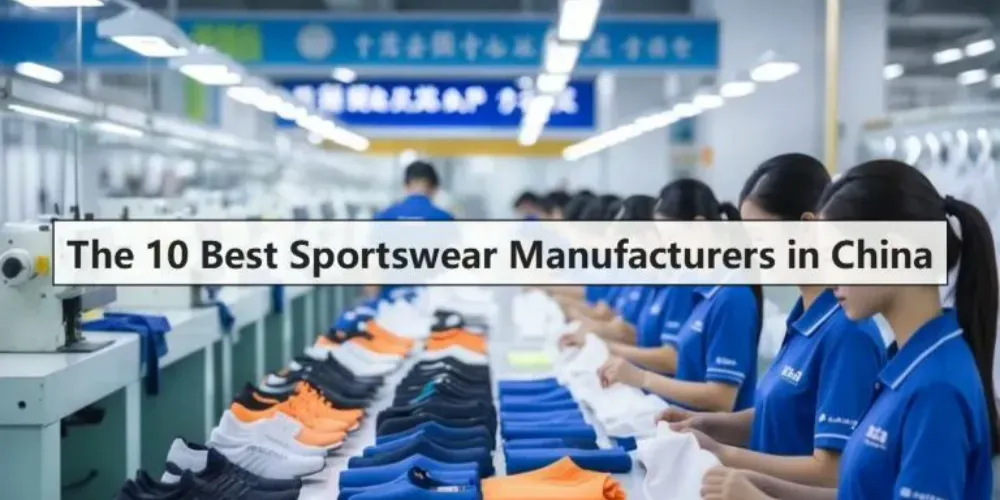
List Of 10 Best Sportswear Manufacturers in China
Quick Preview
| Manufacturer Name | Key Characteristics | Product Range | Technology & Capabilities | Recommendation Index |
|---|---|---|---|---|
| 1. AEL Apparel | Focus on quality basics, modern styles. Reliable for small to medium orders. | Casual wear, t-shirts, polo shirts, hoodies, leggings. | Digital printing, embroidery, custom labeling. Good QC. | ⭐⭐⭐⭐ |
| 2. Sansansun Sports | Sports-specific manufacturer. Technical fabric expertise. | Sportswear, team jerseys, athletic shorts, compression wear. | Moisture-wicking fabrics, sublimation printing, breathable mesh. | ⭐⭐⭐⭐ |
| 3. HUCAI Sportswear | Similar to Sansansun, strong in custom teamwear and fitness apparel. | Sports jerseys, jackets, yoga wear, cycling kits. | Full sublimation printing, mesh paneling, custom logos. | ⭐⭐⭐⭐ |
| 4. SinoFlex Apparel | Factory-direct low-MOQ manufacturer. Best for startups and DTC brands. | Sportswear, yoga apparel, outdoor functional, casual wear, T-shirts, hoodies, uniforms. | In-house production lines, full design support, DDP shipping, dropshipping. | ⭐⭐⭐⭐⭐ |
| 5. Yotex Apparel | Strong in knitted fabrics and undergarments. Efficient production. | T-shirts, underwear, socks, polo shirts. | Circular knitting, seamless technology, soft finishing. | ⭐⭐⭐⭐ |
| 6. Eation Wear | Focus on eco-friendly and sustainable apparel. Ethical production emphasis. | Organic cotton t-shirts, recycled polyester sportswear, eco-friendly hoodies. | GOTS certified fabrics, recycled material processing, water-saving dyes. | ⭐⭐⭐⭐⭐ |
| 7. Hingto Garments | Experienced in outerwear and woven garments. Good for structured apparel. | Jackets, windbreakers, trousers, shirts, uniforms. | Waterproof/breathable laminates (e.g., similar to DWR), quilting, complex stitching. | ⭐⭐⭐⭐ |
| 8. Yaroad Custom Clothing | Specializes in high-quality custom workwear and uniforms. | Corporate uniforms, safety wear, polo shirts, custom jackets. | Embroidery, badge making, flame-resistant (FR) treatments. | ⭐⭐⭐⭐ |
| 9. MMS Clothing | Broad-line manufacturer, high-volume capacity. Competitive pricing for large orders. | Large range from basics to simple outerwear. | Large-scale cutting, automated sewing, bulk printing/dyeing. | ⭐⭐⭐ |
| 10. Yonglee Group | Large, vertically integrated group. One-stop shop for high-volume, diverse product needs. | Everything from basics and sportswear to complex outerwear. | Full package production from fabric to finish. In-house design support. | ⭐⭐⭐⭐ |
Recommended Reading:
-
Sportswear manufacturers China vs Europe: Which is Better for Your Supply Chain?
-
How to finding sportswear manufacturers: From Tech Pack to First PO
1. AEL Apparel (Shenzhen) — Best for Full-Service Customization
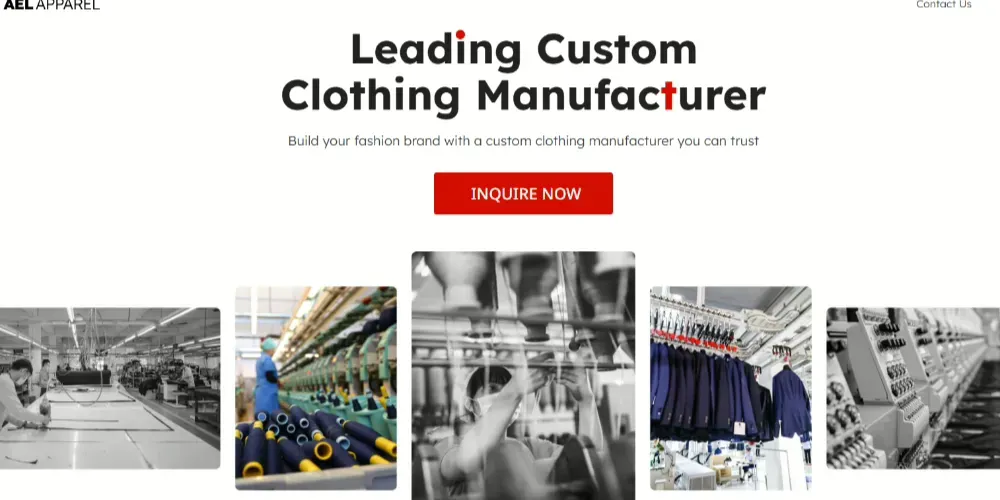
Most manufacturers demand a finalized tech pack before they will even discuss an order. AEL Apparel fills the gap for founders who only have a concept. Based in Shenzhen, they operate as a full-service customization stack, handling pre-production bottlenecks like pattern making, size grading, and specialized fabric sourcing.
Why they make the list: AEL simplifies complex decoration execution. While standard factories often restrict you to one branding method, AEL handles mixed media. For example, they can execute silicone heat transfers for leggings and 3D embroidery for hoodies in the same production run.
This suits startups needing an operational partner to bridge the gap between a sketch and a retail-ready product.
Risks and notes: Broad capabilities often imply a network of partner factories rather than 100% in-house production. Explicitly ask which steps are outsourced. Outsourcing can introduce variables in lead times, so clarify if the timeline for a single sample matches the timeline for a 500-unit run.
🚀 Actionable Insight: Request a “like-for-like” quote. To compare pricing fairly, specify the exact fabric weight (e.g., 280 GSM French Terry) and seam construction (e.g., Flatlock) in your RFQ. Without these benchmarks, you cannot accurately judge their costs against other suppliers.
2. Sansansun Sports (Dongguan)
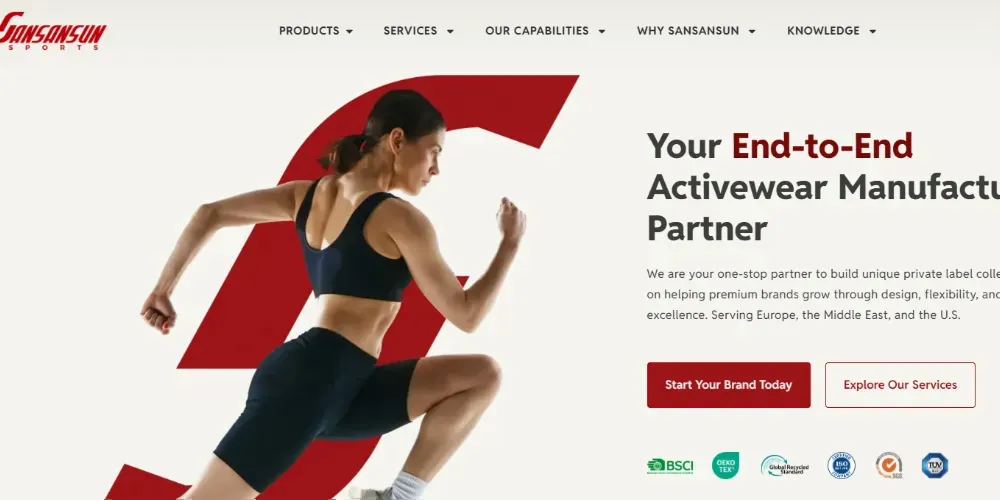
Dongguan is the center of China’s activewear supply chain. Sansansun Sports represents the region’s core strength: scalable yoga and gym wear production.
While smaller workshops often struggle with consistency, Sansansun uses automated cutting and industrial processes to handle volume. This makes them a strong choice for brands graduating from “sample room” quantities to monthly replenishment.
Why they stand out:
-
Broad fabric selection: Access a vast menu of materials, including factory-stated sustainable options like Global Recycled Standard (GRS) certified nylon.
-
Private label flexibility: Their workflow is optimized for applying your branding to white-label goods.
-
Reliable reordering: Their capacity ensures your tenth batch feels exactly like your first.
Watch-outs:
-
True MOQ: “Low MOQ” often refers to the total order. Always confirm the minimum quantity per colorway.
-
Verification: Don’t accept “eco-friendly” on faith. Request current documentation for any OEKO-TEX Standard 100 claims.
Best for: Fast-growing DTC yoga brands scaling beyond the sample phase.
3. HUCAI Sportswear (Dongguan Area) — Best for Certified/Testing-Led Performance Activewear
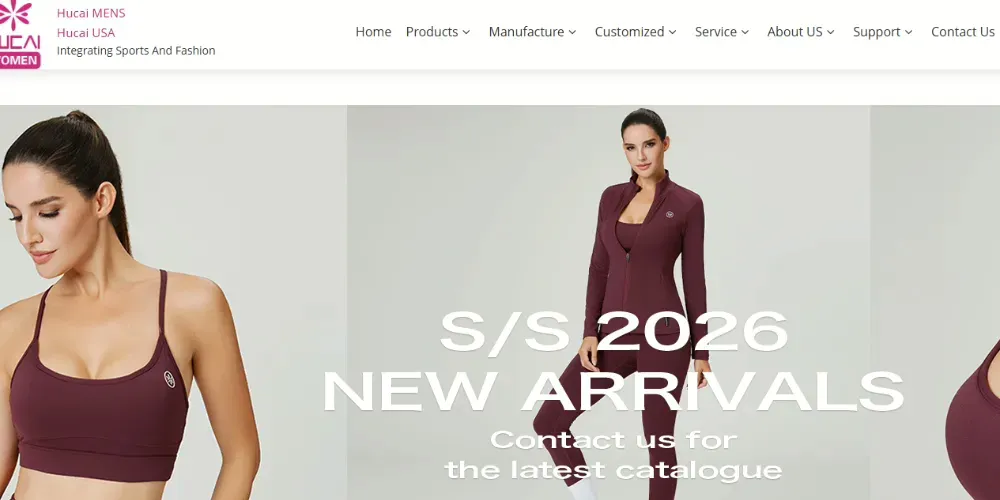
Selling “performance” gear is risky. If “squat-proof” leggings go sheer or seams burst during a workout, your brand reputation crashes. HUCAI Sportswear mitigates this risk by prioritizing technical construction over mass-market speed.
Technical capabilities HUCAI specializes in flatlock stitching to prevent chafing and sourcing functional fabrics. If you need specific performance claims—like quick-dry, UV protection, or anti-bacterial—they have the supply chain to support it.
Always ask for recent lab test reports to verify these claims rather than accepting them at face value.
Trust checks Don’t trust certification icons on a website. You need to validate the factory’s current status:
-
Audit the audits: Request PDF copies of their ISO 9001 or BSCI certifications. Check the expiration dates.
-
Contractual Quality: Define acceptance metrics in your Purchase Order (PO), such as specific seam strength, print quality, or waistband elasticity.
Best for: Boutique brands and procurement teams who write detailed tech packs.
🚀 Actionable Insight: Reduce the risk of bulk failure by asking two specific questions during negotiation: “Can you meet AQL 2.5 for major defects?” and “Do you provide inline QC photos/videos?” If they hesitate on AQL standards, move on.
4. SinoFlex Apparel — Best Overall for Low-MOQ Custom Clothing
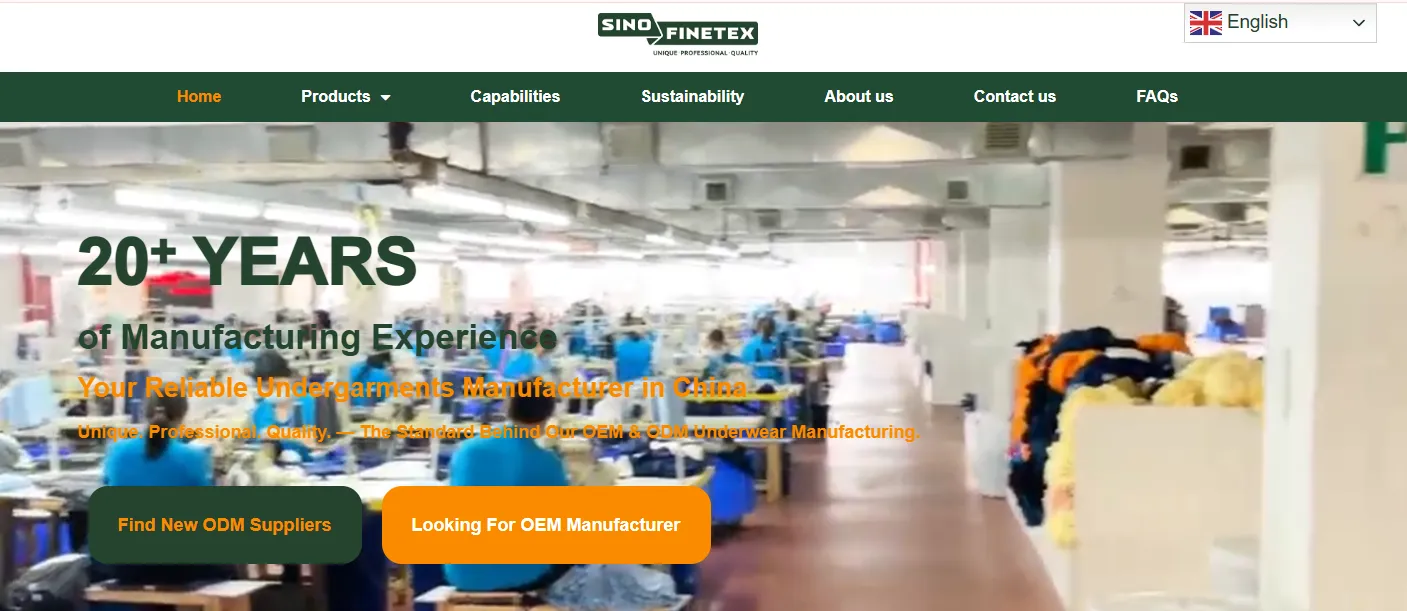
Mega-factories ignore small orders, and agents hide markups. At SinoFlex Apparel, we combine tier-one manufacturing with boutique flexibility. From our own facility in Dongguan, China, we build custom wholesale clothing from scratch.
Our dedicated production lines cover sportswear, yoga apparel, outdoor functional clothing, casual wear, T-shirts & hoodies, uniforms, and more.
Our low MOQs allow DTC brands and new designers to test concepts safely. Start with just 50 units for private label prints or 100 pieces for custom cut-and-sew designs. We provide full design support and deliver physical samples in 7 to 15 days.
After approval, we handle DDP shipping or dropship individual units directly to your customers.
⚡ Power Move: Book a live video walkthrough. Ask our team to walk you live from the office to the cutting area, sewing lines, QC station, and packing zone. This proves we own and operate the factory floor, unlike pure sourcing brokers. Contact us to book your virtual factory tour today.
5. Yotex Apparel (Guangzhou) — Best for High-Performance Sets with Flexible OEM/Private Label
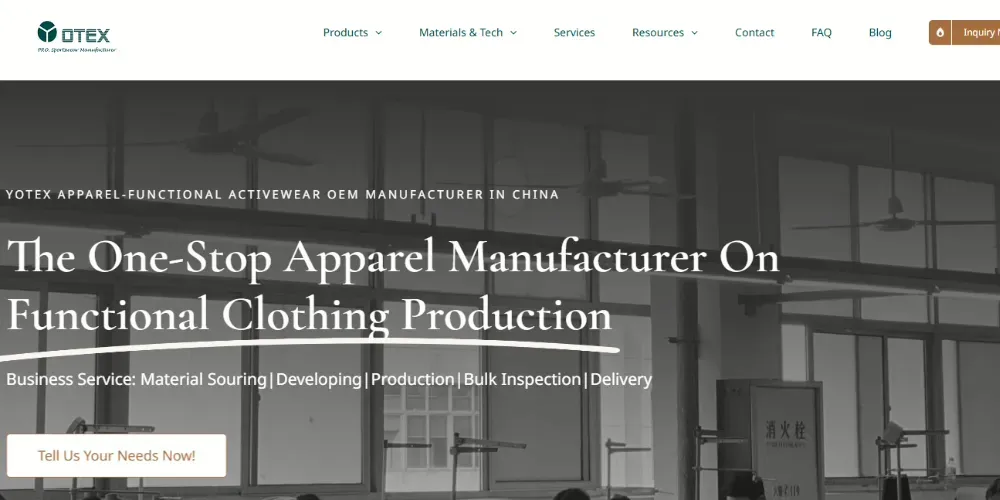
Inconsistent quality kills collections. If your leggings fit perfectly but the matching sports bra lacks support, customers won’t return. Yotex Apparel solves this by specializing in coordinated performance lines rather than isolated items.
Based in Guangzhou, Yotex combines flexible order quantities with export-grade quality control. This makes them the best choice for brands launching a full “core line” of seamless leggings, tops, and jackets without committing to massive volume immediately.
Always confirm their current minimums per SKU, as flexibility varies based on fabric availability.
Don’t take “performance” claims at face value. Verify the technical standards before you pay a deposit:
-
Fabric Composition: Request a spec sheet confirming the exact blend and fabric weight (GSM).
-
Durability: Ask for ISO 12945 pilling test results to ensure the material resists fuzzing after friction.
-
Function: Demand AATCC moisture management reports if you claim sweat-wicking properties.
⚡ Power Move: Force transparency in your quote. Factories often bury setup fees inside the unit price to look cheaper. Demand a breakdown that separates the Sample Fee, Lab Dip Fee (for custom colors), and Print Setup Costs. If you don’t unbundle these, your unit price remains artificially high on reorders even after the setup work is done.
6. Eation Wear (Dongguan)
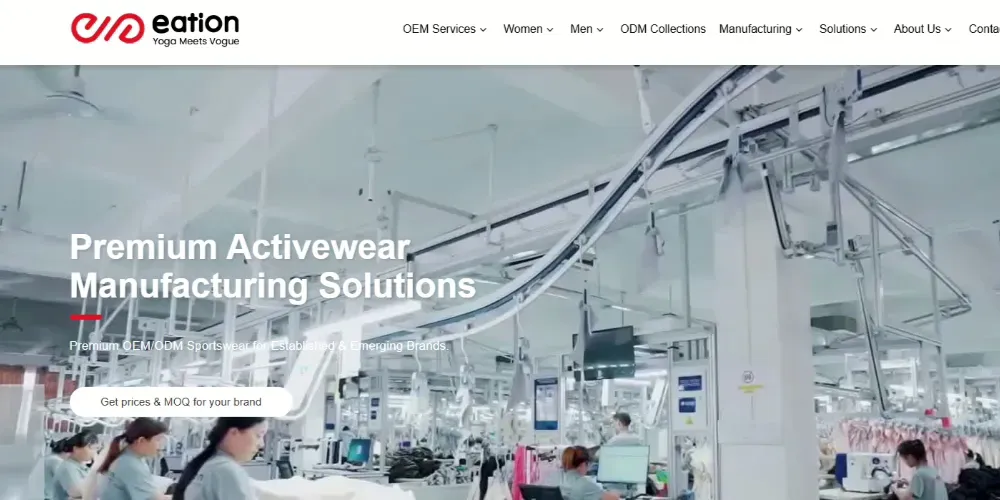
Best for: Influencer-led drops and studio-branded capsule collections.
Eation Wear stands out among yoga wear manufacturers in Dongguan for its specific focus on technical yoga sets. Unlike generic activewear factories, they specialize in comfort-driven construction for leggings, bras, and matching sets. Their OEM/ODM model supports the full lifecycle: custom pattern making, sampling, and private labeling.
This makes them ideal for brands that need cohesive collections. They excel at color matching across different fabric weights, ensuring your leggings and bras actually look like a set.
Don’t just ask for “high quality.” Verify these specific metrics to reduce return rates:
-
Squat-proof opacity: Demand video proof that fabrics don’t go sheer when stretched.
-
Seam reinforcement: Check the gusset and waistband stitching. Standard ASTM D1683 seam strength tests prevent failure during deep stretches.
-
Colorfastness: Ensure prints resist fading. Request testing against AATCC 61 standards for laundering durability.
Operational Note: Capacity fluctuates during peak seasons. Small orders often get stuck behind bulk clients.
🚀 Actionable Insight: Protect your launch date. Explicitly ask: “How do you manage production queues for small orders during peak season?” If they cannot guarantee a specific production slot for your 100-unit order, walk away.
7. Hingto Garments (Shenzhen) — Best for Multi-Category Sportswear + Scalable Cut-and-Sew
Making leggings is simple. Constructing technical hoodies with custom hardware is not.
Based in Shenzhen, Hingto Garments supports brands expanding beyond basic activewear. Unlike factories that only knit seamless products, Hingto operates as a full-service cut-and-sew partner. They handle the entire production chain—including pattern making, fabric sourcing, and custom trims—under one roof.
Why they made the list This broad capability allows you to launch cohesive collections without splitting orders between different suppliers. They can produce high-impact sports bras and streetwear joggers in the same facility, managing complex details like screen printing and embroidery.
This makes them ideal for brands graduating from a single product to a full seasonal assortment.
Watch-outs Sizing consistency is your biggest risk across categories. A “Medium” compression top must fit the same customer as a “Medium” jacket. Always align your grading rules with standard sizing charts before production starts.
Also, secure a written defect policy that references AQL standards to define exactly what counts as a failure.
🚀 Actionable Insight: Reduce bulk variance by requiring ‘First Bulk Piece’ approval. After the Pre-Production Sample (PPS) is signed, demand a photo of the very first unit off the production line before they finish the full run.
8. Yaroad Custom Clothing (Quanzhou, Fujian) — Best for OEM Performance Basics
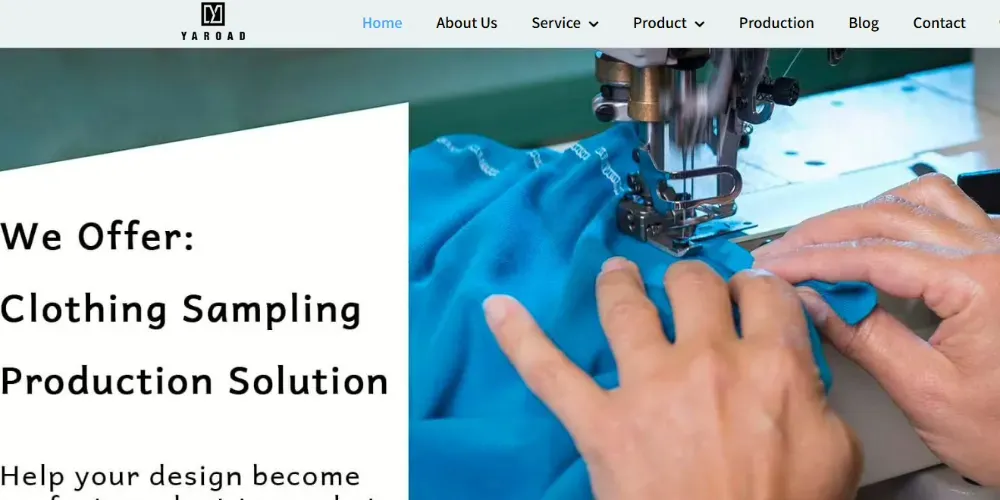
Supply chain chaos often stems from a lack of process. Yaroad solves this by prioritizing Standard Operating Procedures (SOPs) over flexibility. Located in Quanzhou, a massive hub for performance fabrics, they operate as a strict OEM manufacturer.
They do not chase fast-fashion trends. Instead, they focus on long-run production of activewear basics. Their value lies in structured management. They ensure your 1,000th unit matches your first.
This makes them the safe choice for procurement teams that value ISO-style discipline and predictable scaling over rapid design experimentation.
Best for: Buyers optimizing for standardization on recurring purchase orders.
Vetting the “Stable OEM” To evaluate their fit, you must audit their scaling logic. Do not just ask for the standard MOQ. Ask these three specific questions:
-
Fabric MFOQ: “What is the Minimum Fabric Order Quantity for custom-dyed colors?”
-
Size Splits: “Does the MOQ apply per size or per style?”
-
Triggers: “What specific design changes trigger a price increase?”
🚀 Actionable Insight: Real unit economics change with volume. Ask Yaroad to quote two distinct scenarios: a 300-unit “test run” and a 3,000-unit “restock run.” This reveals their true efficiency curve and proves if they are pricing for a long-term partnership.
9. MMS Clothing (Chengdu) — Best for Ultra-Low MOQ Sampling
Most new brands fail because they overcommit to inventory before they sell a single unit. MMS Clothing mitigates this risk by acting as a “sampling-first” partner. Located in Chengdu, they specialize in micro-production runs (often under 50 units).
This allows you to test multiple prototypes quickly. You can iterate on fit, fabric weight, and logo placement without risking thousands of dollars. It is the ideal strategy for validating product-market fit before scaling up.
The Trade-off Flexibility increases unit costs. You will pay a premium over standard bulk pricing. Additionally, “low MOQ” typically applies only to available market stock fabrics. If you require specific Pantone color matching, the minimums will likely rise.
10. Yonglee Group (Shanghai) — Best for Seamless/Technical Knits
Small factories often break when you hit the “scaling ceiling.” A partner perfect for 500 units often collapses when you need 10,000 units of complex compression wear delivered on time.
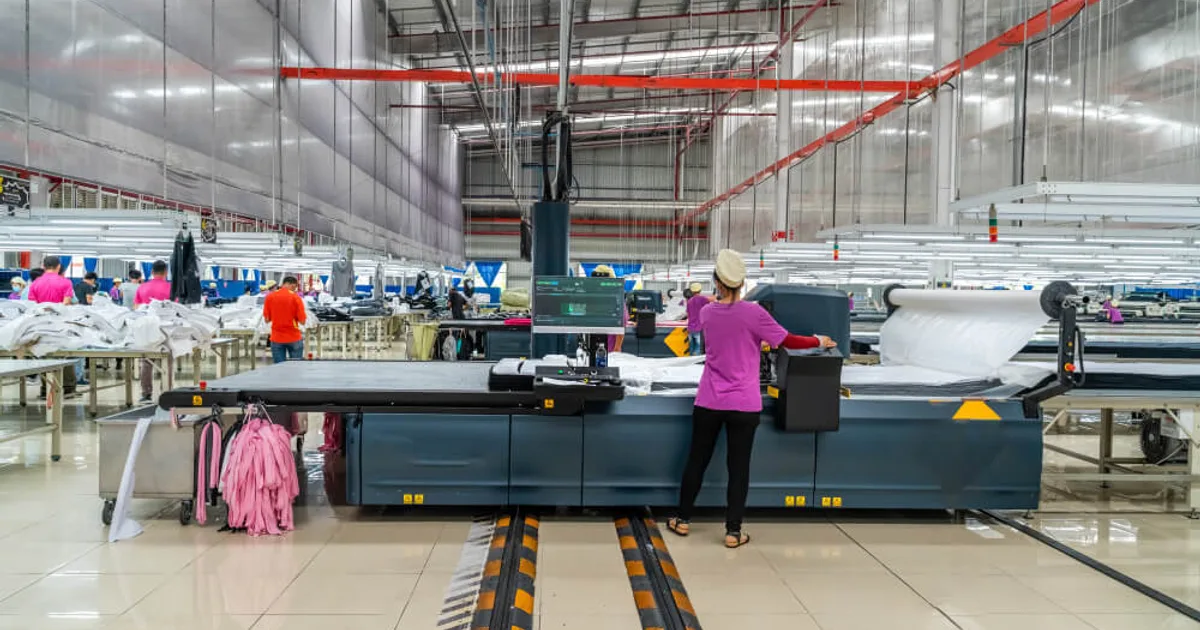
Yonglee Group operates differently. Headquartered in Shanghai, they manage a broad production footprint designed for massive scalability. They don’t just sew; they engineer fabric. Their facility utilizes advanced Santoni seamless knitting machines to create high-performance, chafe-free gear.
This allows for multi-gauge construction—like placing tight compression in the calf and breathable mesh in the thigh—within a single garment. This level of technical detail is impossible with standard cut-and-sew machinery.
Best for: Established brands with validated demand ready to upgrade from “good leggings” to premium engineered construction.
Be aware: Group manufacturing carries consistency risks if orders shift between different facilities. You must verify how they manage standardization across their network before committing to a large program.
⚡ Power Move: Protect your bottom line with a strict Acceptable Quality Limit (AQL) agreement. Define three defect tiers in your contract: Critical (safety hazards like needles), Major (sizing errors/holes), and Minor (uncut threads). Explicitly state that if the random sample fails, the manufacturer pays for a 100% reinspection.
The 7-Step Playbook to Vet Your Manufacturer
Stop asking general questions. General questions get vague answers. You must use specific, technical inquiries to reveal a factory’s true capabilities. Use this checklist to validate potential partners and lock in favorable contract terms.
1. Match Machinery to Product Risk
Not all factories possess the same equipment. A factory optimized for printing t-shirts will fail at manufacturing high-compression yoga pants. Match their machinery list to your product’s failure points.
-
Seamless Knitting: Mandatory for high-end yoga sets. Verify they operate Santoni machines to ensure gusset durability.
-
Cut-and-Sew: Standard for hoodies or joggers. Confirm their ability to execute flatlock stitching rather than basic overlock.
-
Blank + Print: Sufficient for simple team jerseys. Check their sublimation printer resolution.
Action: Request a full equipment list. Look specifically for “circular knitting” hardware if you plan to produce activewear.
2. Audit the “Real” MOQ
Factories often hide limits behind a single number. A stated Minimum Order Quantity (MOQ) of 100 units is rarely the full story. Break the numbers down to reveal the true cost of entry.
Action: Ask these three specific questions.
-
What is the MOQ per style?
-
What is the MOQ per color?
-
What is the MOQ per size?
Critical: Confirm the Fabric Minimum Fabric Order Quantity (MFOQ). Textile mills often demand 500+ yards for custom dye lots even if the sewing line accepts smaller runs. Ask for this data separately to avoid hidden surcharges.
3. Contract Your Quality Control (QC)
Never rely on “good vibes” or verbal promises. Define quality standards explicitly in your purchase order. You cannot claim refunds for undefined defects.
Action:
-
Define Defects: Categorize errors into Critical (safety hazards like needles), Major (functional failures like wrong sizing), and Minor (cosmetic threads).
-
Set the Standard: Specify Acceptable Quality Limit (AQL) 2.5 for major defects. This global standard limits major defects to 2.5% of the total order.
-
Inspect Early: Demand photos of the “First Off The Line” unit. Approve this reference sample before bulk production continues.
4. Verify Certifications Directly
Logos on a website prove nothing. Certificates expire and unscrupulous factories occasionally use documentation from other companies. Verify claims directly with the issuing body.
Action:
-
Materials: Request the OEKO-TEX or GRS (Global Recycled Standard) certificate ID. Validate the expiry date on the official portal.
-
Social Compliance: Demand the latest BSCI or SMETA audit report. Reject any audit older than two years. Note that certifications reduce risk but do not replace physical inspection.
5. Protect Your Intellectual Property (IP)
Sportswear designs are easily copied. Establish legal and technical barriers before sharing sensitive files.
Action:
-
Sign an NDA: Execute a Non-Disclosure Agreement before sending full tech packs.
-
Watermark Files: Apply a semi-transparent logo over design files. Retain high-resolution source files until the deposit clears.
-
Claim Ownership: Add a contract clause. Secure full rights to sublimation templates and patterns upon final payment.
6. Calculate Total Landed Cost (TLC)
The unit cost is not your profit margin. You must calculate the full cost to get the product to your warehouse.
Action: Build your price model using this formula.
TLC = Unit Cost + Packaging + Inland Freight + International Shipping + Duties + Inspection Fee.
Compare quotes using DDP (Delivered Duty Paid) terms. This Incoterm forces the manufacturer to include shipping and tax liabilities in the upfront price.
7. Build a Realistic Timeline
Factory estimates are optimistic. Your schedule must be realistic. A “30-day” lead time often excludes weekends, holidays, and shipping transit.
Action: Plan for these realistic intervals.
-
Sampling: 7 to 15 days.
-
Bulk Production: 15 to 30 days.
-
Shipping: 3 to 5 weeks for Sea Freight.
-
Buffer: Add 14 days for customs holds or peak season congestion.
Practical Next Step
Do not email just one factory. Email three.
Collect distinct quotes using the questions above. Compare LeelineWear against competitors like Hucai and Yotex. Standardize the variables to reveal the true best option. To benchmark against other sourcing hubs, review our clothing suppliers in Turkey guide.
- Get a factory-direct quote with DDP shipping: Contact LeelineWear Here.
People Also Ask About Best Sportswear Manufacturers in China
1. What does “low MOQ” really mean for custom activewear in China?
“Low MOQ” is a marketing term that often hides technical constraints. While a factory may agree to sew 50 units, the Fabric MFOQ (Minimum Fabric Order Quantity) is the real bottleneck. Dyeing a custom Pantone color usually requires purchasing 300–500 yards of fabric.
To get true low minimums (under 100 pieces), you must use “market stock” fabric colors that the factory already has in their warehouse.
2. Which certifications matter most for sustainable/ethical sportswear?
You need to distinguish between material safety and labor standards. For the product itself, demand OEKO-TEX Standard 100 certification, which verifies the fabric is free from harmful chemicals like formaldehyde. For ethical labor practices, request a current Amfori BSCI or WRAP audit report.
Always verify the certificate ID on the issuing body’s website, as PDF documents can be forged.
3. How long does it take from tech pack to delivered inventory (US/EU)?
Plan for a 6 to 11-week cycle for a new product launch. The timeline breaks down into three phases:
-
Sampling (7–15 days): Pattern creation and prototype revisions.
-
Bulk Production (15–30 days): Material sourcing, cutting, sewing, and packing.
-
Logistics (3–5 weeks): Sea freight and customs clearance. Note: Always add a 14-day buffer for potential port congestion or customs holds.
4. How do I protect my designs and reduce payment risk?
Legal protection starts with an NNN Agreement (Non-Use, Non-Disclosure, Non-Circumvention), which is enforceable in China, unlike a standard Western NDA. Financially, use leverage rather than trust. Never pay 100% upfront.
The standard structure is a 30% deposit to buy materials and a 70% balance payment due only after a third-party inspection report confirms the quality matches your approved sample.
5. Should I use FOB or DDP when importing sportswear from China?
For most small-to-mid-sized brands, DDP (Delivered Duty Paid) is the safer choice. Under DDP terms, the manufacturer handles the export license, shipping, and import duties, giving you a guaranteed final price per unit. Use FOB (Free on Board) only if you have your own freight forwarder and want tight control over the logistics chain.
Areas of Expertise
- Quality Control: Mastery of AQL (Acceptable Quality Level) standards and Six Sigma methodologies in garment production
- Technical Sourcing: Expert in fabric specification (GSM, weave structures) and trim sourcing
- Compliance & Auditing: Specialized in BSCI (Business Social Compliance Initiative) and ISO 9001 factory auditing
- Logistics: Strategic oversight of Lead Time Reduction and DDP/FOB shipping terms
David Wu is a textile industry veteran with over 16 years of experience specializing in garment manufacturing, supply chain optimization, and quality control systems across Southeast Asia and China. His career is defined by implementing rigorous AQL 2.5/4.0 inspection protocols for mid-to-large-scale private label brands. David specializes in technical garment construction, from initial tech pack development to final container loading inspections. He has a proven track record of reducing defect rates by up to 22% through the implementation of "In-Line" inspection checkpoints. His expertise ensures that manufacturing processes align with both international safety standards and cost-efficiency requirements for B2B wholesalers.