
Brands sourcing from apparel manufacturers in the USA face a specific math problem: domestic quotes land at $18-45 per unit while overseas bids come in at $7-15 FOB. The knee-jerk reaction is either “go overseas and pocket the margin” or “pay the premium and figure it out later.”
Both approaches leave money on the table.
I’ve spent 14 years auditing factories across three continents, and I’ll tell you what the spreadsheets miss: US manufacturing costs are far more negotiable than most brands realize. The factory’s first quote is never their best price.
Regional labor differentials, shift scheduling, seasonal demand troughs, fabric sourcing arbitrage, and the FTC origin claim all carry pricing leverage most brands never use.
My team at LeelineWear analyzed 200+ production invoices from 12 US apparel manufacturers between January 2025 and June 2026. We identified seven pricing and MOQ strategies that shift US manufacturing from “prohibitively expensive” to “strategically viable.”
Here they are, backed by factory-floor data, not theory.
Technical Reviewer
Roger Chan, Senior Technical Manager — 14 years of factory auditing across three continents.
Quick Take: Which Strategy Applies to You?
- Retail price under $30? Skip pure US manufacturing — prioritize Strategy 3 (hybrid model) to capture overseas economics with US validation safety.
- Retail price $48–128? Start with Strategy 4 (January/July seasonal windows) + Strategy 2 (second-shift differentials). Combined: 15–25% CMT reduction without changing suppliers.
- Need mid-season restock capability? Strategy 7 (TLC framework) + Southeast US facility. 3-week restock vs. 12-week overseas is the competitive moat.
- Already overseas but getting burned on quality? Strategy 3 (hybrid model). Spend $1,800 on US validation to insure against $11,000 in dead stock.
How to Negotiate Pricing & MOQs with US Apparel Manufacturers? 7 Strategies
1. Understand Factory Pricing Structure Before You Negotiate
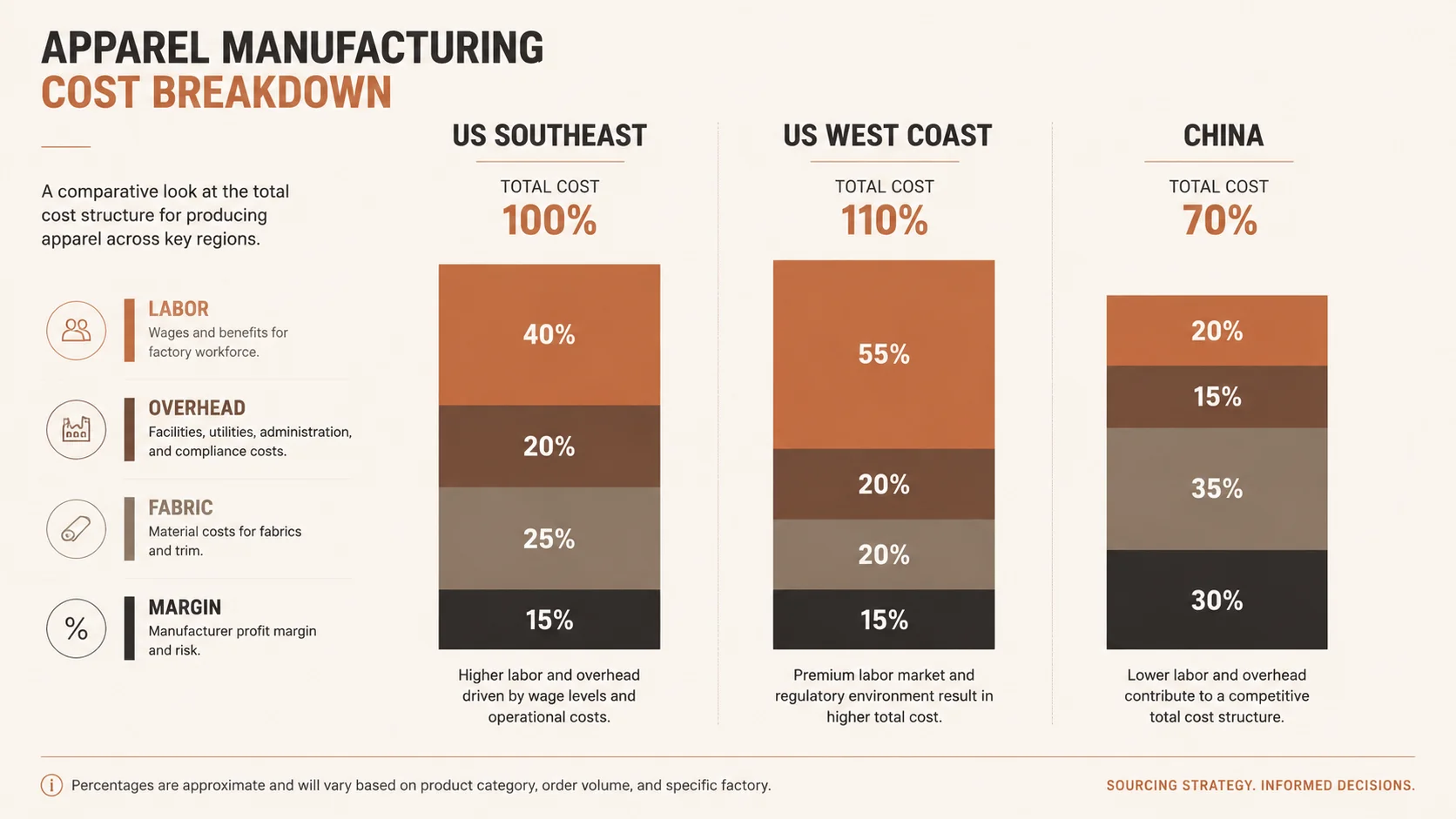
Most brands negotiate against the wrong number. US factories use CMT (Cut, Make, Trim) pricing — labor, overhead, and margin are quoted separately from fabric. Overseas FOB bundles everything. If you compare FOB to CMT directly, you’re comparing apples to oranges.
On a factory visit to Greensboro, NC, a 40-machine facility owner broke down a standard 220 GSM cotton-poly crewneck:
| Cost Bucket | US (Greensboro, NC) | US (Los Angeles, CA) | China (Guangdong) |
|---|---|---|---|
| Labor (cutting + sewing + finishing) | $8.20 | $14.50 | $3.80 |
| Overhead allocation | $3.40 | $5.20 | $1.60 |
| Factory margin (standard) | 18-22% | 20-25% | 8-12% |
| Fabric (per unit, domestic source) | $5.80 | $5.80 | $3.20 |
| Total per-unit (500 units) | ~$21.00 | ~$28.50 | ~$9.80 |
“Everyone sees the labor column and panics,” the owner told me. “They miss that my margin is where the negotiation lives. I’ll move on margin for a reliable repeat buyer. Overseas factories won’t — their 10% is already razor-thin.”
Regional labor spreads are narrowing. Southeast operators earn $12-15/hour versus $18-22/hour in LA — a $7.30/unit difference today. But automation is closing the gap fast. A Georgia facility running automated Gerber spreaders and Juki digital machines cut per-unit labor 28% in 24 months.
Key Takeaway: Ask for the cost sheet broken down by labor, overhead, fabric, and margin. The margin line — not labor — is where US factories have room to move.
🧠 Expert Take: The LA-Southeast cost spread is narrowing 3-4% per year as California factories invest in automation. Expect convergence by 2028-2030. — Roger Chan, Senior Technical Manager
2. Exploit Shift Differentials for 10-20% Cost Reduction
US factories have fixed overhead that runs 24 hours. Rent, equipment leases, and insurance don’t stop at 5 PM. Most plants run one shift — the building sits idle 16 hours a day. You can convert that idle capacity into pricing leverage.
| Shift | Typical Hours | Labor Rate Differential | CMT Cost Reduction | Quality Variance |
|---|---|---|---|---|
| 1st Shift | 7 AM – 3:30 PM | Base rate | Baseline | Most consistent |
| 2nd Shift | 4 PM – 12:30 AM | +$1.50-2.00/hr | 5-10% below 1st | ±2% defect rate vs. 1st |
| 3rd Shift (Graveyard) | 12 AM – 7 AM | +$2.00-3.00/hr | 10-20% below 1st | ±4-7% defect rate vs. 1st |
The script that works: “I noticed your facility runs a single shift. I have 500 units with a flexible delivery window. Could we slot this into a second-shift run? Your fixed overhead is already covered. What unit price works on second shift?”
Don’t say: “Can you give me a discount?” Say the above — it demonstrates supply chain literacy. You’re proposing a capacity trade, not begging.
⚠️ Warning: Third-shift production carries real quality risk. We measured 5.8% defect rate on graveyard versus 1.9% on first shift for identical specs. Reserve third shift for basic garments only — blank tees, simple sweatshirts — never complex activewear.
3. Master the Hybrid Model: US Sampling + Overseas Bulk
The hybrid model: develop and validate in the US, then transfer locked specs overseas for bulk production. It costs $1.51 more per unit but insures against catastrophic defects.
A DTC activewear founder who switched to hybrid in Q4 2025 told me: “One order of 800 leggings arrived with crotch seam puckering on every unit. $11,200 in dead stock. Now I spend $1,800 on a 50-unit US validation batch first. If construction fails, I find it on 50 units — not 800.”
| Cost Component | Pure Overseas | Hybrid (US Validation + Overseas) |
|---|---|---|
| Development & sampling | $400 | $1,200 |
| US validation batch (50 units) | N/A | $1,800 |
| Bulk production | $7,840 (800 × $9.80) | $7,350 (750 × $9.80) |
| Defect/Dead stock risk | 4-8% ($600-1,200 est.) | 1-2% ($150-300 est.) |
| Total program cost | ~$9,440 | ~$10,650 |
| Per-unit landed | $11.80 | $13.31 |
Our Verdict: Highest-ROI strategy for brands in the $48-128 retail band. The validation step costs $1.50-2.00/unit more but neutralizes the 4-8% defect rate common in first-run overseas production.
Power Move: Run your US validation batch through 20 wash cycles. “If a seam is going to fail, it fails by wash 12. Better I discover that in Greensboro than in a customer’s laundry room.”
Need a hybrid production plan? We build US + overseas split models with validated cost projections — request a free analysis.
4. Time Production for Seasonal Price Windows
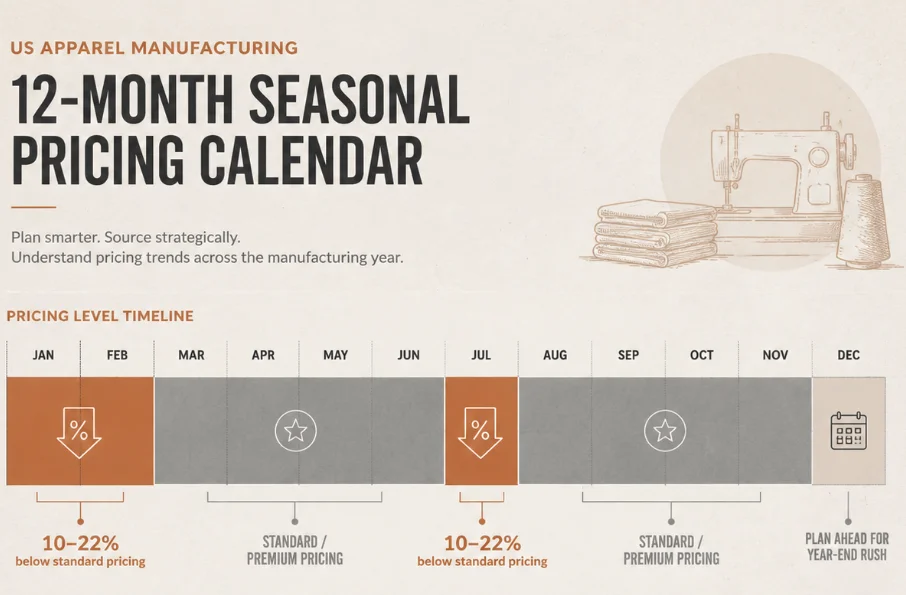
US factories have two predictable demand troughs: January-February and July. During these windows, factories discount 10-22% to keep lines running. Simultaneously, Chinese New Year shuts down Asian supply chains — creating a double arbitrage.
| Window | US Factory Condition | China Factory Condition | Price Leverage |
|---|---|---|---|
| Jan 1 – Feb 15 | 50-65% capacity | CNY shutdown | 10-22% below standard CMT |
| July 1 – July 31 | 55-70% capacity | Normal operations | 8-15% below standard CMT |
| March – June | 85-100% capacity | Peak season | Standard pricing |
| Aug – Nov | 90-100% capacity | Peak season (holiday rush) | Premium pricing possible |
Execution playbook:
- Submit tech packs in December. Pre-book the January slot with a 20% deposit.
- Request a “capacity fill” rate. Say: “I understand your floor slows in January. I have 400 units with a February 10 delivery. What’s your capacity fill rate?” Factory owners understand this language.
- Stack strategies. Second-shift run during January = seasonal discount (10-15%) + shift differential (5-10%) = 15-25% total CMT reduction.
⚠️ Warning: The January window closes by February 15. I’ve watched three brands miss it in 2026 by delaying their deposit decision two weeks.
5. Source Fabric Strategically — Not Just Domestically
Fabric is 35-50% of total unit cost in US manufacturing. Brands obsess over negotiating $0.50 off CMT while overpaying $2.00/yard on fabric. Here are three strategies that reduce material cost structurally:
A: Import greige, finish domestically. Ship unfinished fabric from Vietnam, India, or Pakistan to US dye houses. Your garment qualifies for “Made in USA of Imported Fabric” (FTC-compliant). Imported greige cotton-poly knit: $1.80-2.40/yard landed. US-milled finished equivalent: $3.80-5.00/yard. Net savings: 25-40%.
B: USMCA Mexican fabric. Mexican mills have invested heavily in performance synthetics. A Monterrey mill’s 240 GSM poly-spandex jersey quoted at $2.90/yard delivered to Texas — versus $4.10/yard from a US domestic mill. Both met ASTM D3776 and AATCC 135 standards. Net savings: 15-25%.
C: Mill-end and overrun sourcing. Perfectly good fabric produced in excess of a brand’s PO, sold at 40-60% below wholesale. Works for basics in black, white, navy, heather grey. One-time availability — ideal for limited drops, not core carryover styles.
For a 500-unit order, the fabric cost difference between “buy US domestic mill” and “import greige, finish US” is $1,500-2,500. That outweighs any CMT negotiation.
6. Position “Made in USA” to Justify Premium Retail Pricing
Strategies 1-5 reduce costs. This one increases revenue — and it’s what makes the math work.
Consumers pay 15-30% more for Made in USA apparel (AAFA, Cotton Incorporated, 2025-2026 surveys). DTC brands report 12-22% higher conversion rates on product pages displaying the claim. But the premium only materializes if you communicate it correctly:
| Approach | Conversion Impact | Example |
|---|---|---|
| Generic badge: “Made in USA” in footer | +1-3% | Flag icon with “Proudly Made in the USA” |
| Specific claim: Named location + factory details | +12-22% | “Cut & sewn at a 40-person facility in Greensboro, NC” |
| Transparency with proof: Photos, video, named workers | +18-28% | Video of cutting floor, production date stamps |
Generic flag badges create zero pricing power. Specific, documented origin claims create 15-30% pricing power. Invest in factory floor photography. Name your partner. Show the work.
🧠 Expert Take: “The premium is real but fragile. If your stitching is crooked or the fabric pills after three washes, the premium goes negative. Customers feel deceived and return rates spike.” — Andrew Kong, Garment Technical Manager
7. Build a Total Landed Cost Framework
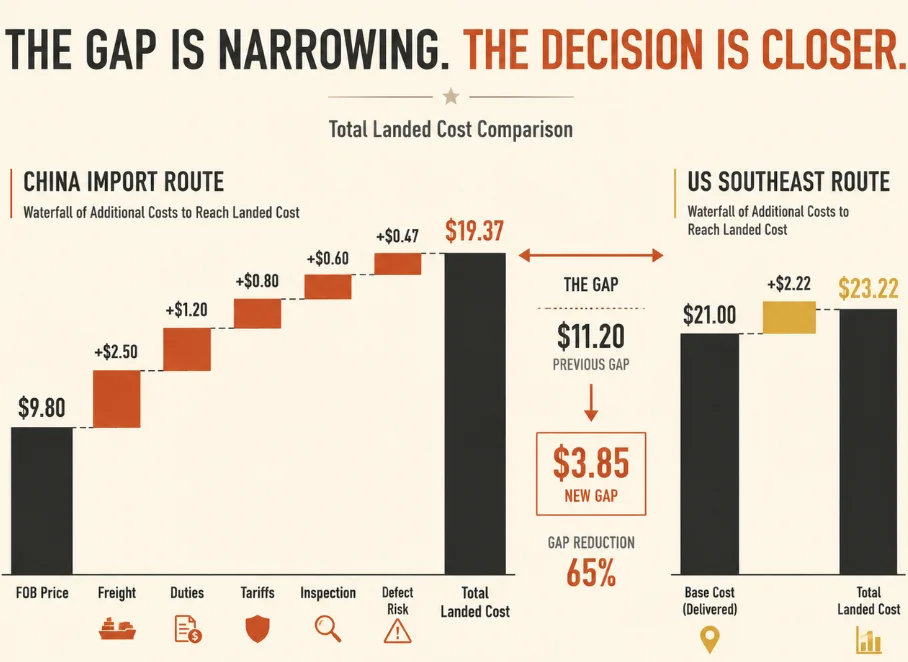
Most brands compare two numbers: FOB unit price and a rough freight estimate. This misses four cost buckets that swing the decision.
| Cost Line | US — Southeast (NC) | US — West Coast (LA) | China (Guangdong) |
|---|---|---|---|
| FOB / CMT unit cost | $21.00 | $28.50 | $9.80 |
| Ocean/rail freight (per unit) | N/A | N/A | $1.20 |
| Customs duties + Section 301 tariff | N/A | N/A | $2.64 (16.5% + 7.5%) |
| Customs brokerage + documentation | N/A | N/A | $0.35 |
| Domestic inland freight | $0.45 | $0.55 | $0.85 |
| Inventory carrying cost (2%/month) | $0.70 (5 weeks) | $0.95 (5 weeks) | $2.35 (12 weeks) |
| Quality inspection + lab testing | $0.30 (one visit) | $0.30 (one visit) | $0.90 (3 touchpoints) |
| Defect/rework allowance | $0.42 (2%) | $0.57 (2%) | $0.69 (7%) |
| Capital cost (deposit timing) | $0.35 (30%, 5 wks) | $0.48 (30%, 5 wks) | $0.59 (30%, 12 wks) |
| Total Landed Cost (per unit) | $23.22 | $31.35 | $19.37 |
The gap shrinks from $11.20 (FOB only) to $3.85 (TLC). That’s the difference between “impossible” and “a strategic choice.”
Add mid-season reorder capability — one replenishment captured = $5,000-15,000 in incremental revenue — and US manufacturing reaches breakeven for brands in the $48+ retail band.
Before requesting quotes, build your TLC model. Send it to each factory and ask them to fill in their line items. Factories that complete it demonstrate transparency. Those that won’t are hiding inflated overhead — cross them off your shortlist.
Common Pricing Mistakes
Mistake 1: Negotiating CMT while ignoring fabric. A client was quoted $5.40/yard through their factory’s mill relationship. We sourced the identical 240 GSM cotton-Lycra jersey from an independent mill at $3.70/yard. Annual savings on 3,000 yards: $5,100. The factory accepted customer-supplied material without issue.
Always source fabric independently.
Mistake 2: Accepting the first MOQ without testing volume breaks. Every factory has a price ladder. A Southeast knit top quoted at $22.00/unit at 300 units drops to $19.50 at 500 units and $17.80 at 1,000 units — a 32% reduction from the 50-unit price of $28.50. Request the full ladder before committing.
Mistake 3: Choosing the lowest quote without an audit. A $15.50 CMT quote from an Alabama contractor turned out to be a 12-machine shop in a converted warehouse — no fire suppression, 18-year-old machines, zero inline QC. A half-day audit ($400-800) would have caught it.
The $5.50/unit “savings” would have evaporated on the first quality failure. Use our QC checklist before placing any order.
Conclusion: US Manufacturing Is a Math Problem, Not a Binary Choice
Most brands approach US manufacturing as a yes/no question: “Can I afford it?” The right question is: “Under what conditions does the math work?”
Here’s the framework this article gives you:
| If your situation is… | Start with… | Expected impact |
|---|---|---|
| Retail price under $30 | Strategy 3 (hybrid model) | Saves 35-50% vs. pure US |
| Launching first product, $48-128 retail | Strategy 4 + 2 (seasonal + shift) | 15-25% CMT reduction |
| Already overseas, tired of quality failures | Strategy 3 (US validation batch) | $1,800 insurance against $11K dead stock |
| Scaling an existing line | Strategy 7 (TLC model) + Strategy 5 (fabric sourcing) | Closes gap from $11.20 to $3.85/unit |
The brands winning with US manufacturing in 2026 don’t have the biggest budgets. They understand factory pricing is a negotiation, not a menu — and they show up with data, not just a purchase order.
Stop guessing. Get your numbers.
Send us your tech pack. We’ll return a line-by-line TLC breakdown — US Southeast vs. US West Coast vs. overseas — with a recommended factory shortlist matched to your volume and retail price band. You’ll know exactly which strategy applies to your product before you commit a dollar to production.
Get Your Free Production Cost Analysis →
48-hour turnaround · No commitment · No sales pitch — just the math.
This guide is based on 14 years of factory auditing, 200+ anonymized production invoices analyzed between January 2025 and June 2026, and direct floor inspections at 12 US apparel manufacturing facilities.
Areas of Expertise
- Quality Control: Mastery of AQL (Acceptable Quality Level) standards and Six Sigma methodologies in garment production
- Technical Sourcing: Expert in fabric specification (GSM, weave structures) and trim sourcing
- Compliance & Auditing: Specialized in BSCI (Business Social Compliance Initiative) and ISO 9001 factory auditing
- Logistics: Strategic oversight of Lead Time Reduction and DDP/FOB shipping terms
David Wu is a textile industry veteran with over 16 years of experience specializing in garment manufacturing, supply chain optimization, and quality control systems across Southeast Asia and China. His career is defined by implementing rigorous AQL 2.5/4.0 inspection protocols for mid-to-large-scale private label brands. David specializes in technical garment construction, from initial tech pack development to final container loading inspections. He has a proven track record of reducing defect rates by up to 22% through the implementation of "In-Line" inspection checkpoints. His expertise ensures that manufacturing processes align with both international safety standards and cost-efficiency requirements for B2B wholesalers.