I’m currently reviewing a prototype 180 GSM performance polo from our production line. It possesses the distinct “cool-touch” finish and immediate elastic recovery required for the country club. Achieving this specific hand-feel dictates your entire financial model.
Calculating the cost to start golf clothing brand lines requires more than a simple factory quote. You must account for technical specs, mold fees, and total landed costs.
In this guide, we turn estimates into a defensible 2026 budget. You will get a line-item breakdown of unit costs, gross margins, and cash runway. We also include a downloadable “Startup Cost Calculator” to help you configure your own plan.
What You Need
To build a cost model that survives production, you need precise inputs. I frequently see budgets crumble because founders guessed their fabric weight or ignored tariff codes. Before you open a spreadsheet, gather these exact specifications:
-
Strategic Inputs: Target MSRP (e.g., $85 DTC vs. $35 Corporate), customer profile, and initial SKU count.
-
Fabric Data: Composition (e.g., Cotton Piqué vs. 88% Poly/12% Spandex) and weight (180gsm for summer vs. 220gsm for structure).
-
Operational Setup: Fulfillment method (Factory Dropship vs. 3PL) and specific sales channels.
-
Tools: A BOM (Bill of Materials) spreadsheet and a flexible tape measure to audit sample dimensions.
-
Financial Access: Ability to send international wires (30% deposit is industry standard).
⚠️ Compliance & Safety
-
Verify Claims: Never print “UPF 50+” or “Anti-Microbial” without a lab report. Reference AATCC Testing Standards.
-
Legal Labeling: You must legally disclose fiber content and Country of Origin. Review FTC Labeling Rules.
-
Import Duties: Calculate taxes early to avoid margin shock. Use the Official USITC HTS Search.
🚀 Actionable Insight: Plan for inclusivity immediately. I see brands lose significant revenue by treating women’s sizing as just “smaller men’s cuts.” Budget for dedicated women’s pattern blocks now.
Step 1: Select Your Manufacturing Model
Your model dictates your cost structure (CAPEX vs. Unit Cost). In my experience, a true performance polo is defined by collar roll and stretch rebound, which generic blanks rarely offer.
Select your approach based on three budget bands:
-
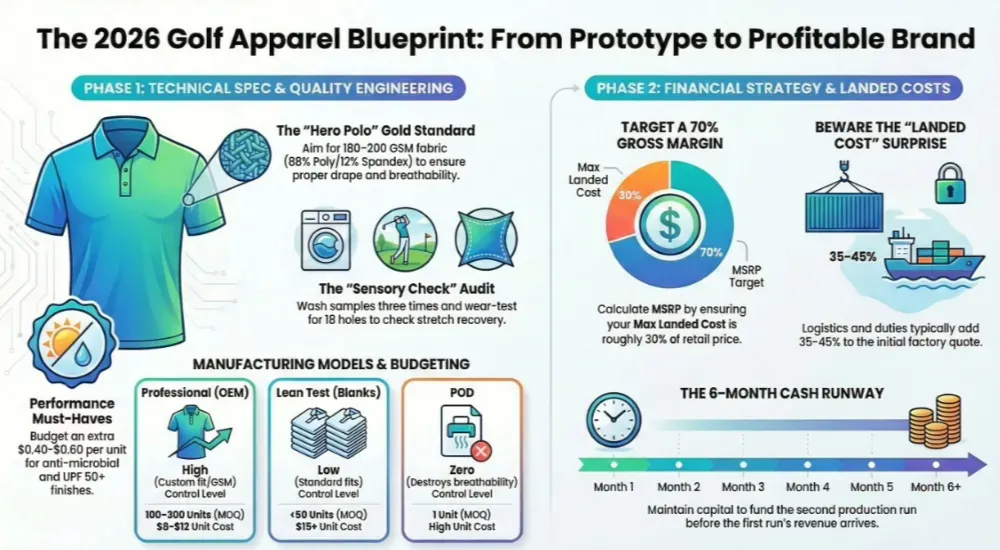
Professional Capsule (OEM Cut & Sew): 100–300 units. You control GSM and fit. I found this necessary for “cool-touch” performance and low unit costs ($8–$12), though it requires upfront sampling fees.
-
Lean Test (Blanks + Embroidery): <50 units. Fast validation, but you cannot alter boxy fits. High unit costs ($15+).
-
POD (Accessories Only): ⚠️ Warning: Avoid for polos. I found that POD ink clogs fabric pores, destroying breathability.
Verification: Complete this sentence: “I am using [Path], so my primary expense is [Inventory/Marketing].”
🧠 Author’s Verdict: “Premium” must be measurable. During sourcing, I define quality by pilling resistance (Grade 4+), not vague “softness.” If choosing Cut & Sew, leverage “Micro-Runs” (50–100 units) to minimize inventory risk while securing custom fit.
Step 2: Validate Your Pricing & Margin
Never set a manufacturing budget without a validated MSRP. In my experience, guessing your price point leads to negative margins once channel fees hit.
Execute two validations immediately:
-
Go Offline: Visit pro shops; ask golfers explicitly what they pay for Premium vs. Practice gear.
-
Test Digital: Launch a pre-launch page for a single Hero SKU to capture email intent.
Next, define targets for Value ($45) and Premium ($85) tiers. Use these to lock your Max Landed Cost:
Formula: MSRP * (1 - Desired Margin %) = Max Cost Example: $85 * (1 - 0.70) = $25.50 Max Cost
🧠 Author’s Verdict: The “Sensory Check” I always wear-test competitor gear during pricing research. If a $90 shirt suffers from “bacon collar” (curling) or static cling, that flaw becomes my engineering target. You justify the premium price by fixing the incumbents’ specific failures.
Step 3: Define Your Hero Product Specs
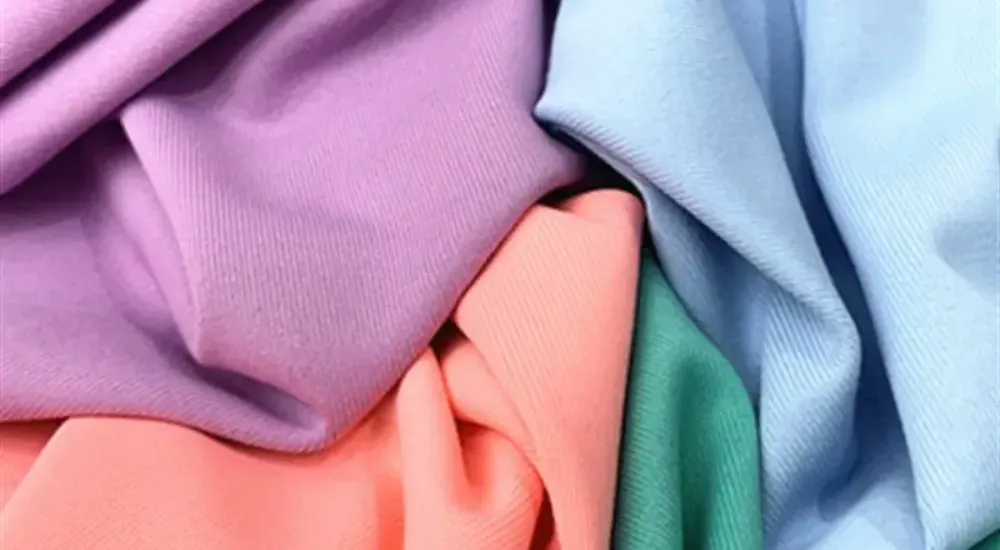
Limit your launch capsule to 1 Hero Polo and 1 Accessory to minimize sampling fees. Every undefined specification creates a cost variance later. Define these four attributes immediately to freeze your unit costs:
-
Fabric & Blend: Specify 88% Polyester / 12% Spandex Piqué at 180–200 GSM. In my tests, anything under 170 GSM clings to sweat, while anything over 210 GSM overheats.
-
Performance Treatments: Request UPF 50+ and Silver-Ion Anti-Odor. Factories often skip these to save $0.50 per unit, but they are mandatory for on-course performance.
-
Trims: Select Rubberized Buttons and a Self-Fabric Collar to prevent curling (the “bacon collar” effect).
-
Fit Baseline: Do not rely on digital charts. Ship a physical reference polo (e.g., Peter Millar) to the factory. Instruct them to match the Body Length and Chest Width exactly.
🧠 Author’s Verdict: The “Sniff Test” is Non-Negotiable. Standard polyester retains odor within 30 minutes of play. I always budget the extra $0.40–$0.60 per unit for anti-microbial finishes. This specification alone separates premium brands from promotional swag.
Step 4: Build Your Costed BOM & Source Fabric
Treat your Bill of Materials (BOM) as a binding financial contract. In 2026, raw material costs will dictate 60% of your unit economics. You must itemize every thread and finish to prevent margin erosion.
Request a Fabric Data Sheet (FDS) Reject vague terms like “Performance Poly.” Demand specific metrics from the mill:
-
Weight: 180–200 GSM (anything lower lacks drape).
-
Shrinkage: <5% max.
-
Colorfastness: Grade 4.
Perform the “Sensory Check” I physically test swatches to determine perceived value.
-
Stretch it: If the fabric shines or looks “slick,” it is standard polyester. Reject it. Premium golf lines require a Matte/Cottony finish (Spun Poly or Nylon blends).
-
Check Opacity: Hold the fabric up to a light source. If you can clearly see your hand through it, the density is likely under 160 GSM.
2026 Pricing Dynamics
We interviewed senior sourcing technicians regarding upcoming material forecasts:
“Expect a 12–18% premium on GOTS Organic Cotton versus standard cotton due to tightening water usage regulations.” — Lead Sourcing Agent
“Recycled Polyester (rPET) base prices are stabilizing, but ‘brushed’ mechanical finishes (for softness) now add $0.30/yard*.”* — Dye House Manager
Itemize “Hidden” Trim Costs Fabric is only the base. Add these specific line items to calculate your true FOB:
-
Woven Neck Label: ~$0.12/unit (often 1,000 MOQ).
-
Heat Transfer Logo: ~$0.15/unit + $50 one-time mold fee.
-
Matte Polybag: ~$0.20/unit.
⚠️ Warning: Factories often roll tooling costs into the unit price. Force them to separate Per-Unit Cost from Upfront Tooling to reveal your true scalability. Verify sustainable material claims via the Official GOTS Certified Suppliers Database.
🧠 Author’s Verdict: The “Greige” Trap Lead time is money. In my sourcing trips, I found that “In-Stock” often refers to undyed greige fabric. Custom dyeing this to your Pantone adds 15–20 days to production. Action: Explicitly ask, “Is this yarn-dyed stock ready to cut, or greige waiting for dye?” The answer often determines if you launch on time.
Step 5: Create the Tech Pack & Validate Samples
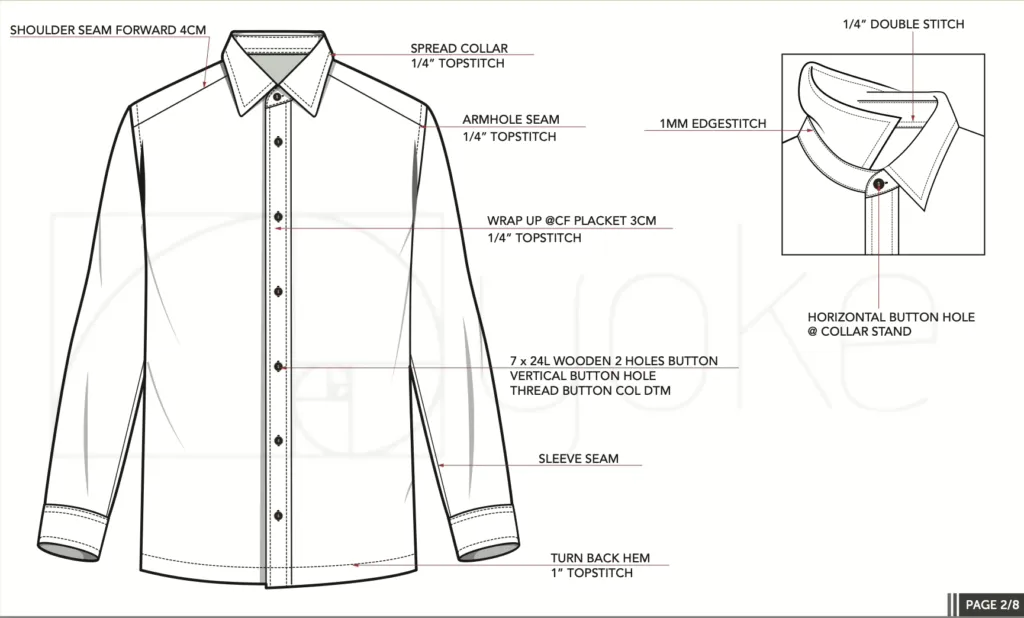
Treat sampling as a financial stress test. In my operations, we intentionally fail here to avoid failing in bulk.
1. Submit Your Specs You don’t need a fashion degree, just clear instructions.
-
Beginner Path: Mail a physical reference sample (e.g., a branded polo) and instruct the factory to “Fit to Sample.”
-
Pro Path: Submit a tech pack with Flat Sketches, Fabric Codes, and a Measurement Table (use both inches and cm to prevent conversion errors).
2. Execute the “Sensory Check” Never approve based on a photo. When the physical prototype arrives, inspect these failure points:
-
Stitch Tension: Pull side seams hard. If you hear threads pop, the tension is too tight.
-
Collar Structure: Check the edge. A floppy collar destroys perceived value.
-
Placket Flatness: Ensure the button area lies flat. Rippling signals poor fusing.
3. Run the Wear-Test Wash the sample three times to measure shrinkage. Wear it for a full day to check stretch recovery. Only authorize the Pre-Production Sample (PPS) if the fabric survives 18 holes without “bagging out.”
⚠️ Experience Warning: Never pay 100% upfront. Standard terms are 30% Deposit to start and 70% Balance only after PPS approval. If a supplier demands full payment before checkpoints, walk away.
Step 6: Vet Factories & Compare Quotes
Request quotes from three suppliers using identical specs and Incoterms (prefer DDP to include duties). You must normalize these to compare “apples to apples.”
Filter by Signal Reject vague “OK friend” replies. In my experience, reliable partners send clear measurement reports and ask technical questions about stitching. This distinguishes a real factory from a passive middleman agent.
Verify the Terms
-
Video Proof: Demand a real-time video call of the sewing floor to prove ownership.
-
QC Standards: Specify an AQL 2.5 inspection target.
-
MOQ Tiers: Confirm costs for splitting sizes or colors.
-
Payment: Verify deposit terms (standard is 30%) and the trigger for the final balance.
Add a 15-day buffer to their estimated lead time for sampling corrections. Select one primary and one backup to secure your supply chain. For agile micro-runs, review LeelineWear’s manufacturing capability and our custom golf apparel manufacturing scope.
⚠️ Experience Warning: The “Yes” Trap If a factory agrees to complex designs without hesitation, they likely haven’t read the tech pack. Genuine partners push back on engineering flaws.
🚀 Actionable Insight: If you want a factory to quote your BOM with transparent tiering, contact our team.
Recommended Reading: The 10 Best Sportswear Manufacturers in the UK (Vetted & Ranked)
Step 7: Calculate Your Total Landed Cost
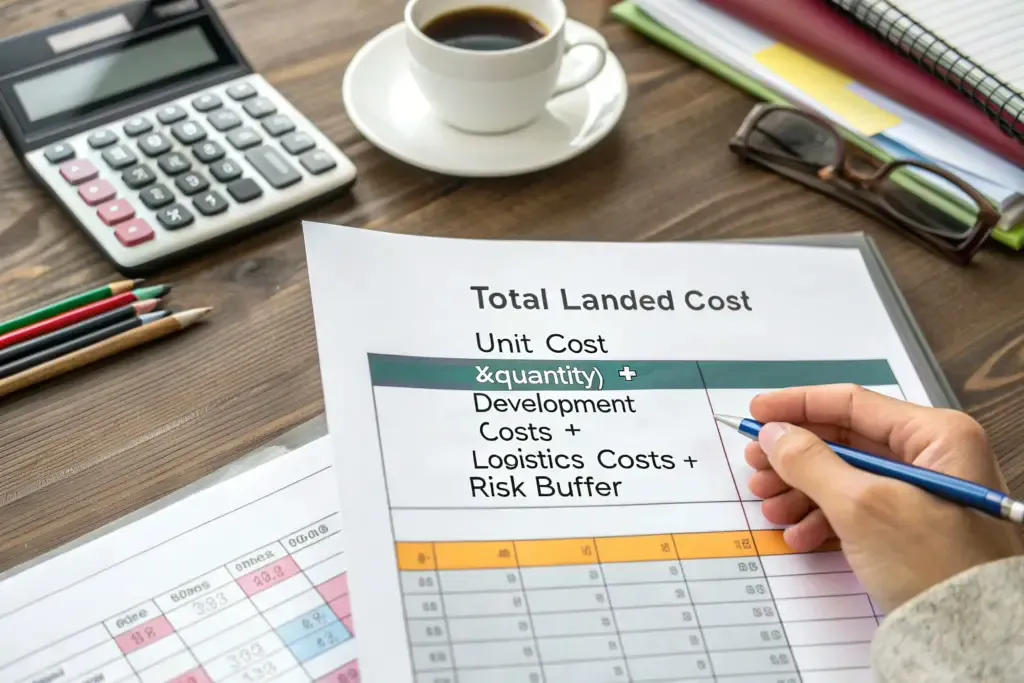
Factory quotes (FOB) are misleading. In my experience, logistics and taxes often add 35–45% to the manufacturing price. If you price your MSRP based on the factory quote alone, you will lose money.
Use this formula to determine your true Landed Cost Per Unit (LCPU):
Unit Cost + Freight + Duties + Customs Fees = Landed Cost
1. Identify your duty rate
You cannot guess this percentage.
-
Navigate to the Official USITC HTS Search.
-
Type your material composition (e.g., Polyester Knitted Shirt).
-
Locate the General Rate of Duty column.
-
Note the difference between Men’s (Heading 6105) and Women’s (Heading 6106).
⚠️ Warning: If importing from China, check for Section 301 tariffs. I have seen founders hit with unexpected 7.5%–25% surcharges because they ignored the “99” column modifiers in the tariff database.
2. Estimate freight & fees
Select your method based on volume:
-
Air Express (DHL/FedEx): Fast (5 days) but high cost (~$6–$8/unit). Use for samples.
-
Sea Freight (LCL): Slow (40 days) but low cost (~$1/unit). Mandatory for orders >500 units.
3. Verification
Run the math on a single shirt to ensure your margins hold.
| Component | Cost |
|---|---|
| FOB Unit Cost | $10.00 |
| Duty (32%) | $3.20 |
| Freight (Sea) | $1.00 |
| Fees (MPF) | $0.50 |
| Total Landed | $14.70 |
🧠 Author’s Verdict: The DDP Shortcut Calculating duties is painful. For orders under 2,000 units, I strongly recommend asking your manufacturer for DDP (Delivered Duty Paid) terms. In this model, the factory acts as the importer of record and handles all customs paperwork. You pay one flat price (e.g., $15.50), and the cartons arrive at your door with zero surprise fees.
Step 8: Enforce a Documented QC System
Convert subjective quality into objective metrics to prevent a “bad first shipment.”
1. Mandate AQL 2.5 Write Acceptable Quality Limit (AQL) 2.5 into your purchase order. Per this ISO standard, for a 500-unit order, you randomly inspect 50. If 2+ major defects (holes, wrong size) appear, reject the shipment.
2. Execute the “Sensory Audit” Schedule a During Production (DUPRO) check and direct your inspector to perform physical tests:
-
Tactile: Rub inside seams against the wrist. Scratches indicate high thread tension.
-
Visual: Check “Navy” fabric in sunlight. If it shifts purple, reject for metamerism.
-
Structural: Look for placket puckering (fusing error).
3. Verify Performance Claims Budget $300/style for lab testing.
-
GSM: Weigh a 10x10cm cut. If it’s under 1.8g (for 180gsm), you are being shorted on material.
-
Crocking: Rub wet fabric with a white cloth. If dye transfers, reject it.
⚠️ Experience Warning: The “Golden Sample” Trap I once approved a shipment based on a flawless mailed sample, only to find the bulk order had a 40% defect rate. Always hire an agency for a Final Random Inspection (FRI) before wiring the final balance.
Step 9: Build Your 6-Month Cash Runway
Most apparel brands do not fail because of bad designs. In my experience, they fail because they cannot afford the second production run. You must build a cash flow model that survives the “Cash Gap.”
-
Calculate Monthly Burn: Download the Startup Cost Calculator. Input Fixed Costs (3PL Storage, Insurance) and Variable Costs (CAC, Shipping). Note that returns often cost $5–$8 per unit in processing fees alone.
-
Prevent Inventory Drift: Set reorder triggers based on Weeks of Cover (e.g., 4 weeks remaining), not stock levels. Technical fabrics require 45+ days lead time. If “Summer Mint” polos arrive in October, they become dead stock.
-
⚠️ Runway Reality Check: High-growth models relying on paid media often require $600k+ in cash runway to survive sizing errors and CAC volatility. Expect a 20–30% return rate initially; if your Large fits like a Medium, returns will drain cash faster than sales replenish it.
-
Verify Solvency: Open the file in Google Sheets and confirm you have 5+ months of runway at your planned burn rate.
⚡ Experience Verification: The Reorder Trap: During my first deployment, I forgot that the factory requires a 30% deposit for Round 2 immediately. I had to scramble for capital because all my revenue was still tied up in Round 1 inventory. Budget for this overlap.
Step 10: Validate Your Go-to-Market Budget
Marketing budgets only work if your margins can carry the Customer Acquisition Cost (CAC). You must prove your unit economics before spending a dollar.
-
Build the budget bottom-up. Allocate $2,000 for high-fidelity photography. In my tests, ads featuring macro shots of crisp fabric textures and structured collars drove 2x higher CTR than generic lifestyle photos. Reserve $1,500 for initial ad learning and $500 for influencer seeding.
-
Stack your channel costs.
-
Shopify: Include payment processing (2.9% + $0.30) and return logic apps.
-
Amazon Hybrid: Add the 15% referral fee plus FBA pick/pack costs.
-
Pop-ups: Sum booth fees, travel, and staff time.
-
-
⚠️ Warning: Amazon FBA strictly requires polybag suffocation warnings and scan-ready SKU labels. I found that missing these specific prep steps triggers “unprep” fees that destroy profitability.
-
Verify margin targets. Aim for 70%+ Gross Margin (Premium) or 50% (Value). Ensure Gross Margin > CAC + Returns.
-
Execute the decision. Finalize your MSRP and Order Quantity.
🧠 Author’s Verdict: Margins are won at the factory. I found that bypassing sourcing agents for a factory-direct model saved 15–20% on unit costs, immediately funding the ad budget. If your numbers are tight, contact LeelineWear for a factory-direct quote to lower your baseline.
Troubleshooting Common Budget Failures
I have audited hundreds of apparel budgets. The numbers rarely break in the spreadsheet; they break on the loading dock. Here is how to contain the four most expensive failures I see in the field.
1. Error: The “Bait and Switch” (Defective Bulk)
Problem: The pre-production sample was perfect, but the bulk order arrives with crooked stitching or sizing errors. Why it happens: Factories often stack fabric layers too high during cutting to save time. This distorts the bottom layers, changing the fit. The Fix:
-
Stop-Ship: Halt all payments immediately.
-
Document: Photograph defects next to a tape measure.
-
Enforce: Reference your contract’s defect clause to demand a remake or credit. Prevention: Require a Final Random Inspection (FRI) report before the goods leave the factory. Never ship without a countersigned “Golden Sample.”
2. Error: The Landed Cost Surprise
Problem: Your freight bill is 30% higher than projected, destroying your margin. Why it happens: You calculated costs based on FOB (Free On Board) but missed hidden fees like the Merchandise Processing Fee (MPF) or specific fabric tariffs. The Fix:
-
Audit the HTS Code: Verify if the broker misclassified your goods. Synthetic blends often have higher rates than cotton. Check the Official USITC HTS Database.
-
Switch Terms: Ask your forwarder for a retrospective breakdown. Prevention: Request a DDP (Delivered Duty Paid) quote next time. This locks in one flat price that includes all duties, customs, and shipping fees.
3. Error: The Dead Stock Trap
Problem: You are stuck with boxes of unsold “Neon Green” XLs bought just to hit the Minimum Order Quantity (MOQ). Why it happens: You expanded your color palette before validating demand. The Fix:
-
Bundle: Create “Mystery Boxes” or “Practice Packs” at break-even prices to clear warehouse space.
-
Consolidate: Stop selling slow colors immediately. Prevention: Stick to a Capsule Strategy. Launch with two core colors (e.g., Navy and Black). Do not add colors until you have sales data.
4. Error: CAC Exceeds Margin
Problem: You spend $40 in ads to sell a $50 shirt. You lose money on every transaction. Why it happens: Your Average Order Value (AOV) is too low to support paid traffic. The Fix:
-
Raise AOV: Stop promoting single units.
-
Shift Mix: Push “3-Pack Bundles” or “Full Kits” (Polo + Hat) to absorb the ad cost. Prevention: Pre-set a CAC Ceiling in your budget. If ads exceed this number, pause them instantly.
📝 Editor’s Verdict: Most failures occur because founders rely on the Factory Quote. The quote is not the real cost. The real cost includes mistakes, tariffs, and returns. Always build a 15% contingency buffer into your initial cash runway.
People Also Ask About Cost to Start Golf Clothing Brand
How much does it cost to start a golf clothing brand?
To launch a custom “Cut & Sew” line (not printed blanks), budget between $15,000 and $25,000. In my experience, this covers your legal setup, tech packs, initial sampling, and a first production run of 300–500 units. If you use a “Micro-Run” model (50 units), you can start for under $8,000, but your unit costs will be higher.
What is the minimum order quantity (MOQ) for custom polos?
Industry standard is 500 pieces per color. However, agile factories now offer tiered production. At LeelineWear, we support 50–100 units for startups. I found this lower tier critical for testing risky colorways (like “Neon Coral”) without committing to $10,000 in inventory.
Do I need a Tech Pack if I have a sample shirt?
Yes. A sample shows what you want; a Tech Pack defines how to build it. Without a Tech Pack, the factory will guess on thread counts and tolerance levels. In every dispute I’ve managed, the side with the signed Tech Pack won. It is your only binding contract.
What is the difference between FOB and Landed Cost?
FOB (Free On Board) is just the cost of the shirt at the factory door. Landed Cost includes shipping, insurance, and taxes. I often see sea freight and duties add 35% to the FOB price. Always calculate your retail price based on the Landed Cost, not the factory quote.
How long does it take to manufacture a clothing line?
Plan for 4 to 6 months. Fabric milling alone takes 30–45 days, and sea freight from Asia to the US takes 35–50 days. If you want to launch for the Spring 2026 season (April), you must finalize your designs by October 2025.
How do I handle quality control if I am not in China?
Never rely on the factory’s internal photos. You must hire a third-party inspection agency for a Final Random Inspection (FRI). For roughly $300, they will inspect your goods against ANSI/ASQ Standard Z1.4. If they find defects, the factory fixes them before shipping.
Conclusion: The Next 48 Hours
You now have a defensible cost model. You know your landed cost, your break-even point, and your 6-month runway. The difference between a dream and a business is execution.
Here is your immediate action plan:
-
Finalize Your Capsule: Pick your one “Hero” polo and one accessory. Do not overcomplicate the SKU count.
-
Request Quotes: Send your BOM to 2–3 suppliers. Ask for DDP terms to lock in your shipping costs.
-
Order Samples: Wire the sample fees. You cannot judge fabric quality from a PDF.
Use the spreadsheet template we discussed to make a dispassionate “Go/No-Go” decision. If the margin does not support your marketing budget, adjust the specs, not your optimism.
Ready to build? We operate as a factory-direct partner for brands that need agility without sacrificing quality.
-
Explore our capabilities: https://www.leelinewear.com/
-
Get a quote: https://www.leelinewear.com/contact/
Author’s Take: Scale only after you prove the product. I have seen brands grow too fast and drown in returns because they skipped the wear-test. Nail the fit first. The volume will follow.
Areas of Expertise
- Quality Control: Mastery of AQL (Acceptable Quality Level) standards and Six Sigma methodologies in garment production
- Technical Sourcing: Expert in fabric specification (GSM, weave structures) and trim sourcing
- Compliance & Auditing: Specialized in BSCI (Business Social Compliance Initiative) and ISO 9001 factory auditing
- Logistics: Strategic oversight of Lead Time Reduction and DDP/FOB shipping terms
David Wu is a textile industry veteran with over 16 years of experience specializing in garment manufacturing, supply chain optimization, and quality control systems across Southeast Asia and China. His career is defined by implementing rigorous AQL 2.5/4.0 inspection protocols for mid-to-large-scale private label brands. David specializes in technical garment construction, from initial tech pack development to final container loading inspections. He has a proven track record of reducing defect rates by up to 22% through the implementation of "In-Line" inspection checkpoints. His expertise ensures that manufacturing processes align with both international safety standards and cost-efficiency requirements for B2B wholesalers.