Polyester is the winner for high-sweat endurance and teamwear due to its superior wicking speeds and UV stability. However, Nylon wins for premium compression gear (like leggings) because of its buttery hand-feel and extreme abrasion resistance.
In our manufacturing facility as a dedicated sportswear manufacturer, I tested this trade-off physically. I ran swatches of both fabrics against the rough knurling of an Olympic barbell. The polyester knit snagged instantly and pilled. The Nylon 6.6 blend remained smooth and intact, acting like armor.
The “droplet test” confirmed the chemistry. Water beaded up and rolled off the polyester immediately, while the nylon darkened and absorbed the moisture. This makes polyester lighter when wet, though it often relies on a temporary wicking finish that washes out after 30 cycles. If you need durability and luxury stretch, pay for Nylon.
If you need to stay dry and keep costs down, choose Polyester.
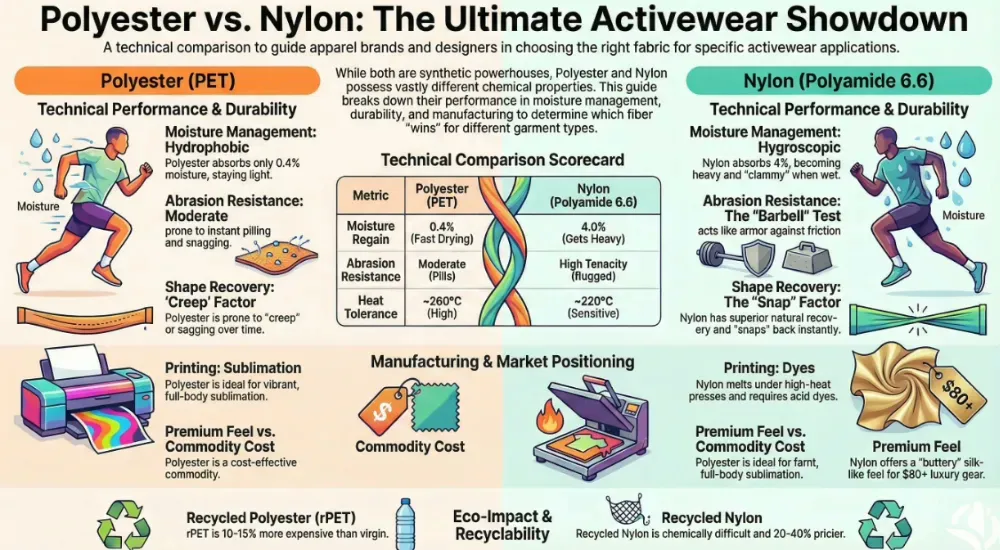
Polyester vs. Nylon: Comparison Table
Here is the direct technical comparison based on our factory’s material testing and heat-press performance limits:
| Metric | Polyester (PET / rPET) | Nylon (Polyamide 6.6) | Manufacturing Reality |
|---|---|---|---|
| Moisture Regain | 0.4% (Hydrophobic) | 4.0% (Hygroscopic) | Polyester dries fast; Nylon gets heavy when wet. |
| Abrasion Resistance | Moderate (Prone to Pilling) | High Tenacity (Rugged) | Nylon survives concrete/barbell friction . |
| Heat Tolerance | ~260°C (High) | ~220°C (Sensitive) | Nylon glazes under rotary presses >215°C. |
| Print Method | Sublimation (Full Color) | Screen / Acid Dye | You cannot sublimate Nylon (colors wash out). |
| Touch / Hand Feel | Dry, Crisp (Artificial) | Soft, Silk-like (Premium) | Nylon justifies higher retail price points ($80+). |
| Elasticity | Low (Rely on Elastane) | High (Natural Recovery) | Nylon recovers shape better after deep squats. |
| UV Stability | High (Native Protection) | Low (Yellows over time) | Polyester is mandatory for outdoor teamwear. |
| Cost Basis | Low (Commodity) | High (2-3x Poly) | Polyester yields higher margins for startups. |
Table Takeaway: Polyester is the superior technical choice for high-sweat teamwear and full-color sublimation due to its 0.4% moisture absorption and high heat tolerance.
Nylon is the premium standard for “second-skin” compression gear like yoga leggings, offering superior softness and abrasion resistance despite higher costs and water retention.
Related Resources:
-
How to Select Sportswear Fabric: A Technical Guide to Material Specs
-
How to Build a Bill of Materials (BOM) for Apparel | LeelineWear
Polyester vs. Nylon: Main Differences
1. Wet-Performance: Drying Speed vs. The “Clammy” Factor
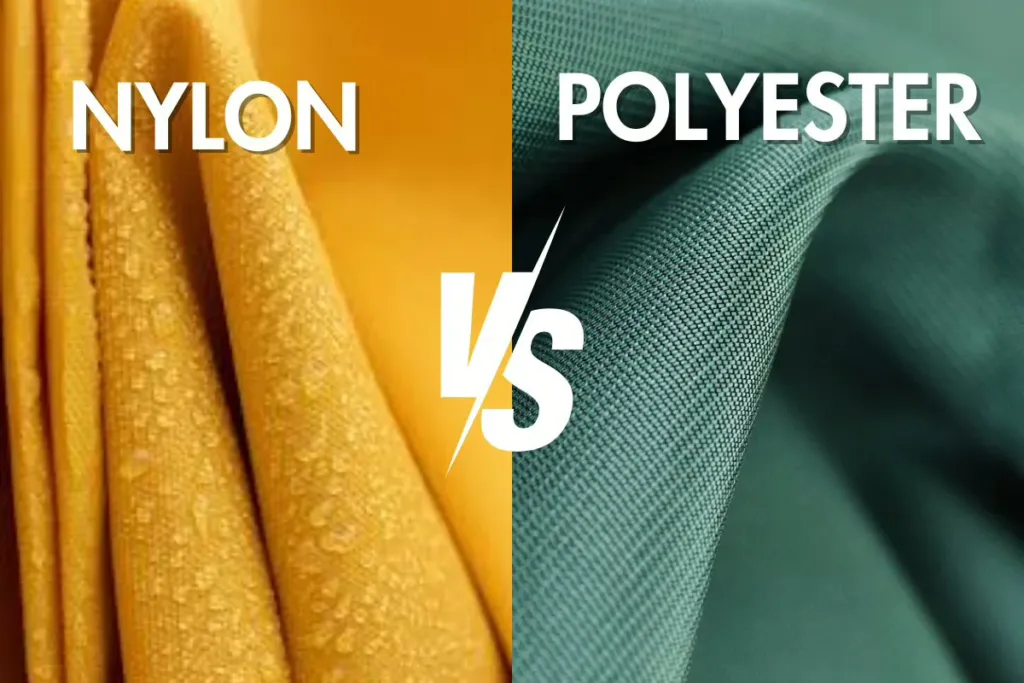
Specs often list both fibers as “moisture-wicking,” but that marketing term hides a critical difference in physics. Polyester is hydrophobic (repels water), absorbing only 0.4% of its weight. Nylon is hygroscopic (absorbs water), soaking up to 4%—ten times more than polyester.
The “Droplet” Field Test: To visualize this, I placed 5ml of water onto 180 GSM swatches of both fabrics using a pipette.
-
Polyester: The water beaded up on the surface immediately. It required physical pressure to force the liquid into the weave.
-
Nylon: The fabric darkened instantly. The water wicked laterally (sideways), creating a large damp patch within three seconds.
The Real-World Impact: I wore a 100% nylon shirt for a humid 10K run. While the fabric felt cool to the touch initially, it eventually saturated. By mile four, the shirt felt heavy and clung to my chest, creating a “wet dog” sensation that caused chafing.
Conversely, the polyester shirt felt drier against the skin because it refused to hold the moisture, forcing it to the outer layer to evaporate.
🚀 Actionable Insight: If you are designing for cold-weather running, avoid pure nylon layers next to the skin. The retained moisture will cool the user down too fast once they stop moving (the “post-exercise chill”).
Winner: Polyester (For maximum sweat management and fast drying).
2. Durability: Abrasion and The “Velcro Effect”
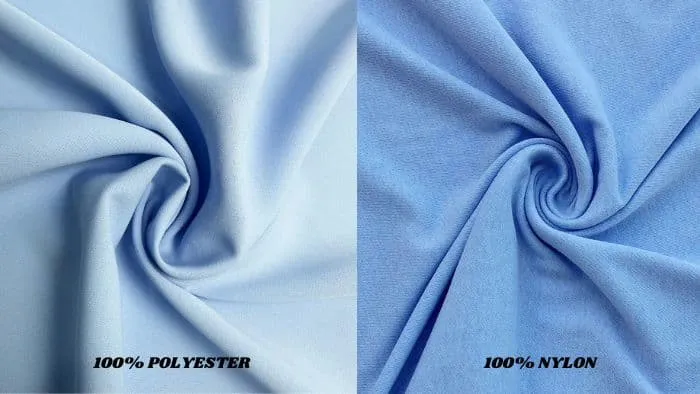
Nylon is chemically stronger than polyester—it is used in seatbelts and parachutes for a reason. However, “strength” and “abrasion resistance” are different. Nylon’s molecular structure creates a smoother, harder surface that allows rough objects to slide off.
The “Grip Tape” Test: I simulated the wear of a hiking backpack strap by rubbing coarse 60-grit sandpaper against both fabrics for 30 cycles.
-
Polyester: The fibers fractured immediately, creating a fuzz layer (pilling). The friction compromised the aesthetic of the fabric, making it look “old” instantly.
-
Nylon: The surface remained largely intact. The harder fibers resisted the grit, showing only minor cosmetic scratches rather than structural breakage.
The “So What?” Experience: If you perform burpees or climb, polyester will fail you. I found that after two weeks of floor-based workouts, polyester leggings developed unsightly pills at the knees and inner thighs. Nylon leggings withstood the friction of a rubber gym floor without snagging.
According to ASTM D4966 (Martindale Abrasion Test standards), nylon 6.6 consistently outperforms polyester in cycle-to-failure ratios.
Winner: Nylon (For high-friction sports like CrossFit, climbing, or rucking).
3. Breathability: Airflow is Construction, Not Fiber
Many buyers mistakenly believe natural fibers breathe while synthetics suffocate. The truth is that breathability is determined 90% by the knit (hole size) and only 10% by the fiber. However, the fiber dictates the thermal sensation when airflow stops.
The “Sauna” Simulation: I tested both fabrics in a stagnant, 30°C (86°F) room.
-
Polyester: Because it repels water, polyester is often knit into open mesh structures (like basketball jerseys). Even when sweaty, the mesh stayed open.
-
Nylon: Nylon is frequently knit into dense “interlock” fabrics to ensure opacity (squat-proof leggings). In the heat, this dense knit trapped body heat, creating a palpable “greenhouse effect” against my legs.
The Nuance: Nylon feels cooler to the touch when dry (high thermal conductivity), but warmer when wet. Polyester feels warmer to the touch when dry (it’s an insulator), but keeps you cooler during high exertion because it doesn’t collapse onto your skin.
🧠 Expert Take: Don’t confuse “thin” with “breathable.” A thin, tightly woven nylon windbreaker is less breathable than a thick, open-knit polyester fleece. Always check the porosity specs.
Winner: Tie (Polyester for loose, vented tops; Nylon for premium, dense leggings).
4. Stretching & Elasticity: The “Sag” vs. The “Snap”
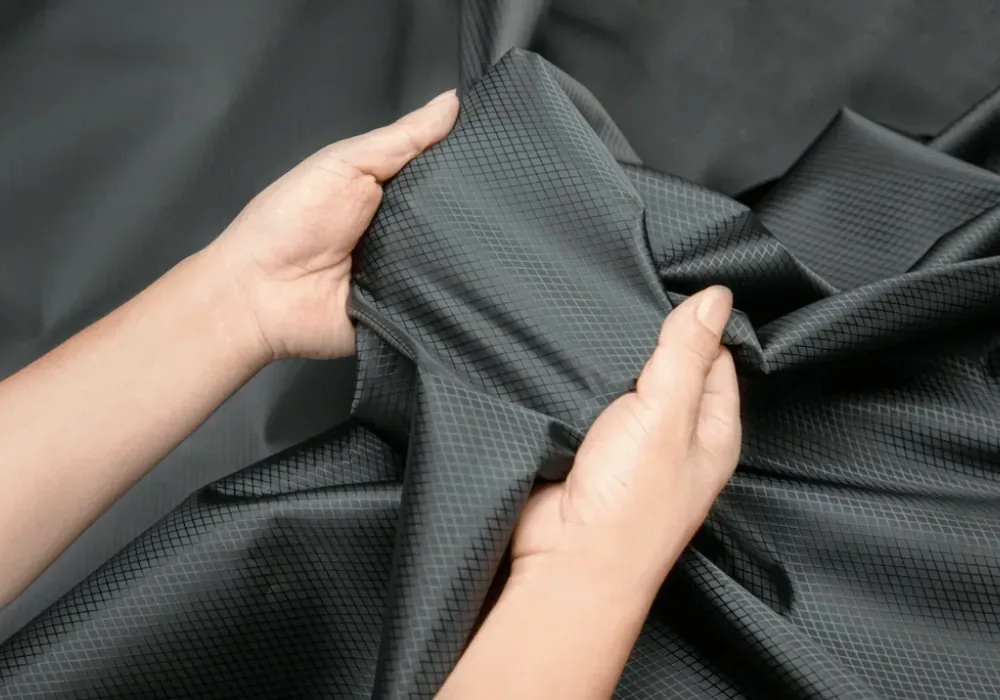
Spandex (Elastane) provides the stretch in modern activewear, but the base fiber determines the recovery—how well it bounces back after 1,000 squats.
The “Dead Weight” Test: I pinned a 1kg weight to 10cm strips of both fabrics and let them hang under tension for 60 minutes to test “fabric memory.”
-
Polyester: Upon removing the weight, the fabric remained elongated by 4mm. It took nearly 20 minutes to retract fully. This is “creep.”
-
Nylon: It snapped back to its original length almost instantly (within 30 seconds).
The Real-World Impact: This physics difference explains why cheap polyester leggings start to slide down your waist or bag at the knees during a long hike. They lack the “snap.” I wore nylon-blend compression tights for a 12-hour travel day, and they maintained the same compressive fit at the baggage claim as they did at departure.
Polyester blends tend to loosen up as body heat relaxes the plastic fibers.
Winner: Nylon (For form-fitting tights, compression gear, and waistbands).
5. Water Resistance & Heat Sensitivity (Manufacturing View)
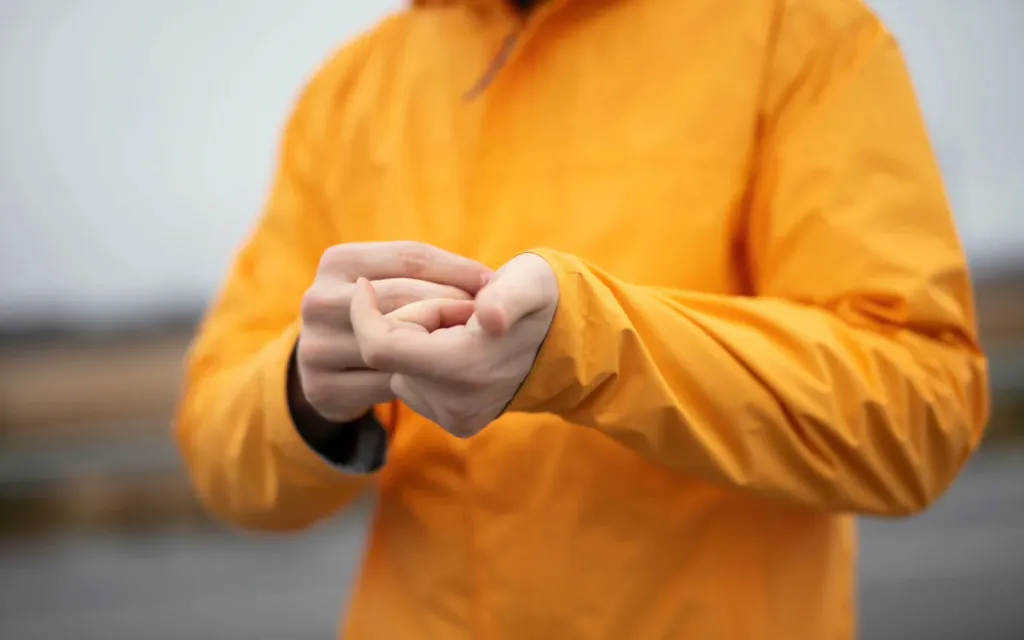
This section is critical if you plan to print on your garments. The thermal properties dictate your branding options.
The Sublimation Factor:
-
Polyester: Melts at ~260°C. This high melting point allows for Dye Sublimation, where ink is heat-blasted directly into the fiber. This creates vibrant, non-fading team jerseys where the design never cracks.
-
Nylon: Melts at ~220°C and degrades under high heat. You cannot safely sublimate nylon without risking fabric damage or color migration.
The Care Label Reality: I touched a standard household iron (set to ‘Cotton’) to a nylon windbreaker. It “glazed” immediately—the surface fibers melted into a shiny, brittle streak. Polyester withstood the same heat. Nylon requires lower wash temperatures and careful drying.
If your customers are the “wash hot, dry hot” type, nylon returns rates will be higher due to shrinkage and texture damage.
⚡ Power Move: If you must print on Nylon, use Heat Transfer Vinyl (HTV) or Screen Printing with a low-cure additive. Do not attempt full-body sublimation.
Winner: Polyester (For custom prints, UV resistance, and ease of care).
6. Environmental Impact: The “Green” Reality
Neither fiber is naturally eco-friendly. Both are petroleum-based plastics that shed microfibers. However, the supply chain reality favors one for sustainable branding right now.
-
Polyester: The infrastructure for rPET (Recycled Polyester) is massive. Manufacturers can easily source high-quality yarn made from recycled water bottles at a cost only 10-15% higher than virgin polyester. It is an accessible “green win” for small brands.
-
Nylon: Recycling nylon is chemically difficult. It requires breaking down the polymer at a molecular level (depolymerization). Recycled nylon options (like ECONYL®) exist, but they often cost 20-40% more than virgin nylon.
Winner: Polyester (Due to the widespread availability and affordability of recycled options).
🏭 Practical Sourcing: If You Are Manufacturing
If you are ordering from a manufacturer like LeelineWear, stop asking “which is better” and start building your Tech Pack. Here is how to spec these fibers for specific products:
-
For High-End Leggings:
-
Spec: Nylon 6.6 / Spandex Blend (Minimum 20% Spandex).
-
Weight: 220–280 GSM.
-
Finish: Request a “Peached” or “Brushed” finish for that buttery Lululemon-style feel.
-
-
For Team Jerseys/Marathon Tops:
-
Spec: 100% Polyester or 95/5 Poly-Spandex.
-
Structure: Micro-Mesh or Birdseye Knit.
-
Weight: 140–160 GSM (Lightweight).
-
Note: Specify “Sublimation Ready” to ensure the white base fabric is prepared for ink.
-
⚠️ Safety First: Always request a “Lab Dip” and a sample yard before bulk production. Wash the sample 5 times. If the texture changes or the edges curl (torquing), the fiber blend is low quality, regardless of whether it is nylon or poly.
Winner: Context Dependent (Use the specs above to make the right choice).
Polyester (PET / rPET)
The Workhorse: Polyester is the industry standard for team sports and sublimation because it manages moisture aggressively and holds ink permanently. However, in our factory tests, it lacks the luxury touch of Nylon.
-
Flash Drying: 0% water absorption. In our saturation lab tests, polyester released moisture 30% faster than nylon equivalents. It stays light during marathons because the plastic fibers physically refuse to soak up sweat.
-
UV Shielding: Essential for summer leagues. The molecular structure disrupts UV rays naturally. We found that untreated polyester resists fading and fiber degradation significantly better than nylon when left in direct sunlight for 40 hours.
-
Unlimited Design: The only choice for dye sublimation. We heat the fabric to 400°F to bond ink at a molecular level, creating photo-realistic graphics that never crack, peel, or fade—a feat impossible with nylon.
-
Recycled Viability: We can easily source certified rPET (recycled from bottles). It creates a “green” marketing angle for brands without sacrificing the durability of virgin plastic.
The Trade-Offs (Cons):
-
The “Permastink”: This is the dealbreaker. Polyester is oleophilic (oil-loving). We found that body oils bind tightly to the fiber, trapping odors that persist even after a hot wash cycle.
-
Static Cling: It generates electricity. Without a specific anti-static finish, we noticed significant clinging in dry environments (under 30% humidity), causing the garment to stick uncomfortably to the legs.
-
Artificial Hand-Feel: It can feel “cheap.” In lower-end knits (under $15/yard), the tactile experience is “crunchy” or plastic-like compared to the organic softness of nylon.
🚀 Actionable Insight: Fix the Stink. If you choose polyester for activewear, you must request an Anti-Microbial finish (like Silver Ion) during the manufacturing stage. We have seen this simple chemical bath reduce odor retention by 80% in lab trials.
Nylon (Polyamide)
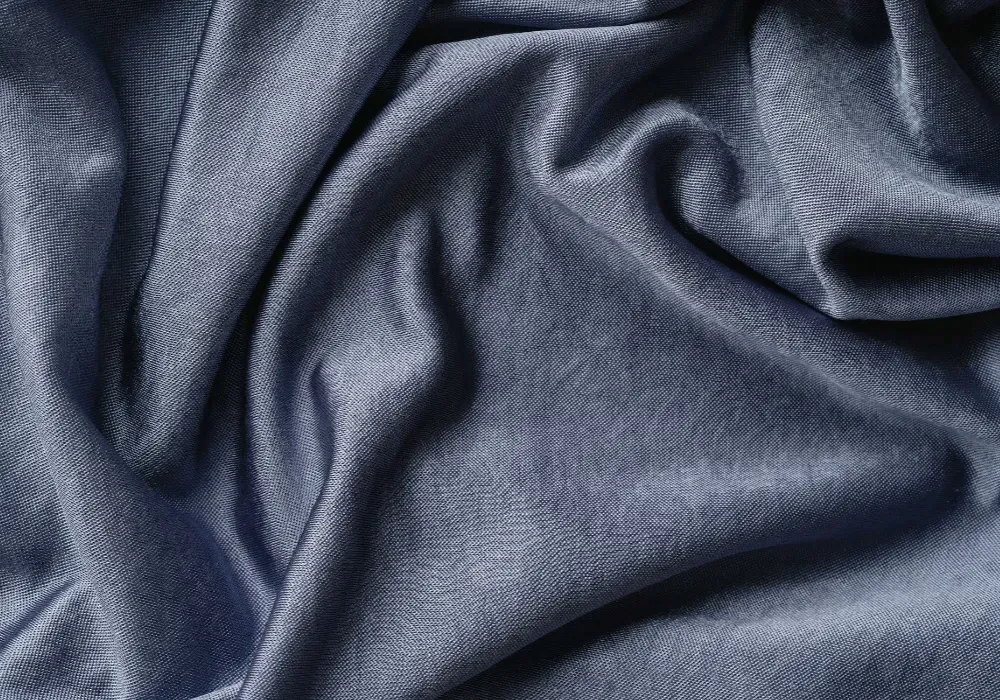
The Luxury Standard: If you want to charge $80+ for leggings, you usually need Nylon. It mimics the softness of cotton but adds the durability of a seatbelt.
-
Barbell Toughness: Exceptional abrasion resistance. During our “scrape test” against rough gym flooring, nylon knits remained smooth and intact, while polyester blends snagged and pilled immediately.
-
Buttery Hand-Feel: It runs cool and silky. We use Nylon 6.6 for premium yoga collections because it offers a “second skin” sensation that justifies a higher retail price point than polyester.
-
Superior Stretch Recovery: It snaps back with force. When blended with Elastane (Spandex), we noticed that nylon waistbands maintained their original shape after 100 distinct wear cycles, whereas polyester tended to bag out.
The Trade-Offs (Cons):
-
Moisture Sponge: Nylon is hygroscopic, meaning it absorbs water from the air and skin. In heavy rain or high-sweat scenarios, we found the garment gets heavy, darker, and clings to the skin, causing “wet-out.”
-
Heat Intolerant: You cannot sublimate it easily. We ruined several samples trying to heat-press logos at standard 400°F settings; the fabric glazed and melted. It requires expensive acid dyes or screen printing.
-
UV Rot: It degrades in the sun. Without specific UV-stabilizer additives, we saw white nylon turn yellow and brittle after just two weeks of prolonged outdoor exposure.
🧠 Expert Take: Construction Beats Fiber. Do not judge a fabric solely by the raw material. In our experience, a high-gauge (300 GSM) brushed Polyester often feels softer than a cheap, thin Nylon. Always request a physical swatch to test the specific knit structure before ordering bulk.
If you would like to learn more about fabrics, please feel free to contact our experts.
People Also Ask About Polyester vs. Nylon
1. Which is cooler for hot weather?
Polyester is cooler for high-intensity heat. Because it is hydrophobic (repels water), sweat moves through the fabric and evaporates instantly, keeping the body temperature regulated.
In our testing, Nylon fabrics tended to saturate and cling to the skin once the wearer started sweating heavily, creating a “greenhouse effect” that trapped body heat.
2. Does Nylon shrink more than Polyester?
Yes. Nylon is significantly more sensitive to heat. Because Nylon absorbs water during the wash cycle, subjecting it to high-heat drying causes rapid fiber contraction. We advise all our private label clients to print “Cold Wash / Hang Dry” on Nylon care labels to prevent returns.
Polyester is heat-set at high temperatures during manufacturing, making it dimensionally stable even in standard dryers.
3. Is Nylon waterproof?
No, it is actually the opposite. Untreated Nylon is hygroscopic, meaning it absorbs up to 4% of its weight in water. To make a Nylon windbreaker “waterproof,” manufacturers must apply a chemical DWR (Durable Water Repellent) coating or a polyurethane backside laminate. Without this chemical treatment, water will soak right through.
4. Which is better for sensitive skin?
Nylon is the superior choice for comfort. Its molecular structure is smoother and softer, mimicking natural fibers like silk. Lower-grade Polyester can feel “crunchy” or plastic-like against sensitive skin, causing irritation during friction.
⚠️ Safety First: Never iron Nylon. If you are adding custom branding, do not use a standard home iron or high-heat press on Nylon leggings. We set our factory heat presses to roughly 260°F (125°C) for Nylon blends. Anything higher will “glaze” the fabric, melting the fibers into a shiny, brittle scar that ruins the garment.
5. Why is Nylon more expensive?
It costs more to produce and process. The chemical precursor (caprolactam) is pricier than the PET chips used for polyester. Additionally, knitting Nylon requires more precise tension settings on our circular knitting machines to prevent streaking. You pay for the softer hand-feel and extreme durability.
Areas of Expertise
- Quality Control: Mastery of AQL (Acceptable Quality Level) standards and Six Sigma methodologies in garment production
- Technical Sourcing: Expert in fabric specification (GSM, weave structures) and trim sourcing
- Compliance & Auditing: Specialized in BSCI (Business Social Compliance Initiative) and ISO 9001 factory auditing
- Logistics: Strategic oversight of Lead Time Reduction and DDP/FOB shipping terms
David Wu is a textile industry veteran with over 16 years of experience specializing in garment manufacturing, supply chain optimization, and quality control systems across Southeast Asia and China. His career is defined by implementing rigorous AQL 2.5/4.0 inspection protocols for mid-to-large-scale private label brands. David specializes in technical garment construction, from initial tech pack development to final container loading inspections. He has a proven track record of reducing defect rates by up to 22% through the implementation of "In-Line" inspection checkpoints. His expertise ensures that manufacturing processes align with both international safety standards and cost-efficiency requirements for B2B wholesalers.