10 US Yoga Apparel Manufacturers for Lower MOQs and Faster Reorders
 David Wu QA Consultant
Most “best yoga brands” posts are written for shoppers. This one is written for the person who has to place the order, and it covers yoga only.
For general US activewear capacity, see the US sportswear manufacturing shortlist. For non-yoga private label, see the private-label activewear list. Neither page covers the yoga-specific construction points below.
Every company here was checked in November 2026 against its own published pages and public records: location, service model, published minimum, and lead time. Company figures are labelled. Where a supplier publishes no number, the table says so.
Ranking rule: all ten entries are manufacturers or production partners that accept an order. Retail brands and blank-and-relabel suppliers are excluded, because they cannot take a custom yoga line.
📌 TL;DR: BOMME Studio publishes a 150-unit CMT minimum in Los Angeles. TEG runs the lowest published studio minimum at 10–50 pieces per style. Euphoric Colors has no studio minimum for runs up to 50. For a first run under 100 pieces, start with TEG or Euphoric Colors.
The Shortlist at a Glance
| Company | Location | Model | Published minimum | Lead time |
|---|---|---|---|---|
| BOMME Studio | Los Angeles, CA | CMT (client supplies fabric) | 150 / style | 6–8 wks after materials |
| The Evans Group (TEG) | Los Angeles, CA | Full-package, studio tier | 10–50 / style | 4–8 wks |
| Euphoric Colors | Los Angeles, CA | Cut-and-sew, garment dye | No studio minimum (runs ≤50 / style) | 30–45 days |
| Essentials Made | Los Angeles, CA | Cut-and-sew, development | 72 / style (capsule) | 6–7 wks total |
| Plucky Reach | Los Angeles, CA | Consultancy + partner factories | 100 / style / colorway | 5–7 wks |
| Nikibiki | Vernon, CA | Seamless knit, wholesale | Not published | Confirm by email |
| PuraKai | South El Monte, CA | In-house cut-and-sew | Not published | Confirm by email |
| MFG Merch | Jacksonville, FL | Cut-and-sew + decoration | Quote-based | Confirm by email |
| ARGYLE Haus of Apparel | San Fernando, CA | Full-package | 300+ / style | Per order |
| Griffin Manufacturing | Fall River, MA | Full-package, multi-country | Quote-based | Confirm by email |
The Real Cost of a USA Yoga Run
Before the list, get the economics straight, because minimums are only half of your decision.
- Development and sampling: BOMME Studio publishes development fees of about $800 to $2,500 per style, waived at 600+ units. TEG bundles development across 2 to 15 styles. Either way, sampling is paid work, not a free preview.
- Cut-and-sew unit price: BOMME’s own estimate for a brushed legging made in LA is roughly $22.40 to $30.80 per unit, against $14 to $21 for full-package production in Vietnam.
- The fabric floor: a custom dye lot can require 500 yards per color, roughly 300 to 400 garments. That number can sit above the factory’s own minimum.
- Add-ons: woven labels, hangtags, poly bags, and freight are often quoted separately. Ask for an all-in landed cost per unit.
- Private-label scope: confirm whether the quote covers full cut-and-sew, CMT with client fabric, or label sewing on a stock blank. The three are priced very differently.
💡 Pro Tip: Price two quotes, one at 100 pieces and one at 500. The gap shows whether the factory wants pilot work or volume work, and it usually predicts how a reorder will be priced. For the negotiation itself, see how to negotiate MOQs with clothing manufacturers.
1. BOMME Studio — Best Yoga-Specific Factory With a Published LA Minimum
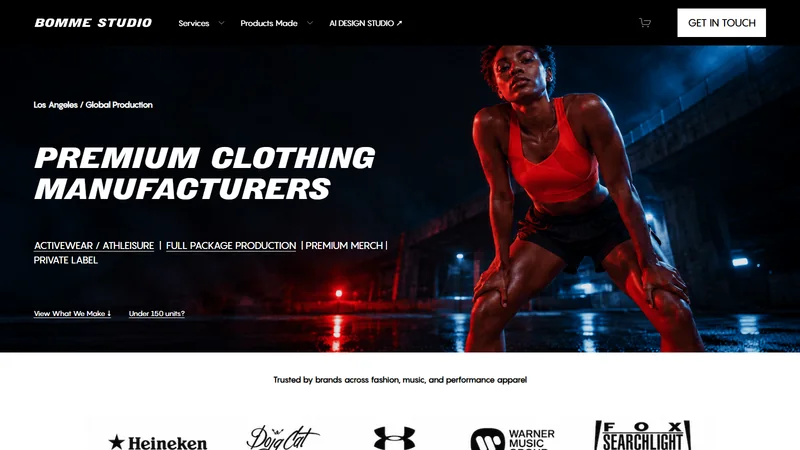
Most entries on this list make activewear. BOMME Studio makes yoga wear, and it is the only entry that publishes a Los Angeles cut-make-trim minimum: 150 units per style.
Documented (November 2026): Los Angeles · founded 2015 by Bo Metz · CMT minimum 150 units per style with client-supplied fabric, two colors or prints included, sizes XS–XL · cutting and QC in LA, sewing in LA or at an audited Tijuana facility disclosed in writing per program · full-package starts around 600 units per style in Vietnam or Korea · 6–8 weeks after materials, development 4–8 weeks.
The 150-unit tier is CMT, not turnkey. The brand brings the fabric, and on a yoga legging the fabric is the product. That is an advantage for a brand with a mill relationship, and a liability for a founder starting from zero.
Have the sewing facility named in your CMT agreement, in writing. Require a flatlock and gusset sample. Yoga is a high-movement garment, and a general activewear sample will not prove the crotch seam.
🛡️ Our Verdict: The strongest fit for a yoga-only brand at 150+ pieces that already owns its fabric.
⚡ Power Move: Secure the CMT agreement with the sewing country named, plus flatlock and gusset samples, before paying for development.
2. The Evans Group (TEG) — Best for 10–50 Unit Studio Runs
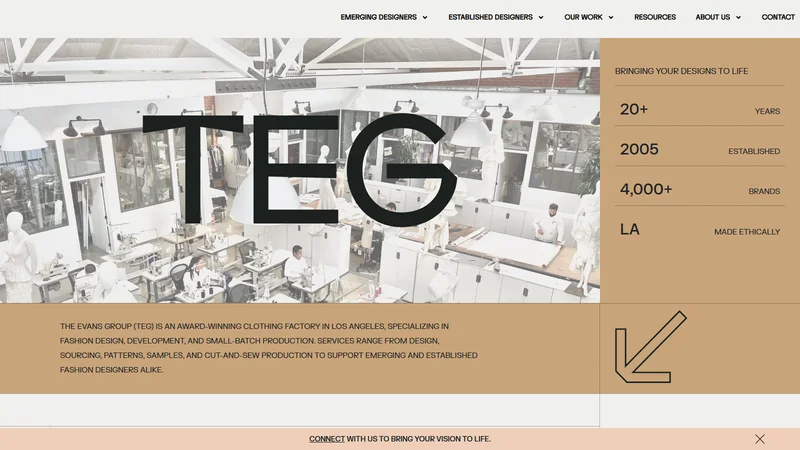
To prove a design before committing capital, TEG is the shortest path in the United States. The Arts District house runs a Studio Level tier at 10–50 pieces per style, cut in-house.
Documented (November 2026): Downtown LA Arts District · founded 2005 by Jennifer Evans · Studio Level 10–50 pieces per style in-house, factory tiers at 50–100, 100–300, and 300+ · design, pattern, sample, grading, and cut-and-sew in-house · studio production 4–8 weeks, rush 1–4 weeks with a fee · CFDA-listed activewear categories include flatlock activewear, bra tops, and dance and exercise wear.
TEG is a broad-spectrum house, not a yoga specialist. Industry roundups make the same point: it also produces eveningwear and tailored garments, so confirm performance-knit handling before you send stretch fabric.
The tech pack therefore has to carry the yoga-specific requirements — flatlock seam, gusset, and opacity at 4-way stretch — rather than relying on the factory to know them.
🛡️ Our Verdict: Best entry point for a 10–50 unit proof run, provided the yoga-specific specs are written into the tech pack.
⚡ Power Move: Book the Studio Level tier for a single legging, and get the patternmaker’s name and the exact flatlock machine used on the sample.
3. Euphoric Colors — Best for No-Minimum Studio Sampling
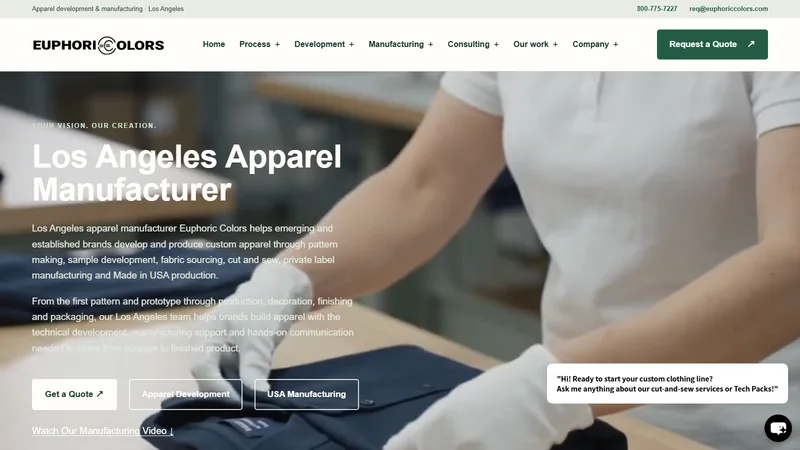
Euphoric Colors sets no studio minimum for runs up to 50 pieces per style, then moves to a factory tier around 50 pieces per style.
Documented (November 2026): Los Angeles · studio production with no minimum up to 50 pieces per style, factory-level minimum around 50 pieces per style · cut-and-sew, private label, and garment dyeing · sampling and pre-production samples 7–14 days, bulk 30–45 days after approval.
Garment dyeing is the differentiator. A cotton yoga set dyed as a finished garment gets a softer, more broken-in handfeel than piece-dyed fabric, and it hides shade variation across a small run.
The catch: custom fabrics, specialty trims, and unusual colors can raise the minimum. Identify which of the three components is off-the-shelf and which is custom before designing a dye lot.
🛡️ Our Verdict: Strong for a first sample set and a 50-piece test, especially for garment-dyed cotton rather than a performance knit.
⚡ Power Move: Send three color targets, check which are stock, and price the 50-piece run in a stock color before committing to a custom dye.
4. Essentials Made — Best LA Cut-and-Sew Option for Cotton Yoga Sets
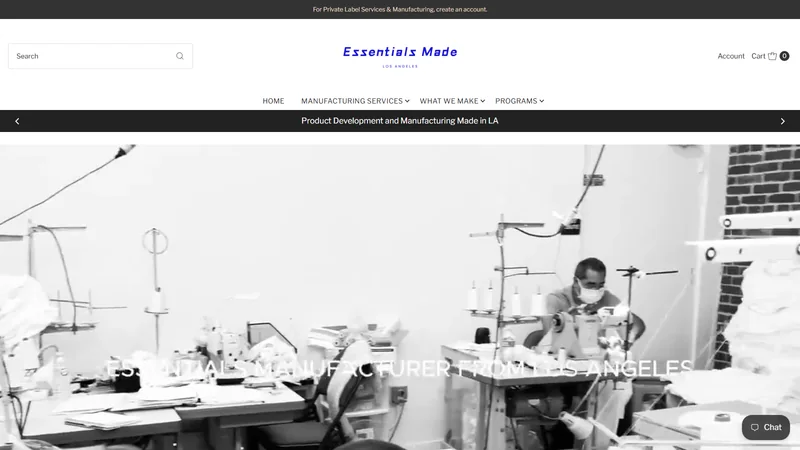
Your customer reads every fabric tag, and the word “polyester” kills the sale. Essentials Made fills a gap most factories skip: a custom cotton program developed per order, not pulled off a blank rack.
Documented (November 2026): Downtown LA Arts District, 1330 S Santa Fe Ave · full-service cut-and-sew, pattern making, and garment dyeing · separate cotton/spandex activewear program covering yoga sets, leggings, sports bras, and crop tops · capsule minimum 72 pieces per style, with at least two styles sharing a fabric and dye lot · samples about 2 weeks, production 4–5 weeks.
Capacity is the first gate. These runs stay small by design. For 2,000 units a season, get a dated production schedule, not a verbal yes.
The organic claim needs care. Essentials Made’s core output is 100% cotton garment-dyed fleece and jersey; its activewear is cotton/spandex. Organic cotton appears in specific client collections, but a company-wide organic certification is not published, so collect the mill certificate per lot.
Cotton-spandex has poorer stretch recovery than nylon-spandex and shrinks more. Test recovery after repeated washes, opacity in a deep squat, and pilling under abrasion. Strong for restorative and lifestyle sets; wrong for hot vinyasa.
🛡️ Our Verdict: Best fit for cotton and cotton-spandex yoga sets at small-batch scale, provided organic certification and recovery data are confirmed in writing.
⚡ Power Move: Collect the wash-recovery report and the organic certificate for the exact fabric lot before sample approval.
5. Plucky Reach — Best for Full Private-Label Pilots at 100 Pieces
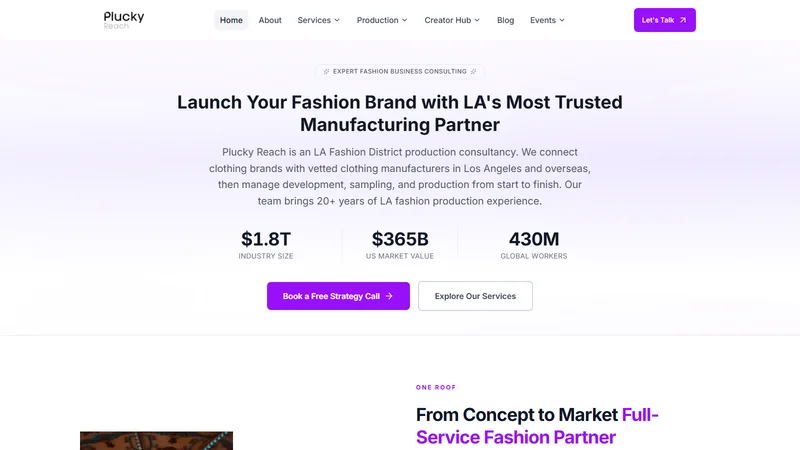
Plucky Reach quotes roughly 100 pieces per style and colorway for activewear. That sits between a sample room and mass production, and for many founders it is the first tier that looks like a real order.
Documented (November 2026): LA Fashion District · production consultancy placing work with partner LA cut-and-sew factories · activewear minimum 100 pieces per style and colorway, general cut-and-sew from 50 per style · 5–7 weeks from an approved sample · full private label including woven labels, hangtags, and retail packaging.
Read the model carefully: Plucky Reach is a consultancy, not a sewing floor. The team matches a tech pack to a factory, which helps, but quality depends on which partner runs the order.
Before payment, verify four things: yoga leggings and sports-bra production, flatlock or gusset construction, pattern-development support, and written capacity to scale if the test sells through. Have the cutting-and-sewing factory named in writing.
🛡️ Our Verdict: Useful for a domestic pilot with a real MOQ floor, but lock the production partner and construction details in writing.
⚡ Power Move: Ask for a 100-piece leggings-and-bra quote with flatlock and gusset specs, plus the 500-piece tier, in one email.
6. Nikibiki — Best for Seamless Bottoms and Fast Reorders
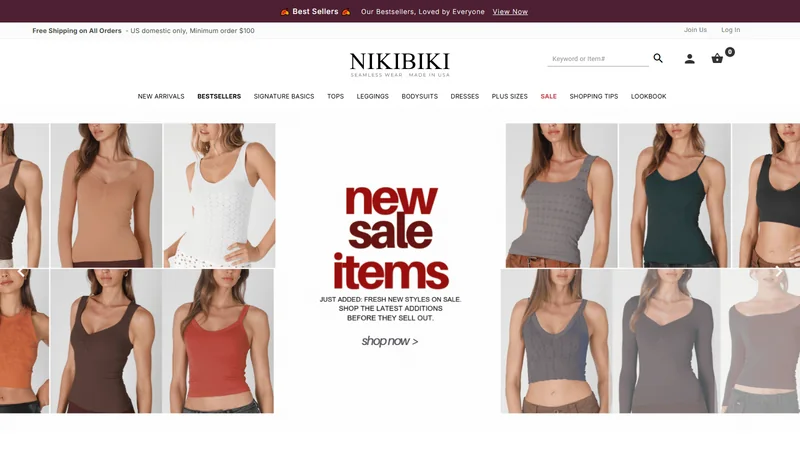
Seamless knitting often means an overseas commitment measured in hundreds of units per color. Nikibiki removes that barrier. The company has knitted seamless women’s apparel in Los Angeles since 2001, and its factory sits at 2141 East 52nd Street in Vernon, next to downtown LA.
Documented (November 2026): Vernon, CA · seamless knitwear since 2001 · 70+ Santoni SM-TOP2S circular knitting machines · company-cited capacity up to 32,000 pieces per day · 92% nylon / 8% spandex on its seamless leggings.
Seamless construction removes side seams. That improves stretch and comfort on high-waist yoga pants. The trade-off is limited customization: the choice is confined to the existing color card and fit blocks.
True cut-and-sew private label is off the table. This is ready-style adaptation, where a label is added but the pattern and fabric blend stay fixed. The wholesale minimum is not published, so treat this as a ready-style source, not a low-minimum promise.
🛡️ Our Verdict: Ideal for a fast, low-risk USA-made test run where speed beats full design control. Confirm label placement, color availability, and the wholesale minimum before ordering.
⚡ Power Move: Request the current color card and a production slot in the same email. Seamless capacity tightens in Q4.
7. PuraKai — Best for GOTS Organic-Cotton Leggings
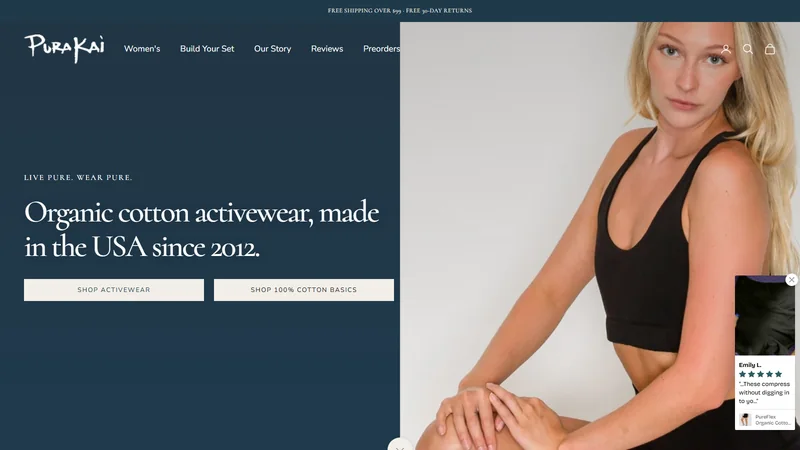
Want organic-cotton leggings with a tighter local supply story? PuraKai fits that brief, and it publishes more of its supply chain than most brands this size.
Documented (November 2026): San Diego HQ at 12526 High Bluff Dr, Ste 300 · factory in South El Monte, CA · licensed California garment manufacturer GA-LR-1001309619 · PureFlex leggings at 92% GOTS-certified organic cotton / 8% spandex · designed, patterned, sampled, cut, sewn, and packed in its own South El Monte facility · knitting and garment dyeing by LA partners.
The supply-chain detail is the point. Material is knitted and dyed by LA partners, and garment production stays local, so the local-production claim covers more than the label stitch.
Treat PuraKai as an eco-led assortment play, not a compression program. Organic cotton feels soft, but it lags nylon-spandex on recovery and sweat performance. Specify MOQ by color, stock-concept limits, and whether pattern, rise, or blend can change, in writing.
🛡️ Our Verdict: Strong storytelling fit. Before briefing a custom legging, ask for a wash-recovery report and a written MOQ.
⚡ Power Move: Collect the GOTS scope certificate and the fabric weight in GSM, then compare both against the recovery target.
8. MFG Merch — Best for Full-Package Cut-and-Sew With Decoration
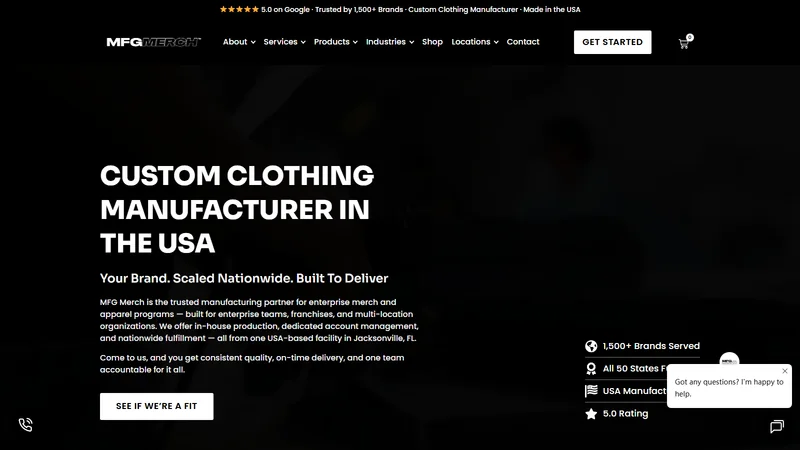
Can one supplier cut, sew, label, and ship a yoga set without handing your order to three vendors? That is the shortlist test this guide applies. MFG Merch runs an in-house cut-and-sew operation from Jacksonville, Florida, and covers sublimation printing and embroidery under the same roof.
Documented (November 2026): 240 Talleyrand Ave, Jacksonville, FL · operating since 2012 · in-house cut-and-sew plus sublimation listed for leggings and jerseys · company site cites about 25,000 units filled per month · its own FAQ states order quantities vary by product type and design setup, with smaller runs possible on some items.
The minimum is quote-based, not published, so the number depends on the design and materials chosen.
Full-package support matters most on coordinated sets. A leggings-and-bra run needs one team owning fit consistency, fabric lot matching, and label placement. Split that across a knitter, a cut-and-sew shop, and a printer, and the brand owns every failure in between.
The business is built around custom apparel and corporate merchandise programs. A dedicated private-label activewear program is not spelled out on the public site, so confirm the scope in writing. Buyers marketing the result as Made in USA should also check the claim against the FTC Made in USA standard.
🛡️ Our Verdict: Strong candidate for coordinated sets where decoration and label work sit in the same building, provided sewing depth and private-label scope are confirmed before a purchase order.
⚡ Power Move: Request peak-season sample cadence, in-house flatlock and coverstitch confirmation, and the name of the person who signs the inspection report.
9. ARGYLE Haus of Apparel — Best for 300+ Unit Programs
At 300 pieces per style, ARGYLE Haus of Apparel is the first entry on this list that behaves like a conventional production house. That suits a pilot that already sold through.
Documented (November 2026): 429 Jessie St, San Fernando, CA 91340, with a Downtown LA showroom · activewear minimum starting at 300 pieces per style · design, prototyping and sampling, bulk manufacturing, labels and hangtags, sourcing, QC, and grading · lead time quoted per order.
ARGYLE is built for a brand with a validated design and a need for a real production run. At that volume, expect a written spec review, a graded size set, and a pre-production sample before bulk.
Two questions separate a 300-unit house from a pilot shop: What is the reorder lead time once a pattern is on file? Will the same factory run the reorder, so color and fit stay consistent across seasons?
🛡️ Our Verdict: Right choice once demand is proven and volume is needed at predictable quality. Too heavy for a first sample.
⚡ Power Move: Lock the reorder clause and the on-file pattern policy into the same document as the quote.
10. Griffin Manufacturing — Best East Coast Full-Package Option
A team on the East Coast is closer to Fall River than to Los Angeles, and Griffin Manufacturing has run full-package athletic production from that building for decades.
Documented (November 2026): 502 Bedford St, Fall River, MA · 125,000 sq ft headquarters and working factory · full-package projects managed from Fall River and placed in the appropriate factory in the USA, Costa Rica, or Asia · past production for Reebok, Champion, and Timberland, and yoga apparel for YOGASMOGA · design, cut, sew, embroidery, and warehousing in house.
The multi-country model is the main thing to pin down. A factory that can place a run in Massachusetts, Costa Rica, or Asia offers a cost ladder, but the country of manufacture changes the labelling and the lead time.
If Made in USA is a brand promise, write the production country into the purchase order before printing a single tag. Then check the claim against the same FTC standard.
For a broader domestic comparison, see the U.S. clothing manufacturer shortlist.
🛡️ Our Verdict: Strong East Coast full-package partner with real athletic pedigree, but the production country must be contractually fixed.
⚡ Power Move: Write the country of manufacture into the purchase order for the specific style, plus the lead time for each of the three options.
A Buyer’s Checklist for U.S. Yoga Apparel Manufacturers
The ten entries above give a starting point. The checks below decide which one fits a given program.
Method note: Every published number in this article was checked against the company’s own site or public records in November 2026. Where a supplier does not publish a figure, this article says so rather than guessing. The fact-checking process and editorial policy explain how corrections are handled.
1. Yoga-Specific Technical Checkpoints
Yoga leggings fail in predictable places: seams, crotch, stretch, opacity, and fabric weight. These are the specs a procurement team must check.
- Flatlock stitching: This seam sits flat against the skin and reduces chafing in high-movement poses. Order a seam sample and run your thumb along it. If it feels raised, reject it.
- Gusset construction: A diamond or triangle gusset adds fabric at the crotch, improving comfort and reducing seam stress. Specify the gusset pattern.
- 4-way stretch: Fabric must stretch lengthwise and crosswise and return to shape. Pull a swatch both ways.
- Recovery: This measures how well the fabric bounces back. A 10-cycle home-laundry test to AATCC TM135 tracks shrinkage and growth; a stretch-recovery test to ASTM D2594 grades bounce-back. Reject any lot that keeps stretching.
- Squat-proof opacity: Do a squat test under bright light, and ask for a measured opacity figure at 4-way stretch rather than a verbal assurance.
- Target GSM: Compression leggings commonly sit at 220–280 GSM; lighter studio leggings at 180–220 GSM. Lower GSM risks see-through fabric; higher GSM feels stiff and hot.
2. Factory-Vetting Checklist
Before paying a deposit, ask these five questions.
- Tech-pack requirements: Is a full tech pack required, and can the factory help build one? A sketch-only intake leaves fit and construction to guesswork.
- Sample workflow: How many rounds are included, and what is the turnaround per round? Put it in writing.
- Inspection standard: Verify the AQL level used for final inspection (the sampling scheme is ISO 2859-1), and ask who signs the report.
- Finished-garment testing: Does the factory test shrinkage, colorfastness, and recovery? Insist on the reports.
- Compliance documents: For skin-contact fabric, request OEKO-TEX Standard 100. Match recycled-content or U.S.-origin claims to the right certificate, and collect lot numbers before sample approval. The FAQ below covers the rest.
3. Action Paths by Buyer Type
Startup pilot run: Start at the lowest published tiers: TEG, Euphoric Colors, then Essentials Made’s capsule tier. For the commercial terms behind a first run, see the private-label program for emerging brands. Approve the sample against the technical checkpoints above, and do not skip the squat test.
Growing private-label brand: Move to the 100–150 piece tier: Plucky Reach or BOMME Studio. For boutique-scale positioning and trims, see the boutique sportswear sourcing model. If you need reorders in under six weeks, stay domestic. With a six-month plan, overseas can save 20 to 30% per unit, so run both quotes side by side.
Established brand: Use a hybrid approach. Keep a U.S. partner for fast replenishment and source bulk orders overseas. LeelineWear manufactures yoga apparel in China and can quote an overseas or hybrid program alongside domestic quotes.
Commercial disclosure: LeelineWear is a sportswear manufacturer in China. It is not on the list above, and no U.S. factory paid for placement here.
USA Yoga Apparel Manufacturing FAQs
What MOQ should I expect from a USA yoga apparel manufacturer?
Expect anything from 10 to 300 pieces per style, depending on the model. TEG publishes 10 to 50 pieces per style at studio level.
Euphoric Colors runs no studio minimum for up to 50 pieces per style. Essentials Made starts at 72 per style on its capsule tier.
Plucky Reach quotes 100 per style and colorway for activewear, and BOMME Studio 150 per style for CMT in Los Angeles. Nikibiki, PuraKai, MFG Merch, and Griffin do not publish a single number, so ask for one in writing.
Is domestic manufacturing worth the higher unit cost?
Yes, if you value reorder speed and risk. U.S. cut-and-sew unit costs commonly run 20% to 30% higher than overseas. But domestic work avoids 30 to 45 days on the water, customs delays, and large inventory bets. Compare total landed cost, not sticker price.
What stitch type is best for yoga leggings?
Flatlock is best for high-movement seams. It lies flat against the skin and reduces chafing.
Ask for a flatlock seam sample and check that it sits smooth, not raised. Coverstitch is common on hems, but flatlock handles the crotch and inner-leg seams better. On a flatlock machine, a one-notch feed error can twist the leg, so judge the sample.
What certifications should I ask for?
Ask for OEKO-TEX Standard 100 for skin-contact fabrics.
Ask for GRS or RCS with lot-level transaction certificates if you market recycled content. For U.S. production claims, check the FTC Made in USA standard. For inspection, confirm the factory’s AQL level. Collect certificates before sample approval, because missing lot numbers stall retail compliance.
Do I need a tech pack before requesting quotes?
A rough quote is possible with a reference sample and a sketch, but production needs a tech pack. A tech pack sets measurements, fabric, stitch type, and label placement. Without one, quotes vary and factories guess. Ask whether they help build tech packs; a factory that accepts only a sketch is a red flag.
Ready to shortlist a factory? Send a tech pack or reference sample to the team.
Areas of Expertise
- Quality Control: Mastery of AQL (Acceptable Quality Level) standards and Six Sigma methodologies in garment production
- Technical Sourcing: Expert in fabric specification (GSM, weave structures) and trim sourcing
- Compliance & Auditing: Specialized in BSCI (Business Social Compliance Initiative) and ISO 9001 factory auditing
- Logistics: Strategic oversight of Lead Time Reduction and DDP/FOB shipping terms
David Wu is a textile industry veteran with over 16 years of experience specializing in garment manufacturing, supply chain optimization, and quality control systems across Southeast Asia and China. His career is defined by implementing rigorous AQL 2.5/4.0 inspection protocols for mid-to-large-scale private label brands. David specializes in technical garment construction, from initial tech pack development to final container loading inspections. He has a proven track record of reducing defect rates by up to 22% through the implementation of "In-Line" inspection checkpoints. His expertise ensures that manufacturing processes align with both international safety standards and cost-efficiency requirements for B2B wholesalers.