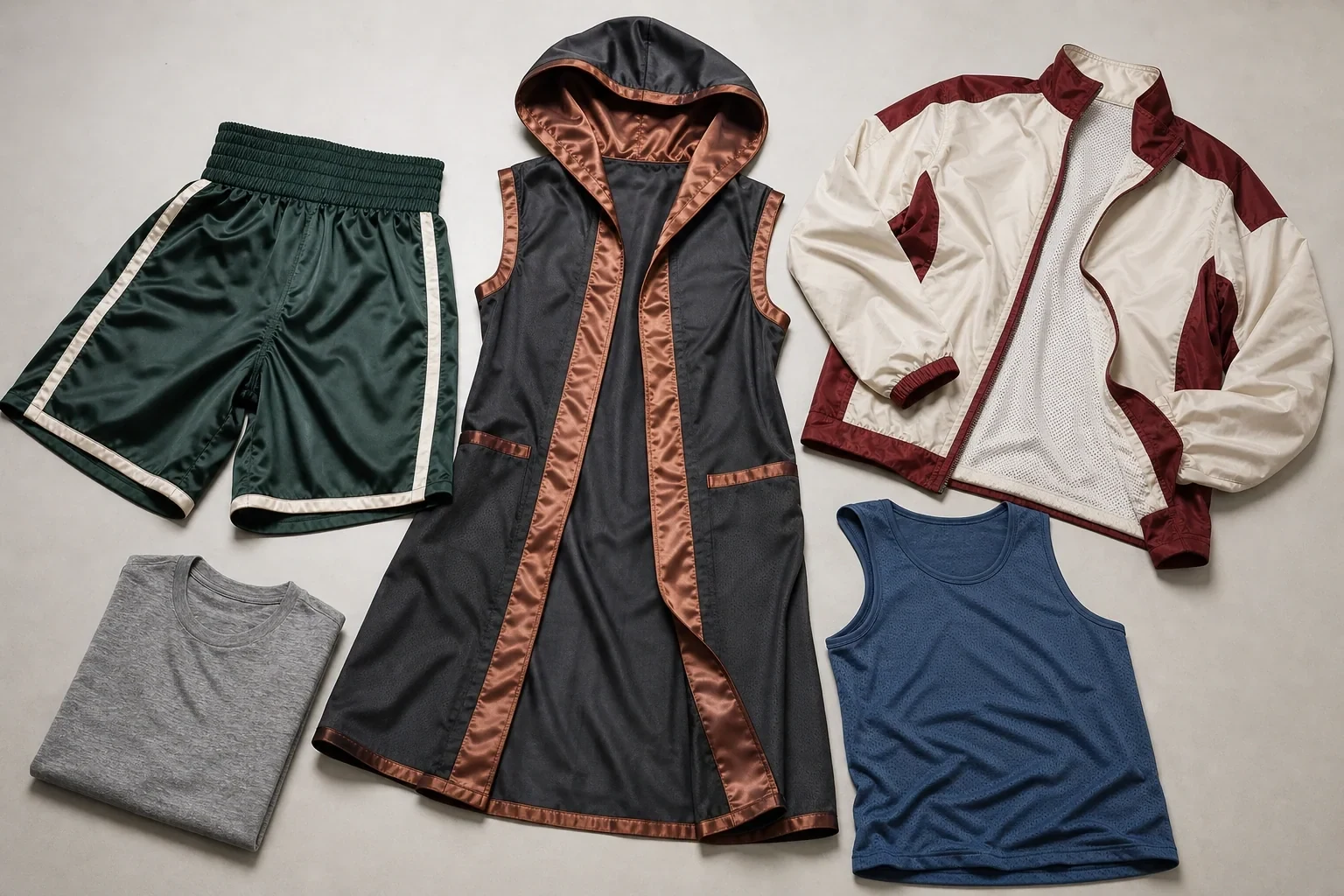
In short: Boxing apparel splits into six core silhouettes you can source, spec, and scale: professional trunks, walkout robes and corner jackets, competition sets and team uniforms, compression layers and rash guards, hybrid MMA shorts, and training basics. Each has its own spec baseline, failure mode, and compliance risk — and on trunks, the waistband decides whether the garment survives the ring.
| Garment type | Best for | Spec baseline | First failure point |
|---|---|---|---|
| Professional trunks | Hero SKU and fight-night programs | 3 in elastic minimum; 80% stretch, 95% recovery | Waistband roll and recovery loss |
| Walkout robes and corner jackets | Broadcast and event branding | High-density performance satin; double-layer hood | Embroidery registration and shade drift |
| Competition sets and team uniforms | Clubs, federations, events | Predominantly red or blue; contrasting 5–10 cm belt band | Color, length, and marking compliance |
| Compression layers and rash guards | Training and crossover lines | 160–230 GSM four-way stretch | Underarm seam chafe and recovery loss |
| Hybrid MMA shorts | Cross-training bridge SKU | 160–200 GSM nylon-spandex; gusseted crotch | Drawcord pull-out and hem sag |
| Training tanks, tees, and warm-ups | Volume and reorders | 140–180 GSM tank; 160–200 GSM tee | Print fade and seam bulk |
Most fightwear articles rank gear for athletes. Procurement teams need boxing apparel types they can source, spec, cost, and scale.
I spent two months comparing six core silhouettes. I checked fabric performance, seam construction, compliance risk, decoration options, MOQ realities, and factory QC feedback. Production details, not design, exposed the real gaps.
Start with our sportswear fabrics guide for the material baseline, review the custom boxing apparel manufacturing capabilities, then use the LeelineWear homepage as your sourcing reference.
1. Professional Boxing Trunks
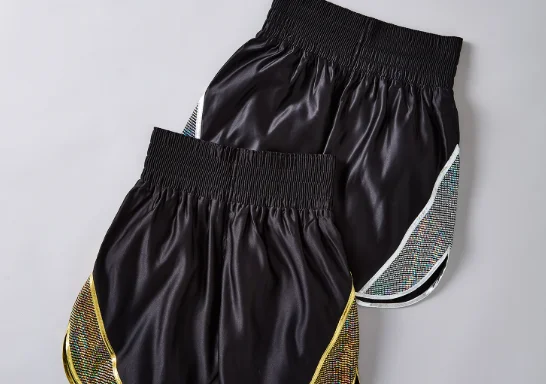
A boxing trunk can pass sample review and fail in the ring. The waistband is why. I have seen a trunk roll during sparring because the elastic was too narrow. That is a spec problem.
Pro trunks are the hero SKU for any boxing line. Classic loose leg, deep side slits, visual beltline. The waistband decides performance.
I asked Zhang Wei, our Lead Textile Engineer, what buyers miss.
Waistband construction? “Use extra-wide elastic, 3 inches minimum. Four inches for heavyweights. Needs 80% stretch and 95% recovery. Below 90% recovery, it sags after one wash.” We verify that on ASTM D2594.
Mechanical stretch panels? “Add them at the hip gusset when the shell is non-stretch. Without them, stiff satin restricts hip rotation.”
Poor waistband spec? “A narrow or stiff waistband digs into the iliac crest. It limits hip rotation and causes rolling. I have seen waistbands roll over during a clinch.”
LeelineWear’s Verdict: We reject any trunk that fails our 500-cycle stretch test or rolls after 30 minutes of ring simulation.
Procurement checklist: lock these before sampling:
- Shell: polyester satin or performance satin
- Elastic width: 3 inches minimum
- Waistband height: 2.5–3 inches exposed
- Slit depth: 6–8 inches
- Lining: polyester mesh or tricot
- Decoration: sublimation on performance satin only; screen print on satin cracks
- Tech pack fields: elastic type, stretch/recovery, slit depth, attachment method
Start with our sportswear fabrics guide, then lock the sportswear tech pack before sampling.
🚀 Actionable Insight: Lock elastic width, recovery, and slit depth in the tech pack before you approve sampling.
2. Boxing Robes and Corner Jackets
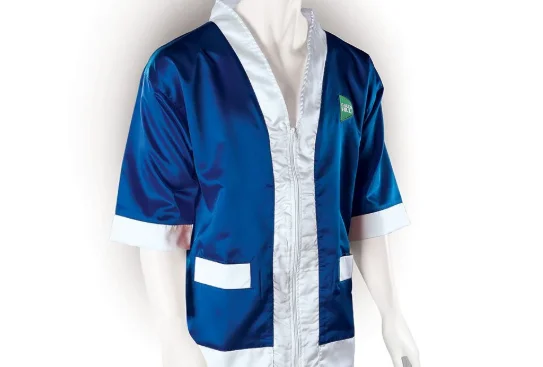
A walkout robe is on camera for maybe 90 seconds. Those 90 seconds still sell the brand. Buyers who spec robes like training gear get an amateur-looking clip.
Robes and corner jackets are ring-entry pieces. Big back panel for sponsor visibility. Contrast trim for team identity. The corner jacket unifies the crew behind the fighter on camera.
These are branding SKUs, not training essentials. They carry your logo to a lens, not sweat in a gym.
I compared two shells from two of our own production runs.
| Metric | Standard Polyester | Premium High-Density Performance Satin |
|---|---|---|
| Fabric cost per robe | $14 | $21 |
| Cut-to-sew yield | 94% | 89% |
| Sew defect rate | 0.7% | 1.2% |
What the numbers mean: The $7 fabric gap becomes about $9 after yield loss. Premium satin also showed a slightly higher sewing-defect rate in our trial, all caught at final inspection.
The payoff lands downstream. The tighter weave holds embroidery registration. Dye lots stay consistent across reorders. Standard polyester cracks at the embroidery needle and shifts shade between runs.
Sourcing checks for wholesale boxing robe suppliers:
- Hood: Double-layer, flat-lock seams. Single-layer hoods crush on camera.
- Sleeve sweep: Wide sweep, 3-inch cuff. Check drape on a live model, not a flat lay.
- Trim: Contrast piping in team colors. Applique on a tight budget, embroidery only on premium satin.
- Packing: Robes are bulky and volumetric weight wrecks landed cost. Request vacuum compression.
- Premium pays off: Broadcast fights, champion-tier fighters, reorder SKUs where shade consistency matters.
For fabric waste and recovery, see our sustainable sportswear manufacturing page.
LeelineWear’s Verdict: We spec premium high-density performance satin for broadcast fights and reorder SKUs. Standard polyester only for promo-only pieces where shade drift never reaches a second run.
🚀 Actionable Insight: Match your shell to your channel. Broadcast and reorder SKUs earn the premium satin. Promo pieces do not.
3. Competition Sets and Team Uniforms
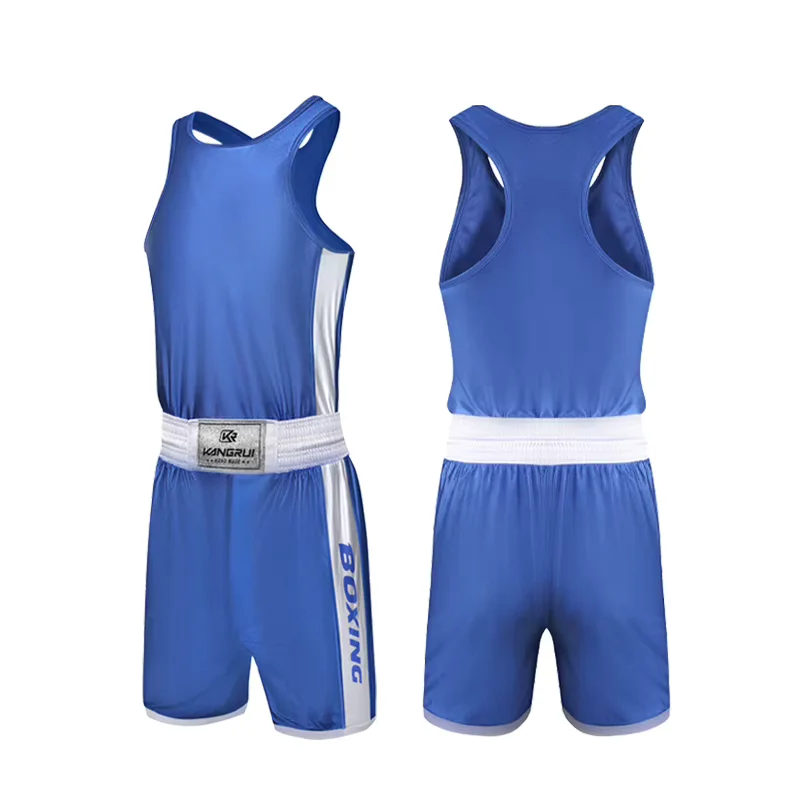
At amateur events, the uniform is checked at Sports Entry before the boxer steps in the ring. Color, length, beltline, and markings are inspected — and a detail that never showed up in sampling can stop a kit on the day.
This silhouette family runs two ways. One is the amateur trunk paired with a competition top. The other is a singlet-style kit for federations that mandate a one-piece. Then add club and academy teamwear for tournament repeat orders. Same floor, two approval paths.
Lock these compliance specs before you cut fabric:
- Corner color: The uniform must be predominantly red or blue to match the boxer’s corner. Check the exact shade against the event’s technical guidance.
- Beltline contrast: The beltline must carry a contrasting color band 5–10 cm wide, and drawstrings must not sit outside it (World Boxing Rule 13.5).
- Shorts length: Shorts or skirts must not be shorter than mid-thigh and must not cover the knee (Rule 13.5).
- Markings and attachments: Flag and manufacturer marks have size limits, and tape or fastening devices used to attach the uniform are prohibited (Rule 13.5.14). Confirm metal, reflective, or hard-plastic trim with the event technical delegate before you cut.
Source: World Boxing Competition Rules (November 2024), Rule 13.5. Professional bodies such as the WBC, IBF, and WBA publish separate rules — confirm the version your event uses.
Then vet the factory. Ask for roster size runs. A 30-fighter club needs graded sizes, not one size block. Confirm number and name handling for every athlete.
Confirm mid-season replenishment and grading for Western fits, which run wider than standard Asian blocks. Match DDP timing to your event date. A clean approval process beats the cheapest quote. Every time.
🛡️ Our Verdict: Get the compliance sheet signed and dated before you cut fabric. A quote that cannot document the event’s uniform rules is not a cheap quote.
🚀 Actionable Insight: Get the compliance sheet signed and dated before you cut fabric. Cheap quotes hide failed inspections.
4. Compression Layers and Rash Guards
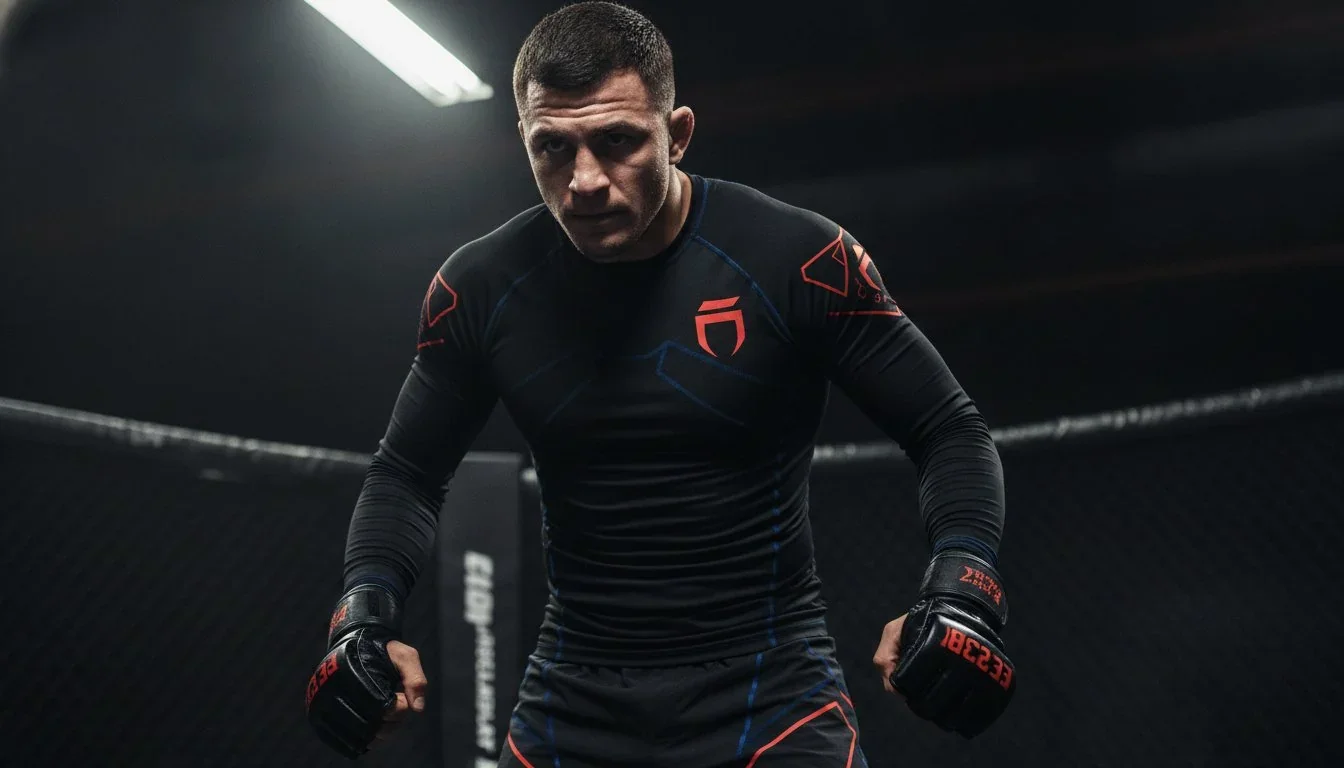
A compression top can feel great and fail in round two. The fabric cannot move sweat.
These are the training and crossover layer: compression tops, rash guards, women’s support tops, base layers. Boxing conditioning lines start here because grading a fitted top is easier than grading a trunk. This is your first fabric decision.
Compare this stack before you sample:
- 4-way stretch poly-spandex, 160–230 GSM. Under 160 GSM goes see-through on a deep squat; over 230 traps heat.
- Ventilation. Micro-mesh or bird’s-eye underarm and spine panels.
- Anti-microbial. Ask for AATCC 100 retest data, not claims. Base fabric should carry OEKO-TEX Standard 100.
- Flatlock seams. Keep them off the shoulder and underarm bone line.
Manager Chen pulled a 175 GSM top off our flatlock line last month. He pointed at the underarm join: “Bird’s-eye mesh saves the athlete. But if the panel edge is not bonded flat, that seam chews skin after 200 reps.”
Sublimation needs a light polyester base, so white and pastel colorways stay cheap. Dark, saturated shades on high-spandex fabric usually go to cut-and-sew paneling. Paneling adds about $1.20 per unit and 4 days lead time.
Ask your mill for vertical wicking height, dry time, 50-wash recovery, and anti-microbial retest data.
LeelineWear’s Verdict: In our internal bench test, we compared nine poly-spandex bases at 170–210 GSM. Three hit 5 cm vertical wicking in 10 minutes. Two lost recovery after 30 washes and sagged at the hem. A support top is not an add-on. Put it in the private-label line at 100 units, not 500.
🚀 Actionable Insight: Test recovery and wicking before approving hand feel. Sagging fabric drives returns.
5. Hybrid MMA Shorts
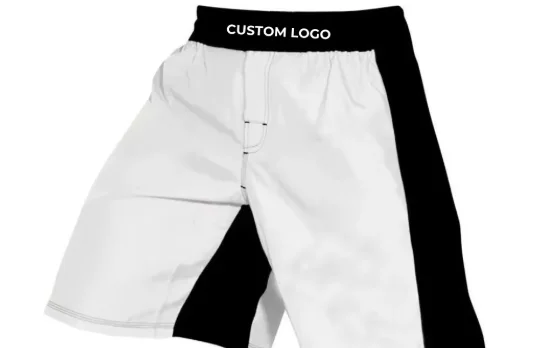
Boxing brands that only sell trunks leave money on the table. Customers cross-train. They need one short for bag work, grappling, and fight camp. The hybrid MMA short bridges boxing and MMA.
It captures entry-level buyers and gym rats. In our production data, $28–$35 hybrid shorts complement $45–$60 trunks. This adds a mid-price option without cannibalizing trunk sales.
Hybrid shorts use a 4-way stretch body (160–200 GSM nylon-spandex), gusseted crotch, shorter rise (8–10 inch inseam), smaller side vents, and elastic waistband with drawcord or hook-and-loop closure. Trunks differ.
Pattern changes decoration. Less flat real estate than a trunk. Stretch distorts screen prints. Sublimation works; test recovery. We ran a 50-wash test on three fabrics. The 20% spandex blend held shape; the 15% blend sagged at the hem.
Manager Chen said last week: “A hybrid short takes more stress at the waistband than a trunk. The drawcord must anchor to the elastic, not just the shell. Otherwise it pulls out during a grapple.”
For private label, test recovery and waistband pull. Bartack side vents, crotch gusset, and drawcord exit. Ideal customers: boxing gyms adding conditioning, MMA startups wanting one hero SKU, and fight camps ordering team kits. Price 20–30% below your trunk to avoid cannibalization.
LeelineWear’s Verdict: We reject any hybrid short that fails 30 waistband-pull cycles or grows over 5% after 50 washes. On a 150-unit run, we switched from 15% to 20% spandex after the first sample sagged. Cost rose modestly per unit. Returns on that style fell sharply.
⚡ Power Move: Test waistband pull and fabric recovery before approval. Price below trunks to expand, not replace.
6. Training Tanks, Tees, and Warm-Ups
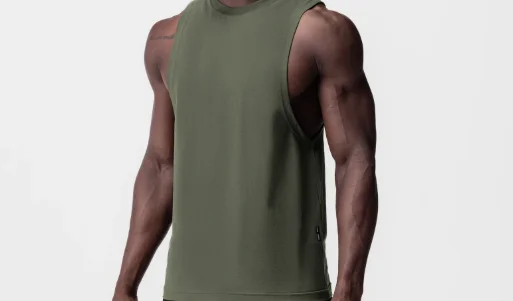
The hero SKUs get the hype. The reorders come from the basics. Training tanks, tees, and warm-up sets are the quiet volume drivers. They fill team packages, retail bundles, and travel kits. And they plan easier around MOQ.
I tested a 12-piece basics range across three poly knits. The 150 GSM interlock won for tanks. It breathes, holds print, and does not cling after sweat. The 180 GSM pique worked for tees: warmer, but stable through 40 washes.
Build details decide repeat orders:
- Breathable poly knit: 140–180 GSM for tanks, 160–200 GSM for tees.
- Anti-odor finish: request AATCC 100 retest data, not just a claim.
- Strategic venting: mesh at back yoke and underarm. Skip center chest where prints sit.
- Print compatibility: sublimation on light poly, screen print on dark cotton-blend tees, heat transfer on names and numbers.
- Colorfastness: sweat and wash testing. We reject below 4 on the grey scale.
- Seams: flatlock on next-to-skin tanks. Standard overlock on warm-up jackets and pants. Cheaper and holds shape.
Warm-up sets anchor the bundle. Top plus pant sells as a travel layer, a corner-crew piece, or a retail set. One fabric platform across tanks, tees, and warm-ups simplifies MOQ planning. You buy one poly knit in three colors, not five fabrics across six styles.
Use these essentials to fill team packages, not as the headline. They keep the account active between hero SKU drops. If you need full-program support, see our custom boxing apparel programs or the homepage for our broader manufacturing hub.
LeelineWear’s Verdict: On a 300-piece basics run, we grouped tanks, tees, and warm-up pants on one 160 GSM poly platform. Three styles at 100 units each hit the standard MOQ without a separate minimum per fabric. Lead time held at 18 days. The reorder came in six weeks.
🚀 Actionable Insight: Launch your first basics run on a single 160 GSM poly platform across three styles. It cuts MOQ risk and speeds your reorder window.
How to Audit Fightwear Factory QC?
Last month, I watched a 5,000-unit fightwear run hit the QC bay. The QC lead froze the lot on the spot. She identified cartons by style, color, and size, then pulled an AQL 2.5 final random inspection sample before any release decision. This is the moment that separates a real factory from a trading company.
Step 1: Run the Tear-Strength Test on Every Fabric Lot
- Condition the garments. Bring samples to 20°C and 65% humidity for 4 hours. This stabilizes the fabric.
- Cut swatches from approved stress zones. Use the underarm, side seam, or crotch gusset. Mark fabric direction with an arrow.
- Run the tear test. Use ASTM D2261 or your tech pack standard. Pull at 12 inches per minute.
- Record pass or fail. Compare to your approved standard. For fightwear, we require 8 lbs minimum on 160 GSM poly-spandex.
- Flag clustering. If three or more failures hit the same fabric lot, size, or sewing line, stop the line. Our last run saw a bad dye lot drop to 5.2 lbs on size L.
Step 2: Check Flatlock Seam Durability on High-Motion Panels
- Inspect seam appearance. Look for skipped stitches, loose tension, or “grinning” (fabric pulling apart). Manager Chen says: “A grinning seam on a rash guard is a return waiting to happen.”
- Measure seam allowance. It should be 6–8 mm on flatlock. Inconsistent allowance causes puckering.
- Perform seam pull and stretch-recovery. Pull perpendicular to the stitch line. Stretch 20% and release. The seam should recover within 5%. We test 10 seams per style.
- Note failures by type. Decide if it is an isolated defect or a systemic line issue. If more than 2 seams fail on the same machine, stop and re-thread.
- Record results. Code each failure as “skipped stitch,” “grinning,” or “recovery loss.” Send this data to the sewing line supervisor.
Step 3: Execute the Disposition Workflow
- Photograph every defect. Capture each failure under bright light.
- Code the defect. Use a 4-digit system: A1 for tear strength, B2 for flatlock.
- Decide rework or reject. Rework goes back to the sewing line with a corrective action ticket. Reject goes to scrap.
- Report back to cutting and sewing. The cutting team gets a report on fabric lot failures.
- Send the buyer report. You get a buyer-facing QC report within 48 hours.
See our clothing sample stages page for pre-production checks. Lock your test standards in the sportswear tech pack before you cut. If you want this QC discipline in your own program, contact us.
Frequently Asked Questions about Boxing Apparel Types
1. What MOQ should I expect for private label boxing apparel?
Standard MOQ is 100 units per color and style. A 50-unit pilot is available for first orders on logo-print styles. We keep a micro-run line open, so small brands do not sit behind bulk orders. Confirm color minimums and size grading before you commit.
2. How long do samples and bulk production take?
Samples take 7 to 15 days from a locked tech pack. Bulk takes 15 to 30 days after sample approval. A 5,000-unit run sits at the top of that range, around 25 to 30 days. Add 5 to 7 days for DDP air freight to the US or EU.
3. What fabric works best for pro boxing trunks versus walkout robes?
Use performance satin for pro trunks. It takes sublimation cleanly and holds shape. Pair it with 3-inch elastic at 80% stretch and 95% recovery. For walkout robes, use premium high-density performance satin. It holds embroidery registration and dye lots. Standard polyester works only for promo pieces.
4. What should be in a boxing apparel tech pack before I contact a factory?
Include shell fabric, elastic width and recovery, slit depth, lining, decoration method, size grade, and Pantone trim colors. Add compliance notes for your sanctioning body. We reject samples that arrive without these fields. Start with our sportswear tech pack guide.
5. How do sanctioning-body rules affect waistband color, trim, and robe use?
Rules vary by body. Under World Boxing Rule 13.5, the uniform must be predominantly red or blue to match the boxer’s corner, shorts must sit between mid-thigh and the knee, and the beltline needs a contrasting band 5–10 cm wide. Tape and fastening devices used to attach the uniform are prohibited. Confirm metal, reflective, or hard-plastic trim with the event technical delegate, and get the compliance sheet signed before cutting.
6. What should I ask a factory about QC before approving a 5,000-unit run?
Ask for AQL 2.5 final inspection, ASTM D2261 tear data with an 8 lb minimum on 160 GSM poly-spandex, and flatlock seam recovery under 5%. Request the buyer QC report within 48 hours. The QC lead froze a lot last month when size L dropped to 5.2 lbs.
Methodology note: This guide draws on our own production records, pattern-maker input, and published competition rules. Figures from internal trials are directional, not a production average.
I am not paid by any fabric mill or machine brand to promote these findings. I receive no kickbacks from the suppliers named here.
Ready to spec a boxing program? Send your tech pack or reference sample to our team, or review the custom boxing apparel capabilities first.
Related reading: sportswear fabrics guide for the material baseline, sportswear tech pack for spec fields, and clothing sample stages for pre-production checks.
Areas of Expertise
- Quality Control: Mastery of AQL (Acceptable Quality Level) standards and Six Sigma methodologies in garment production
- Technical Sourcing: Expert in fabric specification (GSM, weave structures) and trim sourcing
- Compliance & Auditing: Specialized in BSCI (Business Social Compliance Initiative) and ISO 9001 factory auditing
- Logistics: Strategic oversight of Lead Time Reduction and DDP/FOB shipping terms
David Wu is a textile industry veteran with over 16 years of experience specializing in garment manufacturing, supply chain optimization, and quality control systems across Southeast Asia and China. His career is defined by implementing rigorous AQL 2.5/4.0 inspection protocols for mid-to-large-scale private label brands. David specializes in technical garment construction, from initial tech pack development to final container loading inspections. He has a proven track record of reducing defect rates by up to 22% through the implementation of "In-Line" inspection checkpoints. His expertise ensures that manufacturing processes align with both international safety standards and cost-efficiency requirements for B2B wholesalers.