7 Best Next-Generation Sportswear Manufacturers in the UK
 David Wu QA Consultant Updated:
 Last Updated: July 20, 2026
Finding a genuine B2B sportswear manufacturer in the UK — not a middleman or a B2C brand — is tough. Too many lists mix in fashion houses, sourcing platforms, and retail brands that will never take your production order. Every entry below is a verified contract manufacturer with real production capability.
Disclosure
LeelineWear is a China-based sportswear manufacturer. We compiled this list using publicly available information and third-party review platforms. No manufacturer paid for placement on this list. Verify all claims directly with each manufacturer before committing to a production order.
| Manufacturer | Key Characteristics | Product Range |
|---|---|---|
| 1. Blue Associates Sportswear | Silverstone, UK. Full turnkey with own factory. MOQ from 5 pcs (UK) / 300 pcs (overseas). 250+ brands served since 1997. | Cycling, running, triathlon, gym, outdoor, golf, equestrian performance wear. |
| 2. Surridge Sport | Burnley, Lancashire. 150+ years. In-house UK embroidery, print & manufacturing. Bespoke kit across 60 sports. | Football, rugby, cricket, netball, athletics kits + training wear + white label range. |
| 3. Hook & Eye UK | Birmingham, West Midlands. Live tech pack design sessions. MOQ 50 units. UK design team + integrated overseas production. | Leggings, sports bras, compression wear, jackets, performance tees, yoga/gym wear. |
| 4. Hawthorn International | Holborn, Central London. Full-package startup model. MOQ from 50 pcs. 50-99 employees, est. 2012. | Custom sportswear, polo shirts, hoodies, jackets, branded casual wear. |
| 5. Apex Custom Clothing | UK-based. Cycling specialist. Owned factory with in-house sublimation. Founded by ex-MAXGEAR pro cycling squad owner. | Custom cycling jerseys, bib shorts, triathlon kit, sublimated teamwear. |
| 6. White2Label Manufacturing | London, est. 2018. White-label specialist. MOQ from 12 units. Bulk in ~3 weeks. 70+ pre-made styles, 500+ colours. | T-shirts, hoodies, joggers, sportswear blanks with custom branding. |
| 7. MOTiQ | Spalding, Lincolnshire, est. 2014. Full customisation included. Sizes XS-5XL. Headline sponsor of NorthWest Colts League. | Football, rugby, hockey, netball, cricket, golf kits and training wear. |
1. Blue Associates Sportswear (Silverstone)
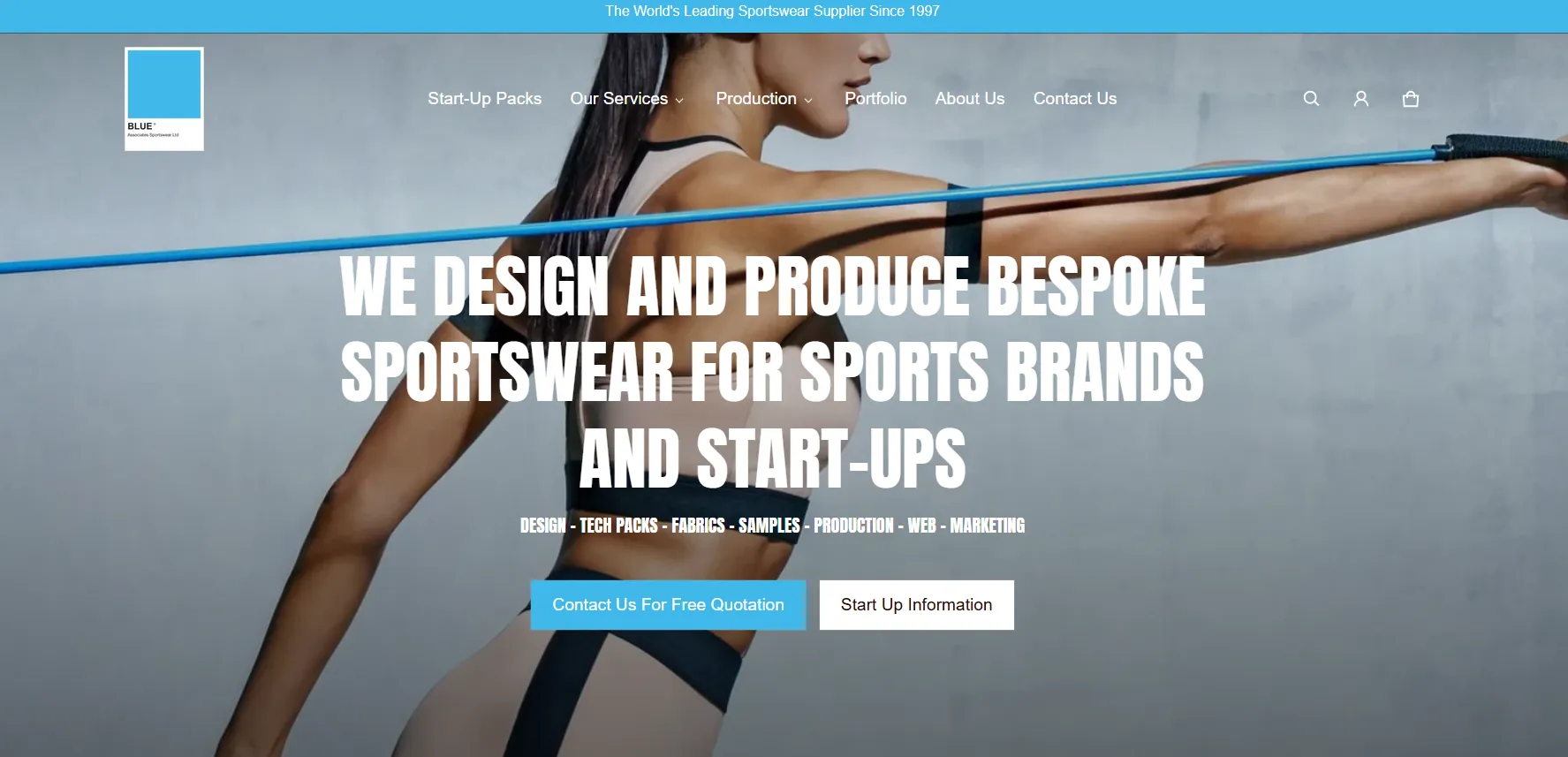
Blue Associates Sportswear is the most complete sportswear contract manufacturer on this list — and the only one with a dedicated UK sportswear factory. Operating since 1997, they have built performance kit for over 250 brands.
Their Silverstone facility runs flatlock, cover stitch, overlock, bonding, heat press, and sublimation printing in-house.
For UK-made orders, MOQs start at just 5 pieces with drip-feed monthly delivery. For scale, their network across Portugal, Lithuania, China, and Vietnam handles orders from 300 units per style. This dual-track model means you keep one partner from prototype to mass production.
The trade-off: development lead times run about four weeks longer than basic factories due to rigorous technical processes. Ask about their performance fabric mill relationships — they access textiles (98% stretch recovery, ISO 105 colorfastness) that generic factories cannot source.
2. Surridge Sport (Burnley, Lancashire)
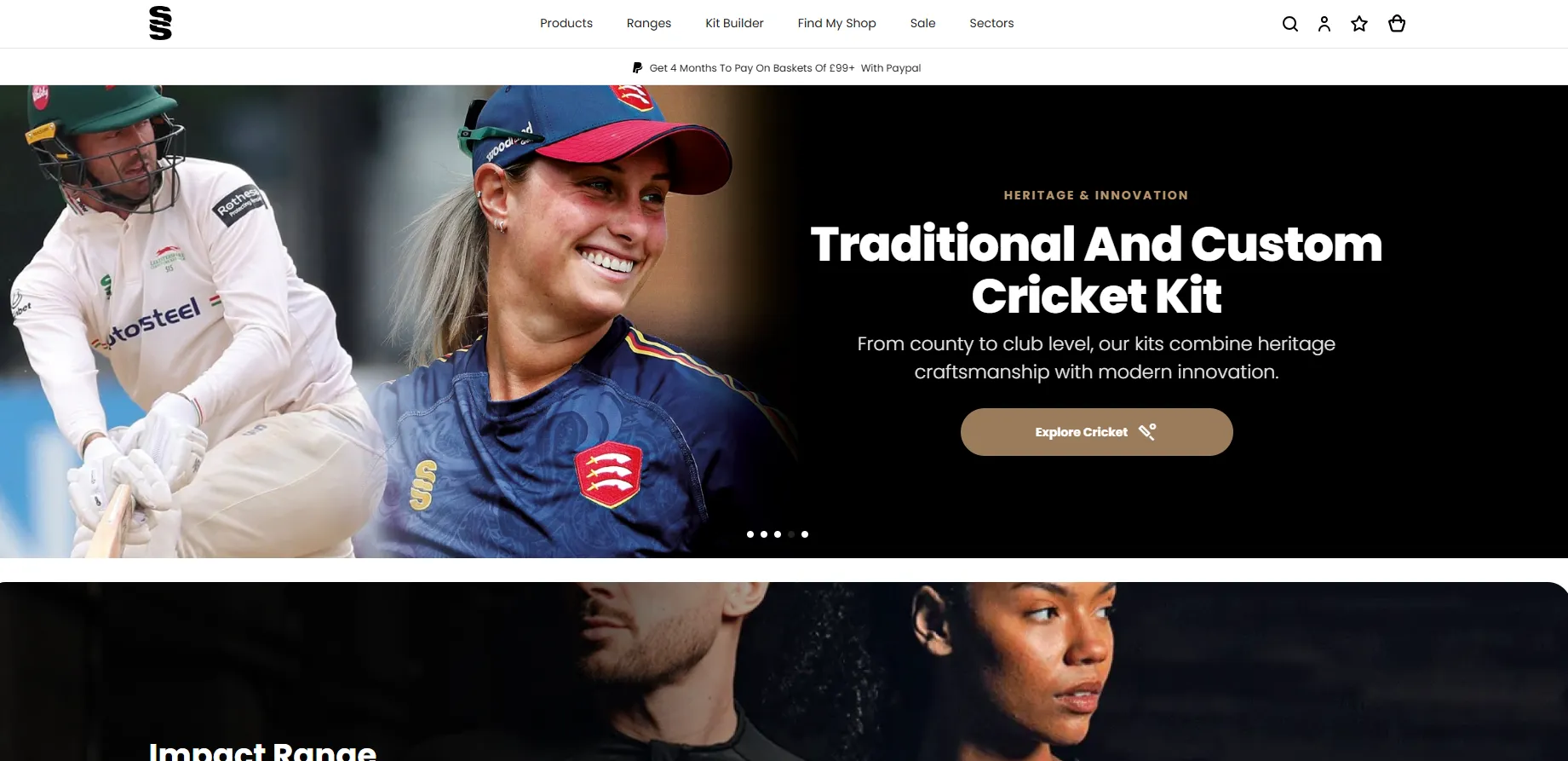
Surridge Sport has been manufacturing teamwear since 1867 — over 150 years. Their 10,000 sq ft Burnley facility handles in-house embroidery, manufacturing, print, and embellishment. They produce bespoke playing kit across 60 sports for clients including AFC Fylde, multiple universities, and Dorset Cricket (partnership running to 2029).
A fully bespoke kit can turn around in 3 weeks. Their 2025 White Label range also lets smaller brands rebrand premium pre-made products. This is a manufacturer built for repeat club and institutional business — not tiny fashion drops.
Request their White Label catalogue before committing to full bespoke development; you may find a pre-existing style that halves your sampling time.
3. Hook & Eye UK (Birmingham)
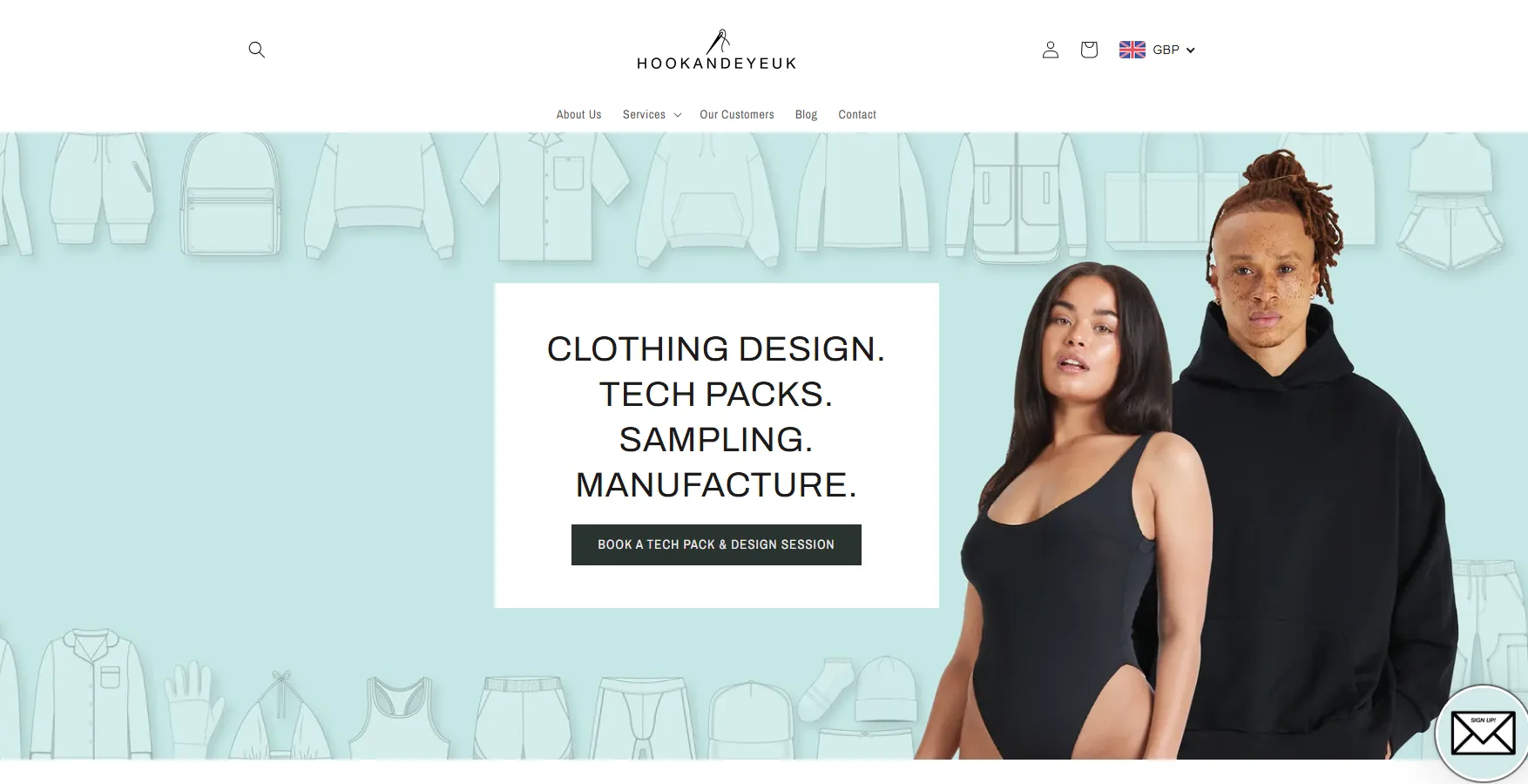
Hook & Eye UK flips the standard factory model: instead of expecting you to arrive with a finished tech pack, their Birmingham studio offers live one-to-one design sessions where an industry-trained designer builds production-ready specs with you.
Operating since 2013, they specialize in premium activewear — leggings, sports bras, compression wear, jackets, performance tees. MOQ is 50 units per style per colour (minimum 2 designs).
Their hybrid model pairs UK-based design, pattern cutting, and QC with integrated overseas production, giving you UK oversight at closer-to-offshore pricing. DDP shipping available.
Book the tech pack design session before committing to bulk — the upfront investment in a proper spec prevents the “looks good, feels cheap” disaster.
4. Hawthorn International (London)
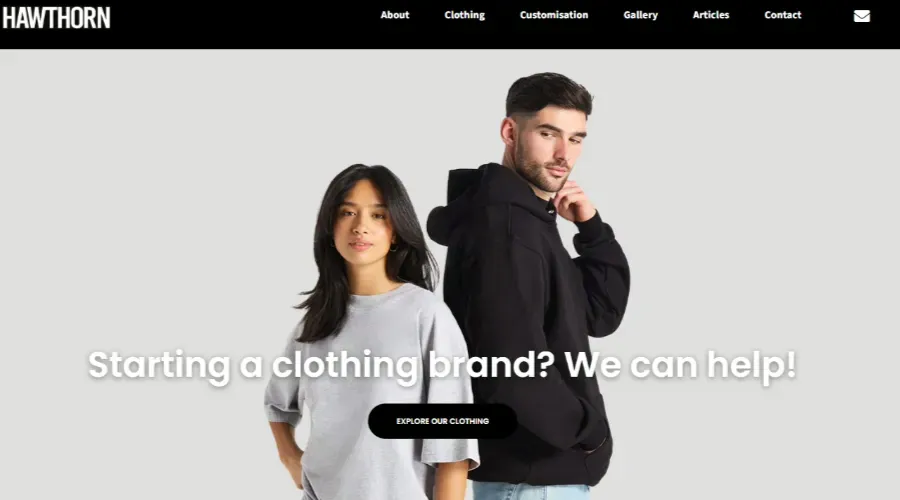
Hawthorn International runs a “Full Package” model for startups — they guide you through fabric sourcing and pattern grading instead of demanding a finished tech pack upfront. Based in central London with 50-99 employees, their MOQs start from 50 units per design, making them one of the most accessible London-based contract manufacturers.
They’re popular for streetwear and activewear launches. The limitation: their standard poly-blends may lack the high compression of specialized four-needle flatlock machines. For elite performance gear, request tensile lab data before committing.
For entry-level to mid-range activewear, they’re a reliable partner. Ask about current sampling lead times before paying a deposit — during Q3 pre-holiday rush, these can stretch significantly.
5. Apex Custom Clothing (UK)
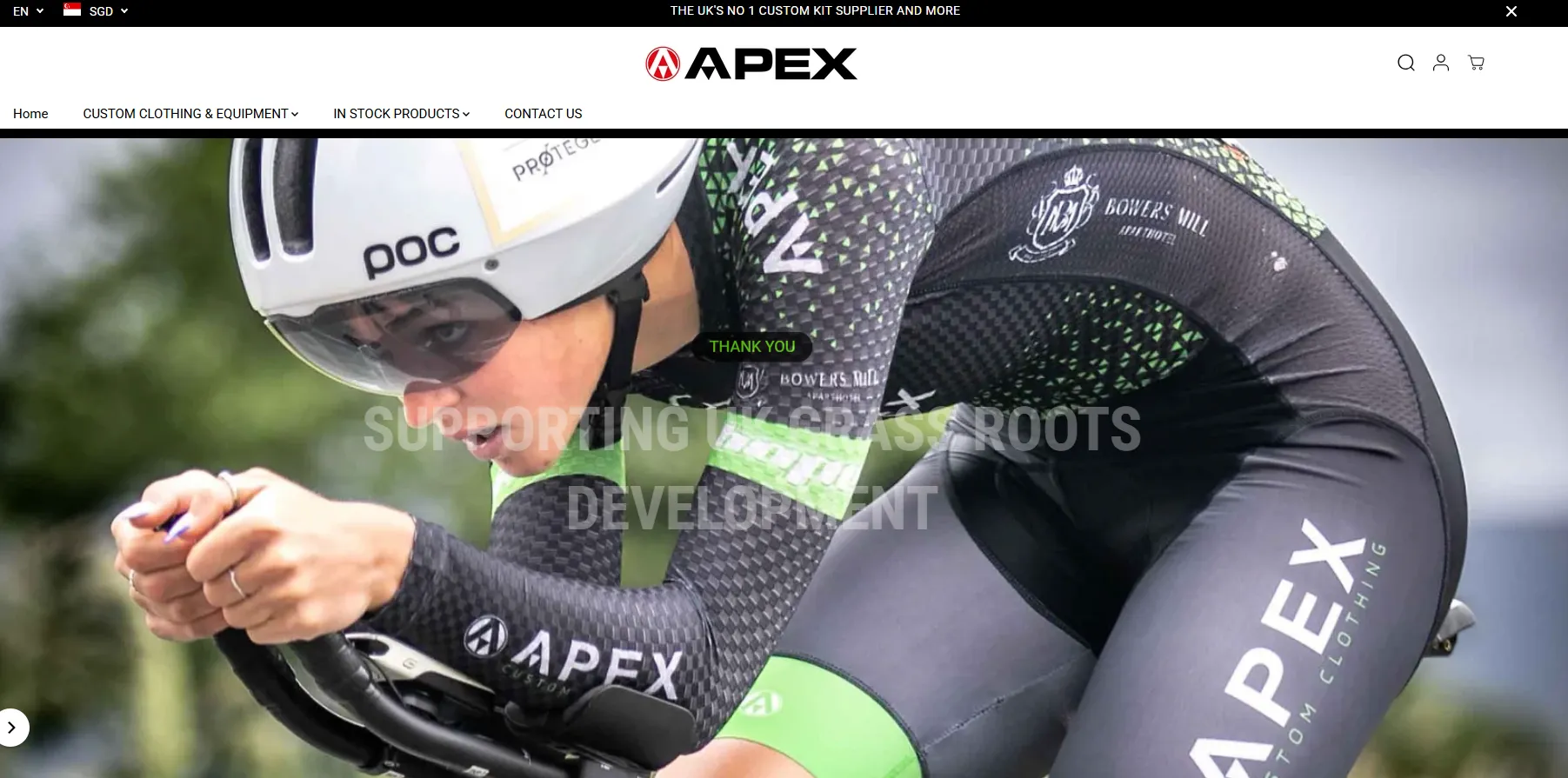
Apex Custom Clothing was founded by Wayne Greenhalgh, former owner of the MAXGEAR cycling development squad and builder of two leading custom clothing brands. Their key advantage: an owned-and-operated factory with state-of-the-art dye sublimation printing — no third-party print vendors adding cost and lead time.
They specifically target the gap between cheap generic catalog kits and prohibitive pro-team minimums, making custom cycling kit accessible for clubs and small brands. The specialization cuts both ways — they excel at cycling and triathlon but may not cover multi-sport production (gym, field sports).
Confirm the specific chamois pad model in your tech pack before approving samples; a premium chamois adds significant perceived value.
6. White2Label Manufacturing (London)

White2Label is the fastest route to market for brands testing positioning. Skip the 90-day development cycle: select from 70+ pre-made styles across 500+ colours, apply your branding (neck labels, swing tags, packaging), and launch in ~3 weeks. MOQs start at 12 units, with samples available within 1 week.
The trade-off is differentiation — you’re selling a standard base garment competitors might also use. For full custom cut-and-sew from scratch, they offer that too, but their core value is white-label speed.
Clarify if the MOQ applies per style or per colour, and order a physical sample of your chosen blank before bulk — fabric hand-feel varies significantly between catalogue options.
7. MOTiQ (Spalding, Lincolnshire)
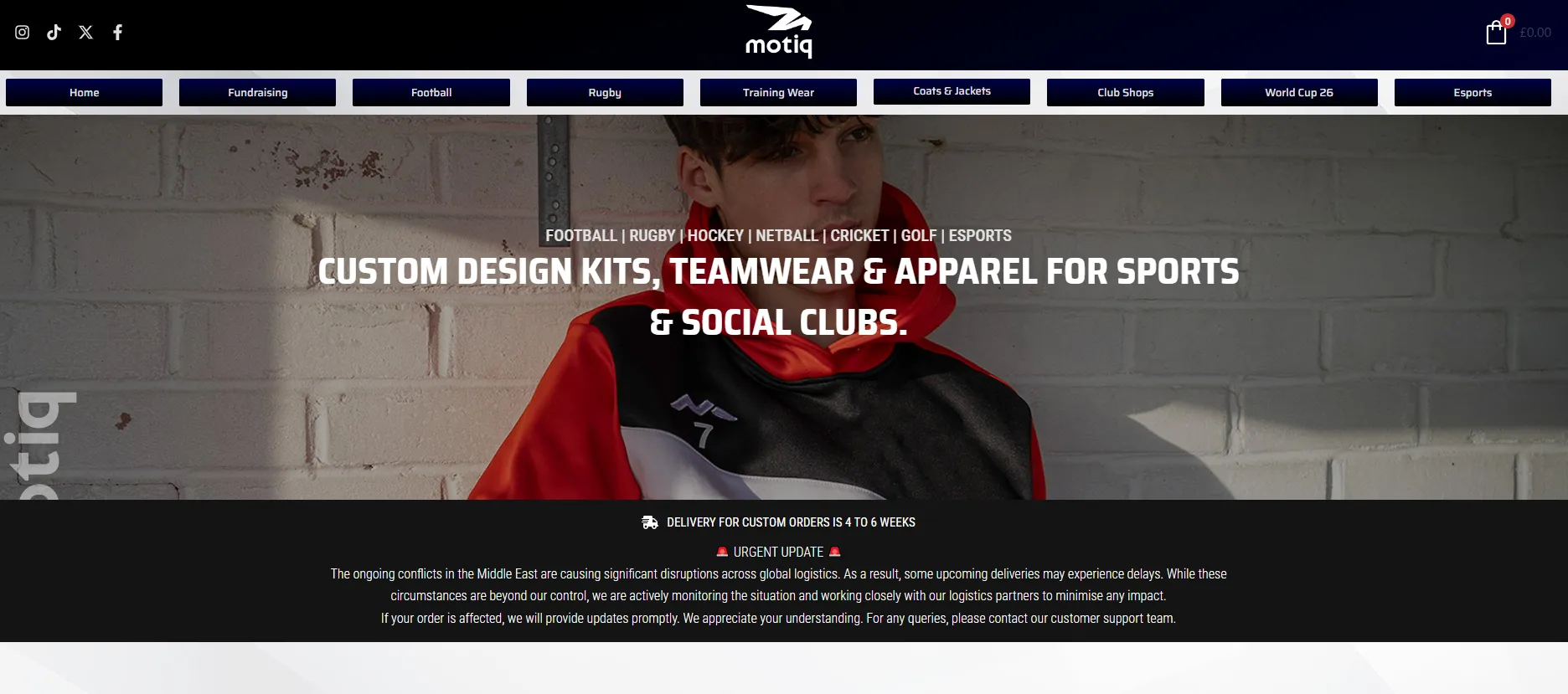
MOTiQ takes the opposite approach to most teamwear manufacturers: full customisation is included in the base price. Club badges, sponsor logos, player names, numbers, and initials — all standard. Founded in 2014, they serve football, rugby, hockey, netball, cricket, and golf clubs.
Their rugby jerseys feature double-stitched reinforced seams, silicon grip patterns, and silicon bottom banding — details usually found at higher price points. Sizing runs youth XS to adult 5XL, lead times 4-8 weeks. They headline sponsor the NorthWest Colts League, demonstrating genuine grassroots commitment.
Order a single sample kit first and check seam reinforcement at stress points before committing the full squad.
What to Know Before You Start UK Production
Fabric: Be Specific or Fail
Vague requests cause 90% of sampling failures. Specify exact blend and weight:
- Elastane %: 8-10% for drape, 12-25% for compression (mandatory for leggings)
- GSM: 140-160 for lightweight tees, 280-320 for squat-proof compression
- Recycled polyester: Demands inconsistent dyeing. Request a Continuity Card for batch-to-batch color matching. Read our guide to sourcing sustainable sportswear for deeper fabric strategy.
QC: The Non-Negotiable 4 Steps
- Pre-Production Sample: Approve the “Golden Sample” before bulk starts. See how clothing samples work across stages.
- Inline Check: Inspect first 10 units off the line — fix stitch issues here
- Wash Test: Wash a sample 5 times. Check shrinkage and logo peeling. This is the most-skipped, most-critical step.
- Final Inspection: Use ISO 2859-1 (AQL 2.5). Over 2.5% defect rate = reject the batch. Learn more about third-party garment inspection.
UK vs. Overseas: The Trade-Off
UK manufacturing gives you speed (2-4 week sampling) and no import duties, but labor costs compress margins. Overseas production through partners like LeelineWear delivers higher margins and access to complex technical fabrics. Above 500 units, the savings typically outweigh the shipping time.
Compare UK vs. China manufacturing costs here.
Where LeelineWear Fits
We offer China manufacturing with European-level QC — factory-direct, no agent fees, small batch support for micro-runs, and end-to-end service covering tech packs, lab testing, and DDP shipping. Start your project with LeelineWear today.
More Supplier Guides
Compare UK production against other sourcing hubs:
- Clothing suppliers in Turkey — low-MOQ, EU-facing production as a UK alternative.
- Sportswear manufacturers in Vietnam — lower-cost activewear at scale.
- Sportswear manufacturers in Bangladesh — high-volume knit and performance production.
- Best sportswear manufacturers in China — the world’s largest apparel base, reviewed.
Frequently Asked Questions about Sportswear Manufacturers in the UK
What is a realistic MOQ for UK custom activewear?
A realistic minimum order quantity for UK sportswear manufacturing ranges from 12 to 500+ units depending on the production method. White Label (pre-made blanks with your branding) requires 12–50 units. Cut and Sew (custom patterns) typically needs 100–250 units per colour.
Seamless knitting starts at 500–1,000 units per style due to machine setup costs. Always verify if the MOQ applies per size or per colour.
How long do UK sportswear production lead times take?
UK sportswear manufacturers operate with shorter lead times than overseas alternatives but higher unit costs. Budget 2–4 weeks for sampling and 6–10 weeks for bulk production. These timelines often double during September–November pre-holiday rush. Book production slots at least 3 months ahead.
What compliance proof should I ask for?
A UK sportswear manufacturer must provide three documents: a UK REACH Declaration for chemical safety compliance, an OEKO-TEX Standard 100 certificate for skin-contact garments, and a GRS Transaction Certificate if you claim recycled content. Request documentation tied to your specific production batch — never accept verbal assurances.
Can UK suppliers do private label and custom branding?
Yes, most UK clothing manufacturers offer private label services including custom neck labels, hangtags, and polybags. Expect separate setup fees beyond the base unit price. Custom packaging typically adds £0.50–£1.50 per unit. Ask about mold fees for silicone heat-transfer logos before placing your order.
UK vs. Overseas: When does outsourcing make more sense?
Choose a UK manufacturer for speed (2–4 week turnaround) and orders under 200 units where domestic logistics outweigh higher labour costs. Outsource to an overseas manufacturer like LeelineWear for higher margins, complex technical fabrics, and volumes above 500 units where shipping costs are absorbed by the per-unit savings.
Compare the costs of UK vs. China manufacturing to find your breakeven point.
Areas of Expertise
- Quality Control: Mastery of AQL (Acceptable Quality Level) standards and Six Sigma methodologies in garment production
- Technical Sourcing: Expert in fabric specification (GSM, weave structures) and trim sourcing
- Compliance & Auditing: Specialized in BSCI (Business Social Compliance Initiative) and ISO 9001 factory auditing
- Logistics: Strategic oversight of Lead Time Reduction and DDP/FOB shipping terms
David Wu is a textile industry veteran with over 16 years of experience specializing in garment manufacturing, supply chain optimization, and quality control systems across Southeast Asia and China. His career is defined by implementing rigorous AQL 2.5/4.0 inspection protocols for mid-to-large-scale private label brands. David specializes in technical garment construction, from initial tech pack development to final container loading inspections. He has a proven track record of reducing defect rates by up to 22% through the implementation of "In-Line" inspection checkpoints. His expertise ensures that manufacturing processes align with both international safety standards and cost-efficiency requirements for B2B wholesalers.