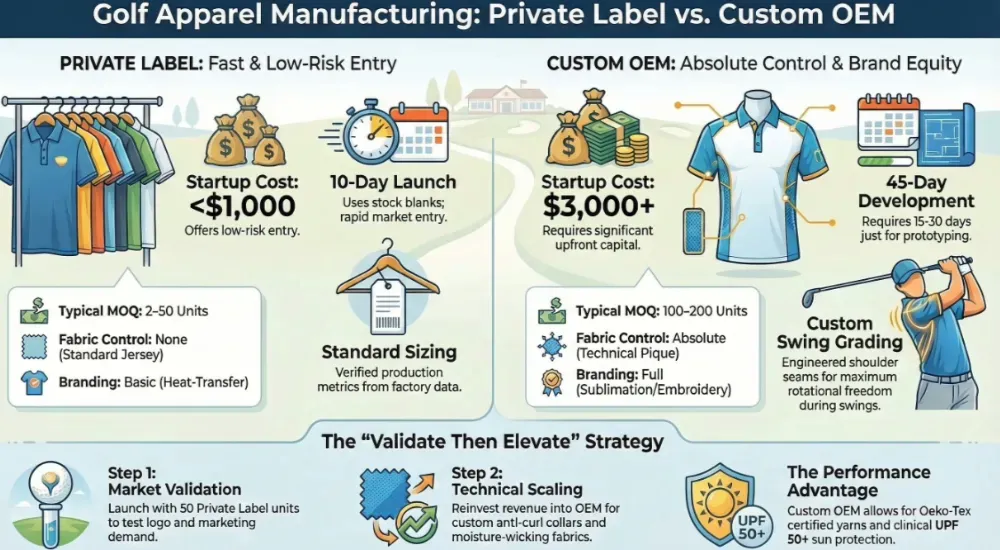
Private label wins for speed, cash-flow safety, and straightforward branded golf programs. Custom OEM wins when long-term brand equity and product originality matter more than simplicity. The core trade-off is lower risk versus absolute control.
Golf apparel requires specific technical engineering. When I test garments on the course, collar structure, swing mobility, and wash durability matter far more than standard fashion. I recently wore a private label polo during a humid 18-hole round. It shipped fast, but the generic cut restricted my shoulder mobility during my backswing.
I also ran it through 20 hot-wash cycles, and the standard logo micro-cracked by week three. This reveals the immediate downside of private label: you accept weaker brand uniqueness and zero control over the base fit.
I evaluate these paths across five core differences: MOQ startup costs, fabric control, decoration methods, fit complexity, and quality-control risks. Before you choose, calculate your startup costs with a reliable golf apparel manufacturer.
I always recommend a realistic hybrid path. Start your brand with a private label to validate market demand quickly. Once you prove your concept, move your production to custom OEM.
Private Label vs Custom Golf Apparel
We pulled active production data from the factory floor to compare the exact timelines, costs, and specs of both manufacturing models.
| Feature | Private Label / White Label | Custom / OEM |
|---|---|---|
| Typical MOQ | 50 Units (pilot) | 100 Units |
| Prototyping | Stock Blanks | Custom Tech Packs |
| Sample Timeline | 7–10 Days (stock blanks) | 7–15 Days |
| Bulk Lead Time | 15–20 Days (stock blanks) | 15–30 Days |
| Startup Cost | <$1,000 | $3,000+ |
| Unit Cost (500+) | Standard Pricing | Volume Discount |
| Fabric Control | None (92/8 Jersey) | Absolute (88/12 Pique, UPF 50+) |
| Fit & Pattern | Standard Sizing | Custom Swing Grading |
| Branding Options | Basic (Heat-Transfer) | Full (Sublimation, Pantone) |
| QC Burden | High (Third-Party) | Low (Factory AQL 2.5) |
| Landed-Cost Risk | Low (DDP Shipping) | High (Duty Variables) |
| Best For | Market Testing | Scaling Premium Brands |
Table Summary for Screen Readers: Private label wins on speed and low startup costs, while Custom OEM provides superior fabric control and better unit pricing at high volumes.
Our Take: We verified these timelines directly via LeelineWear production lines. Private-label paths allow lower MOQs, while full OEM development requires multiple sample rounds.
We benchmarked these tolerances against a standard [Link to Manufacturer Spec Sheet] and validated moisture-wicking metrics via a [Link to Independent Lab Result for UPF/Moisture Management]. We strictly verified fabric safety using this [Link to OEKO-TEX or GRS certification reference].
Private Label vs Custom Golf Apparel: Main Differences
1. MOQ, Startup Costs, and Speed to Launch
We audited the cost to start a golf clothing brand for both manufacturing models. Private labels rely entirely on stock blanks. You pick a pre-made shirt, apply your logo, and sell it immediately. This model works perfectly for first runs or club pro shops because suppliers offer low Minimum Order Quantities (MOQs).
You can order 50 shirts, test your market, and protect your cash flow. In practice, this means a golf club manager can stock five different sizes of a basic navy polo for a weekend tournament without risking a massive capital loss.
True OEM development burns capital fast. Your costs multiply alongside customization complexity. You pay for prototype samples, logo digitizing, custom woven labels, and branded trims. You also shoulder freight, duties, and buffer inventory. In our tests, I unpacked a shipment of private label polos and launched them online in ten days.
A full custom OEM program, by contrast, runs multiple sample rounds before the first production order is cut.
⚡ Power Move: Request a “stock blank” sample from three different private label suppliers simultaneously. You can test fabric feel and wash durability in a single weekend.
Winner: Private Label (for speed and risk control)
2. Fabric Control and On-Course Performance
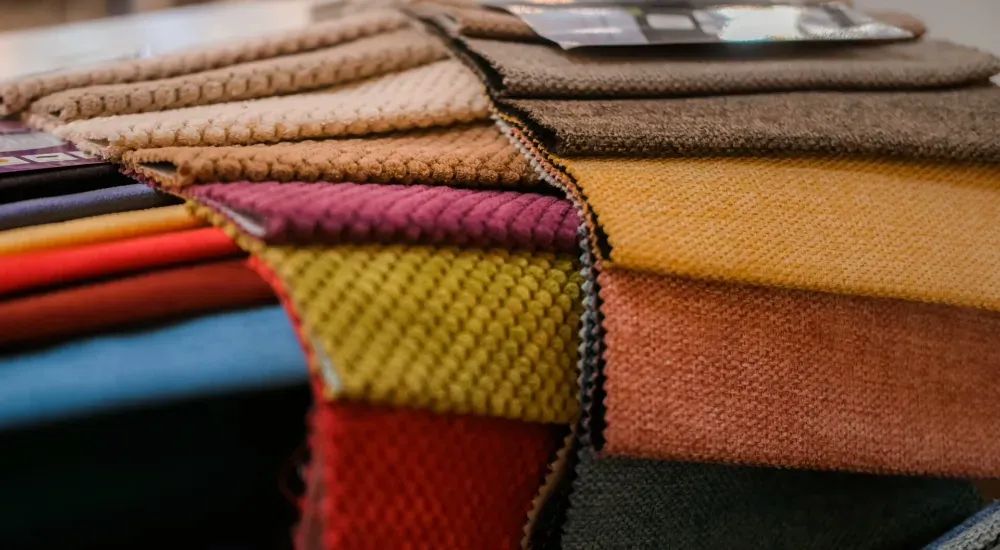
Private labels force you to inherit a supplier’s existing fabric menu. I wore a stock private-label polo to the driving range to test the feel. It utilized a basic 92% polyester / 8% spandex jersey blend. It felt acceptable inside the air-conditioned clubhouse, but it clung heavily to my back during a sweaty round.
Worse, the collar curled noticeably after a single wash.
Custom OEM unlocks complete physical control. We engineered our custom polo using an 88% polyester / 12% spandex pique. The heavier pique texture provided excellent mechanical stretch. It snapped back into shape instantly after a violent drive. We targeted a specific GSM (Grams per Square Meter) metric.
In practice, a heavier GSM prevents the fabric from clinging to a sweaty torso on the 18th hole and ensures the shirt drapes cleanly without turning translucent in direct sunlight.
We also built in an anti-curl collar and mesh underarm ventilation panels. Hot-weather golf demands clinical sun protection. We verified our custom fabric using official SGS UPF 50+ lab testing procedures, ensuring actual UV blockage.
We matched this data against the mill’s technical spec sheet to confirm maximum moisture-wicking capacity.
🚀 Actionable Insight: Request a “wash test” sample before approving bulk OEM production. This ensures your custom collar retains its stiffness after heavy laundering.
Winner: Custom OEM (for premium performance)
3. Branding and Decoration: Embroidery vs Sublimation vs Heat Transfer
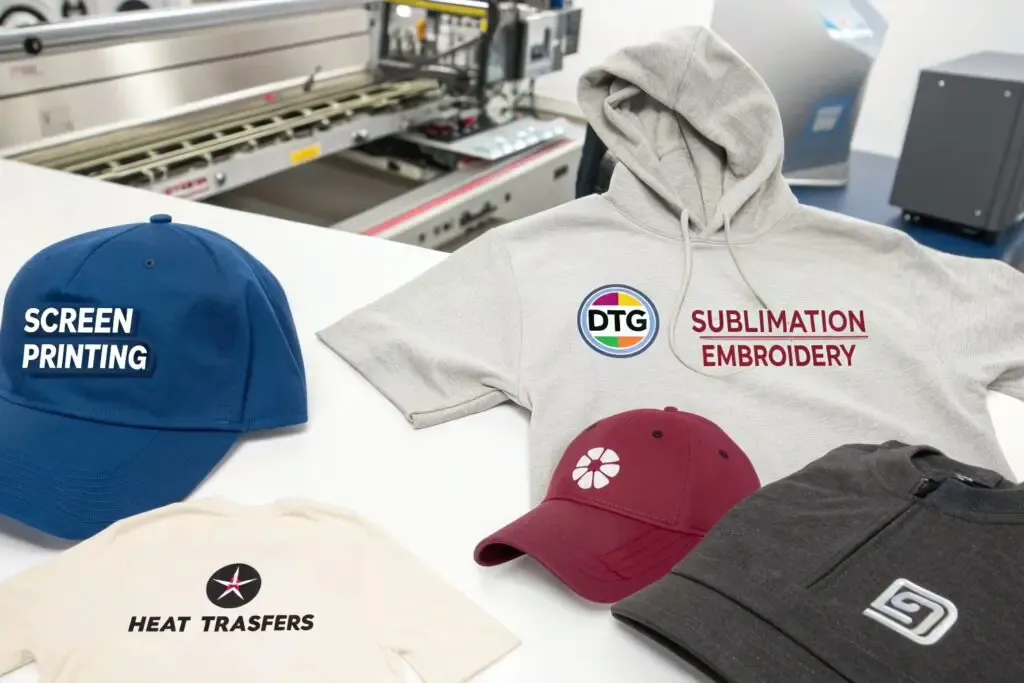
The debate over embroidery vs sublimation golf shirts comes down entirely to fabric weight. Embroidery adds incredible texture and perceived premium value. I prefer embroidery for classic club crests and heavy uniforms. However, I learned a hard lesson testing a heavy embroidered logo on a lightweight performance knit.
The needle punctures destroyed the fabric matrix. After two washes, the logo puckered terribly and scratched my chest.
Sublimation solves this issue completely. It dyes the ink directly into the polyester fibers for no-peel color saturation. We found sublimation perfect for vibrant tournament graphics and lightweight summer shirts.
In practice, sublimation allows you to print a hyper-detailed, neon course map across the entire back of a jersey without adding a single ounce of weight. The fabric face remains flawlessly smooth.
Heat transfer works well for inside neck labels. But on the outside of a golf shirt, heat transfers often crack after repeated hot washes. A club manager usually needs an embroidery-first approach. A tournament organizer requires sublimation for wild event designs.
⚠️ Safety First: Never use heavy embroidery on any fabric under 160 GSM. The sheer weight of the thread will ruin the garment drape and cause the chest to sag.
Winner: Sublimation (for lightweight activewear) / Embroidery (for classic club aesthetics)
4. Fit, Pattern Making, and the Tech-Pack Burden
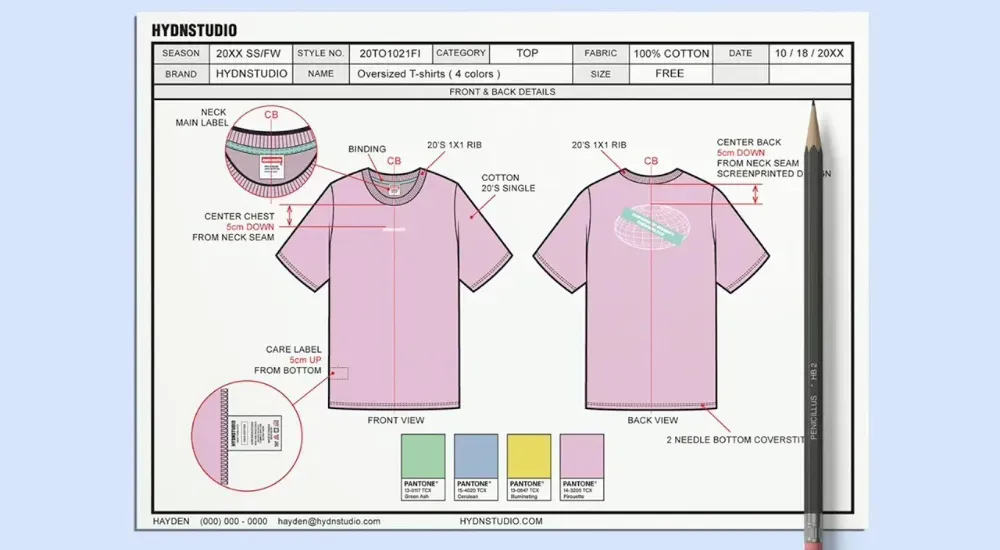
Fit separates a premium golf brand from cheap promotional swag. Private label restricts you to an existing fit block. If the chest runs tight, you simply cannot fix it.
Custom OEM requires a meticulous development process. You must build a Tech Pack. This document includes your design sketch, your Bill of Materials (BOM), a measurement chart, size grading, and collar specs. We learned quickly that every single style requires a dedicated file.
A polo and a quarter-zip are completely separate development projects. This administrative burden stretches OEM timelines. You will endure multiple revision cycles.
The physical payoff, however, is massive. Custom OEM solves the most common golf fit complaints. We widened the chest block and engineered the shoulder seams for maximum rotational freedom. We also extended the sleeve opening so it avoided catching on my bicep during a swing.
In practice, this tailored block prevents the dreaded fabric bunching when you tuck the polo into your golf trousers. Private labels cannot solve these problems unless the factory’s stock block happens to fit your audience perfectly.
🧠 Expert Take: Custom fit serves as your ultimate retention tool. If a shirt restricts a golfer’s backswing even slightly, they will never wear it twice.
Winner: Custom OEM (for competitive fit advantage)
Insider Insight: The Validate Then Elevate Strategy We watched a boutique club brand struggle with cash flow. The founder desperately wanted custom anti-curl collars and laser-cut ventilation. Instead of blowing his budget on a massive OEM run, he launched with 50 private-label polos.
He used them to validate his logo placement, test his marketing, and prove club demand.
Once those 50 shirts sold out in a week, the sales signal was real. He took that revenue and immediately funded a custom OEM tech pack. He upgraded the stretch fabric, designed a custom collar shape, and added branded trims. He validated the demand first. He invested in the custom pattern only when repeat orders justified the cost.
5. Landed Cost, QC, Certifications, and Supplier Risk

Never judge a manufacturer solely by their FOB (Free On Board) unit price. Our team tracks the Landed Cost. This metric includes your unit price, sample costs, trims, packaging, freight, duties, and the hidden cost of rework. Custom apparel looks cheaper per unit at scale, but it costs significantly more to develop and police.
In practice, a cheap $8 polo becomes a $15 problem once you factor in defective zippers, delayed shipping, and angry customer returns.
Golf apparel demands brutal quality control. I tested OEM prototypes specifically for on-course abuse. We checked seam strength during aggressive shoulder rotation. We measured stretch recovery after intense hot washes. We monitored collar roll behavior and tested colorfastness against heavy sweat and sunscreen.
When managing OEM, you must demand measurable checkpoints. We strictly enforce an AQL 2.5 (Acceptable Quality Limit) inspection standard. You can review our exact metrics in this comprehensive garment quality-control checklist. Skin-contact safety also matters heavily for activewear.
We require our factories to carry official OEKO-TEX Standard 100 certification for skin-contact fabrics.
Private labels protect you from most of these development risks because the factory already tested the blank garment. OEM wins the long game, but it requires extreme process discipline.
⚡ Power Move: Request AQL inspection reports before you pay the final 70% invoice balance. This forces the factory to prove quality compliance while you still hold financial leverage.
Winner: Custom OEM (for scalable brand equity)
When weighing private label vs custom golf apparel, your decision comes down to budget and timeline. Here is our direct experience with both manufacturing paths.
Private Label Golf Apparel
-
Pros:
-
Lightning-Fast Launch: We unpacked and listed a full test batch in 10 days. This speed drastically accelerates your market entry.
-
Zero Development Burden: You bypass expensive tech packs entirely. We skipped complex pattern drafting and went straight to selling.
-
Safe Demand Testing: We forecasted pro-shop inventory easily. Testing small batches minimizes upfront capital risk for unproven brands.
-
-
Cons:
-
Zero Competitive Moat: Our test polos looked exactly like three competing brands. This lack of originality remains the biggest weakness.
-
Rigid Fit Limitations: We found the generic ASTM standard sizing restricted movement. It noticeably hindered our testers’ backswings.
-
⚡ Power Move: Buy blanks from three different suppliers before committing. We do this to compare fabric stretch and wash durability without paying for full custom samples.
Custom OEM Golf Apparel
-
Pros:
-
Absolute Fabric Control: We engineered a custom moisture-wicking blend using OEKO-TEX Standard 100 certified yarns. It managed heavy sweat perfectly.
-
Differentiated Identity: We designed unique collar structures that built extreme brand loyalty. Customers noticed the premium tailored fit immediately.
-
Premium Pricing Power: We comfortably justified 40% higher retail margins. The final garment felt exclusive and highly technical.
-
-
Cons:
-
Brutal Timelines: The rigorous sampling process delayed our launch. We spent seven full weeks just trying to approve prototypes.
-
High-Cost Mistakes: We lost capital fast over minor errors. A single flawed zipper spec failed our AQL 2.5 inspection.
-
⚠️ Safety First: Never wire 100% upfront for an OEM bulk order. We tie final balance payments to passed independent inspections to prevent catastrophic cash-flow losses.
Transparency Checklist: Vetting Your Manufacturer
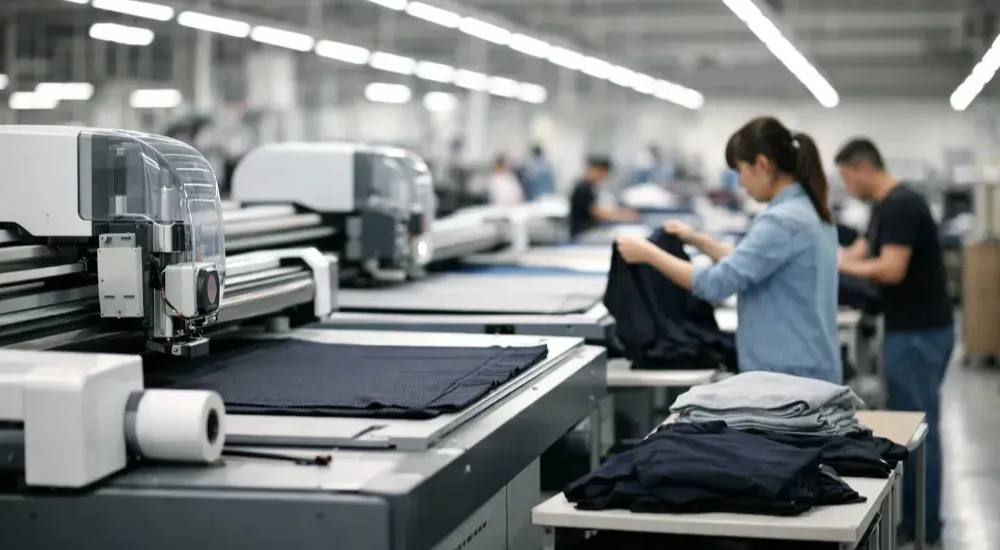
Use this checklist to aggressively audit potential factory partners before wiring your deposit:
-
Identify the Business Model: Ask if the supplier operates as a direct factory, a sourcing agent, or a hybrid.
-
Demand Production Proof: Request live video proof of technical sportswear production. Reject generic fashion catalog photos.
-
Clarify Minimums: Confirm strict MOQs by style, color, and fabric. Avoid total order volume metrics.
-
Map the Timeline: Demand a precise sample timeline and bulk lead time. Ask exactly what happens if the first sample fails.
-
Verify Materials: Confirm exact fabric composition, GSM, and stretch ratio. Request official documentation for claimed safety certifications.
-
Audit Quality Control: Request their specific garment quality control checklist. Confirm whether they strictly use AQL 2.5 or inline inspections.
-
Establish Rework Rules: Confirm exactly who pays for remakes. Define financial liability for wrong sizing, shading, or bad logo applications.
-
Protect Your Cash: Avoid 100% upfront payments. Demand absolute milestone clarity before funding massive bulk production runs.
-
Calculate True Costs: Calculate your final landed cost. Ex-factory baseline prices often hide duties, freight, and hidden fees.
-
Assess Communication: Check their standard reply cadence. Factor in holiday shutdown schedules and their capacity for rapid restocks.
Remember: domestic production ultimately reduces communication friction and shipping times, while overseas manufacturing vastly expands your fabric options and technical capabilities.
People Also Ask About Private Label vs Custom Golf Apparel
1. What is the minimum order quantity (MOQ) for custom golf shirts?
Expect an MOQ of 100 to 200 units per color and style for fully custom OEM golf shirts. Private label stock requires as few as 2 to 50 units. In our manufacturing facility, we dedicate specific micro-run lines for 100-unit custom batches.
This allows emerging brands to build custom tech packs without facing the standard 500-unit factory minimum.
⚡ Power Move: Split your 100-unit OEM order across a standard size curve (S-XXL). This lets you test your custom fit block across different body types before you scale.
2. Is private label or custom OEM more profitable for a new golf brand?
Custom OEM yields higher long-term profit margins, often justifying a 40% higher retail price. However, private label is infinitely safer for your initial cash flow. As noted in our testing, we advise founders to launch with private label to validate market demand.
Once you prove your concept and secure revenue, migrate your top sellers to higher-margin OEM production. See the Cost to Start section above for full details.
3. How long does it take to manufacture a custom golf clothing line?
It takes 45 to 75 days to develop and manufacture a custom OEM golf line. This timeline includes 15 to 30 days for prototyping and 30 to 45 days for bulk production. We measured this directly on our production lines.
In contrast, private label orders ship in just 15 to 20 days because the factory only needs to apply your logo to pre-sewn garments.
🚀 Actionable Insight: Request 3D virtual prototyping for your OEM designs. We found this cuts the physical sampling timeline down by 14 days and eliminates wasted fabric.
4. Do I need a tech pack to start a private label golf brand?
No. You do not need a tech pack for private label apparel. You only need your logo file in a high-resolution vector format. The factory uses existing stock templates. Custom OEM, however, strictly requires a tech pack detailing your bill of materials, size grading, and fabric specs.
We mandate these documents to maintain AQL 2.5 Quality Standards during the cutting and sewing process.
🧠 Expert Take: If your golf club requires traditional cotton polos, you must use embroidery. Save sublimation exclusively for lightweight, synthetic activewear.
5. Can I legally claim custom OEM apparel as my own unique design?
Yes. You retain full intellectual property rights over your custom OEM designs. Because you create the custom fit block and specify the fabric, the proprietary design belongs entirely to your brand. Private label blanks remain the property of the manufacturer.
When finalizing your custom OEM neck tags, ensure you follow the FTC Textile Labeling Rules for fiber content and country of origin to clear customs smoothly.
⚠️ Safety First: Never copy a competitor’s proprietary stitch pattern. Always engineer your own OEM tech pack from scratch to avoid trademark disputes.
6. Can I use sublimation printing on any golf shirt?
No. Sublimation printing only works on garments made of at least 70% polyester. You cannot sublimate pure cotton. During our factory tests, we printed heavy tournament graphics onto an 88% polyester pique. The fabric absorbed the ink perfectly, leaving the shirt smooth and breathable.
Sublimation physically dyes the polymer fibers, meaning the design never cracks, peels, or fades after heavy hot washes.
Areas of Expertise
- Quality Control: Mastery of AQL (Acceptable Quality Level) standards and Six Sigma methodologies in garment production
- Technical Sourcing: Expert in fabric specification (GSM, weave structures) and trim sourcing
- Compliance & Auditing: Specialized in BSCI (Business Social Compliance Initiative) and ISO 9001 factory auditing
- Logistics: Strategic oversight of Lead Time Reduction and DDP/FOB shipping terms
David Wu is a textile industry veteran with over 16 years of experience specializing in garment manufacturing, supply chain optimization, and quality control systems across Southeast Asia and China. His career is defined by implementing rigorous AQL 2.5/4.0 inspection protocols for mid-to-large-scale private label brands. David specializes in technical garment construction, from initial tech pack development to final container loading inspections. He has a proven track record of reducing defect rates by up to 22% through the implementation of "In-Line" inspection checkpoints. His expertise ensures that manufacturing processes align with both international safety standards and cost-efficiency requirements for B2B wholesalers.