Founders routinely treat logistics as an afterthought. At our China factory, I watch brands lose margin by assuming suppliers automatically handle export paperwork.
Mastering shipping clothes from China requires a strict supply-chain workflow. This framework helps e-commerce founders, fashion brands, and procurement managers move garments to U.S. warehouses without surprise fees.
Apparel imports typically fail at three points: miscalculating duties via incorrect Harmonized System codes, discovering poor stitching post-delivery, or selecting expensive Incoterms. You must finalize this process before funding production.
We cover sea and air freight, sea-rail comparisons, DDP structures, QC checkpoints, and labeling compliance.
Author’s Verdict: Logistics planning must start during sampling. If you build your product with LeelineWear, we integrate DDP shipping and customs clearance directly into your quote.
Before You Start: The Pre-Production Checklist
We built this checklist after managing logistics for thousands of clients shipping clothes from China. In my experience running our 20,000 sqm China factory, missing one of these prerequisites causes weeks of delay.
-
Production Inputs: Finalize your tech pack. Include exact fabric composition, order quantity, and your strict delivery deadline. We cannot quote accurate freight costs without your final carton dimensions.
-
Commercial Setup: Decide who controls customs clearance. You must secure an Importer of Record (IOR). Allocate a specific budget for physical samples, third-party inspections, freight forwarding, and import duties.
-
Routing Logistics: Define your destination immediately. US-bound imports require entirely different export paperwork than EU shipments or direct-to-3PL routing.
-
Timeline Estimates: Map all expectations before paying a supplier deposit. Calculate the sample cycle (typically 7-15 days), the production window, and the shipping duration.
-
Risk Control: Always split your deposits. Link the final balance payment to physical sample approval, a passed AQL 2.5 inspection, and photographic proof of packed goods.
⚠️ Safety First: Apparel compliance goes far beyond paying import duties. Do not let goods leave China without sewn-in care instructions, fiber disclosure, and country-of-origin labels. Customs officials will seize unmarked cargo. Review the official CBP/HTS classifications and FTC textile labeling guidance to verify your tags. Routing directly to Amazon? You must strictly follow the official Amazon FBA apparel prep requirements.
Step 1: Define Your Garment in Customs Language
On our China factory floor, founders often request “butter-soft activewear.” Customs ignores marketing jargon. Classify your apparel using a five-part logic: construction, garment type, material, intended user, and verification.
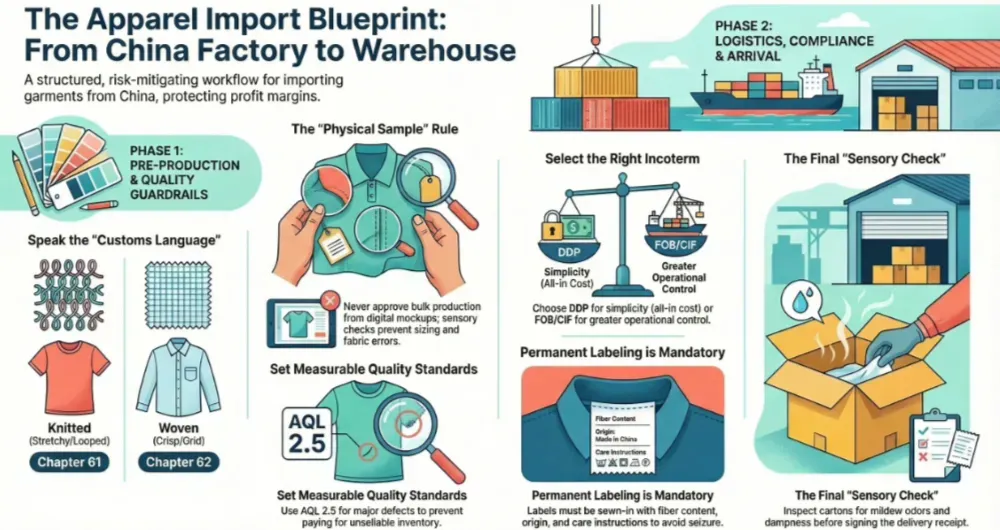
1. Determine the construction method. Pull your fabric sample. If the material stretches easily and features looped yarns, it is knitted (Chapter 61). If it feels crisp, resists stretching, and reveals a crisscross grid, it is woven (Chapter 62).
2. Classify the item and material. Code knitted cotton T-shirts as 6109.10, synthetic women’s sports bras as 6114.30, and woven men’s cotton trousers as 6203.42. I have watched one incorrect digit spike duty rates from 16% to 32% and trigger border holds.
[Image: Close-up macro photograph comparing the stretchy, looped texture of a knitted fabric next to the rigid, crisscross grid structure of a woven fabric, with HS Chapters 61 and 62 highlighted.]
3. Run a verification check. Before paying a deposit, request a formal composition sheet from your supplier. Confirm exact fiber percentages and the intended user. Cross-check this data against the official USITC HTS database.
Expected Result: You now possess a precise technical description and a verified 10-digit HS code. Use this data to request apples-to-apples freight estimates for shipping clothes from China.
⚠️ Experience Warning: Do not guess material blends. Customs will lab-test your fabric. If your label says “100% Cotton” but tests as a 95/5 Cotton-Spandex blend, border officials will seize the shipment.
⚡ Power Move: Secure a binding ruling from a licensed customs broker if your garment blends more than three synthetic fibers.
In our China factory, I see founders treat quality control as a factory problem. In reality, strict QC is the true foundation of successfully shipping clothes from China.
1. Vet the supplier. Verify the company type first. Request unedited, in-house factory videos and production photos. Ask for physical samples of comparable previous work. Compare multiple quotes. Do not accept the first price.
2. Execute a sample-first workflow. ⚠️ Warning: Never approve bulk production from a digital mockup. Order a physical sample to conduct a strict sensory check. Feel the fabric weight in your hands. Pull the seams to check stitch tension and seam consistency. Rub the printed logo to ensure a smooth hand feel and test print durability.
Inspect the garment for clean embroidery and trim strength. Wash the sample to assess shrinkage risk. Verify the label placement and test the fit against your spec.
3. Define your Acceptable Quality Limit (AQL). Set measurable standards for your Pre-Shipment Inspection (PSI). Dictate these terms: 0 critical defects, 2.5 major defects, and 4.0 minor defects. Consult the official ISO 2859-1 standard for exact sampling procedures. This prevents you from paying freight for unsellable garments.
Review our garment quality control checklist for specific defect criteria.
4. Control the shipment release. If the PSI fails, pause the shipment release immediately. Specify exactly what the factory must rework. Hold your final 70% payment balance until the goods pass reinspection. If you source from multiple suppliers, instruct your forwarder to wait.
Consolidate the shipment only after every SKU passes quality control.
⚠️ Experience Warning: I watched a client approve a 500-unit bulk run from a 3D mockup to save time. The shipment arrived running two sizes too small. Always hold the physical fabric in your hands before wiring your deposit.
Step 3: Calculate Landed Costs and Choose a Shipping Mode
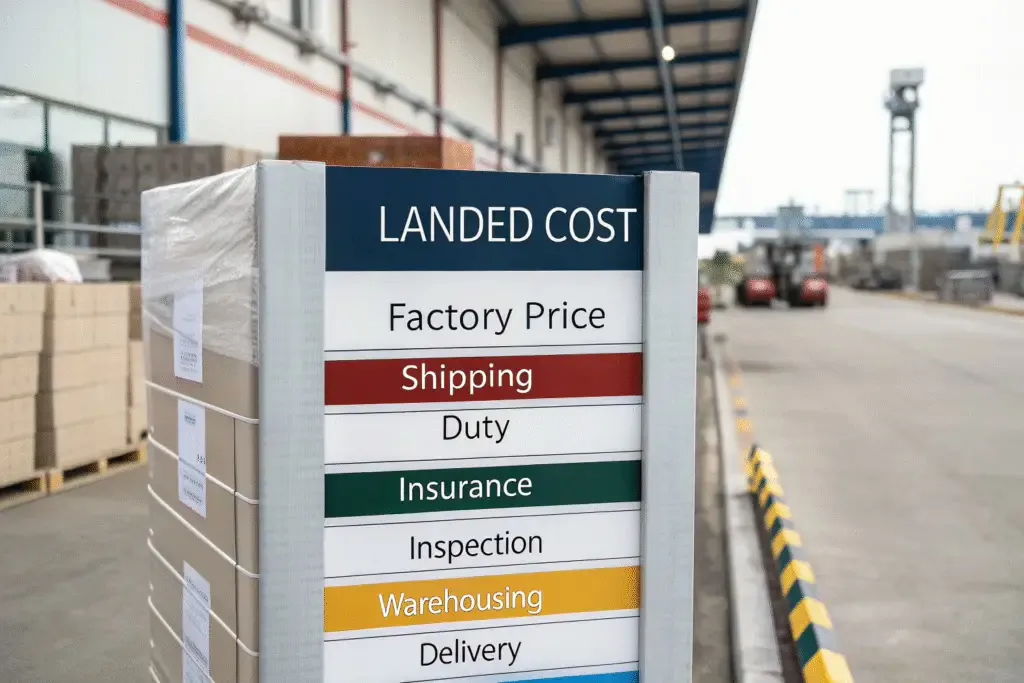
At our China loading docks, I see brands wipe out their margins by treating logistics as an afterthought. When shipping clothes from China, treat freight as a strict unit-economics equation.
Calculate your true landed cost. Add these line items together: Product Cost + Inland China Trucking + Export Handling + Freight + Insurance + Customs Broker + Duty/Tax + Final Delivery.
Use supplier benchmark ranges for directional budgeting only. Specific lanes, peak seasons, and carriers will completely change your final quote.
Select your shipping structure based on urgency, carton volume (CBM), product value density, and launch date.
-
Choose Express for critical samples.
-
Choose Air Freight for fast deliveries. Expect it to crush your profit margins.
-
Choose LCL Sea Freight for medium pallets.
-
Choose FCL Sea Freight for large bulk orders. It is slower but limits humidity exposure compared to mixed containers.
Choose your Incoterm strategy next.
-
Request DDP (Delivered Duty Paid) if you are a beginner. It is operationally easier because it rolls freight and customs into one invoice. Demand full transparency on the exact duty rates charged.
-
Select FOB (Free on Board) or CIF to maximize control for larger operations. Hire your own licensed CBP customs broker for all FOB shipments.
Sea-Rail vs. Air Freight During Chinese New Year (CNY) During our recent peak season tests, traditional air freight prices quadrupled. We booked a hybrid sea-rail route instead. Sea-rail offers a reliable middle path. It costs significantly less than air freight with a stable transit window.
⚠️ Warning: Missing your launch date turns cheap freight into a massive financial liability. Book sea-rail at least four weeks before the CNY shutdown to avoid severe delay risks.
End this step by documenting your chosen Incoterm, shipping mode, and landed-cost range on your spreadsheet.
⚡ Speed Verification: I found that requesting a simple DDP quote takes 24 hours. Setting up an independent FOB broker network takes three weeks.
Step 4: Audit Labels and Prepare Customs Documentation
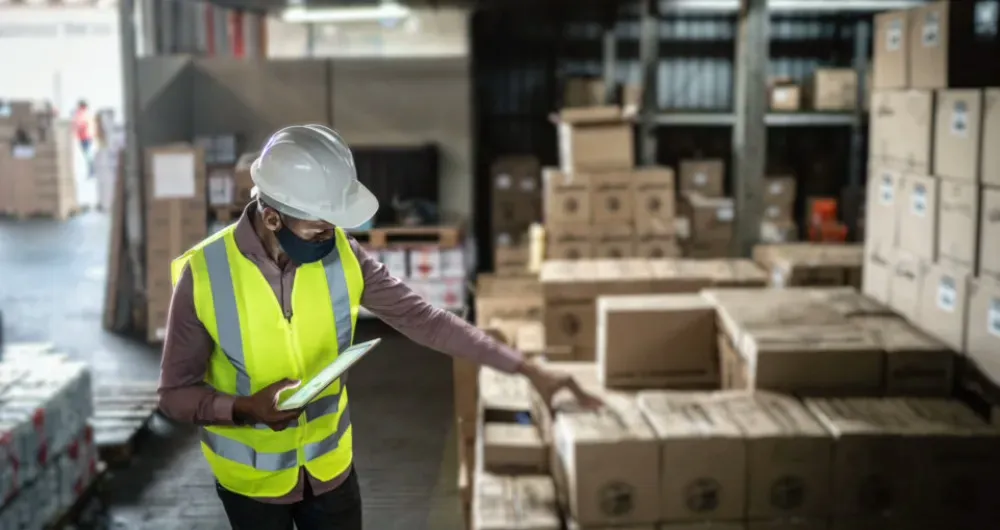
At our China factory, I constantly see founders treat compliance as an afterthought. Fixing a non-compliant label at a U.S. port costs thousands of dollars. Finalize your labels and packaging before goods leave the production floor.
Verify your tags meet updated 2026 U.S. apparel labeling standards. Instruct your supplier to sew permanent labels securely into the neck line or side seam. Do not accept temporary carton stickers for origin statements.
Your physical garment tags must include the exact country of origin, precise fiber content, manufacturer identity, and clear care instructions.
⚠️ Warning: Inspect production samples for common factory mistakes. Watch for inaccurate fiber percentages, easily removable labels, poor English translations, or missing care information.
Gather your critical customs paperwork. Request the Commercial Invoice and Packing List from your supplier. Secure the Bill of Lading or Air Waybill from your forwarder. File your ISF document early for ocean freight. Include a Certificate of Origin or Textile Declaration if requested by your broker.
Prepare your cartons for ocean freight. Pack garments in heavy-duty, double-wall corrugated cartons. Vacuum-pack soft goods to maximize container space. Place active desiccants inside every carton to prevent mold and moisture damage.
Enforce strict carton discipline for Shopify or FBA fulfillment. Apply visible suffocation warnings to every polybag. Print readable product barcodes on the outer packaging. This prevents expensive rework fees upon arrival.
⚠️ Experience Warning: During recent inline inspections, I caught removable origin stickers placed on polybags instead of sewn-in garment tags. U.S. Customs will flag and hold these shipments. Always demand permanent, readable garment labels.
🚀 Actionable Insight: Review the official FTC textile labeling resource to verify tag formatting. If shipping to Amazon, strictly follow the official FBA apparel prep requirements to avoid fulfillment center rejections.
Step 5: Supervise the Loading and Release the Shipment
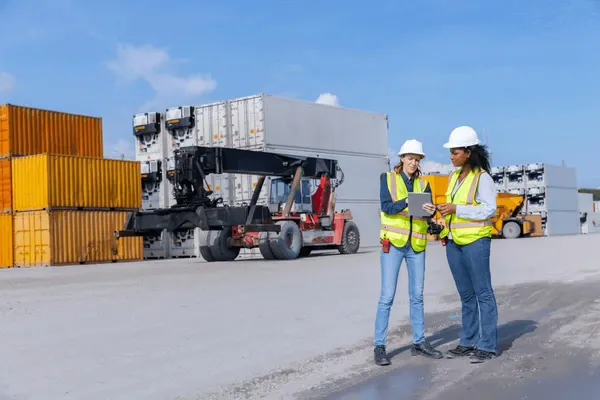
At our China loading docks, I see brands lose control right at the finish line. Approving production does not mean your job is finished. You must actively manage the final handover to the freight forwarder.
Review your Pre-Shipment Inspection (PSI) report.
⚠️ Warning: If the PSI fails, withhold the final balance payment. Instruct the factory to pause loading immediately. Verify the reworked garments before you authorize the release.
Coordinate your logistics for seasonal launches. If sourcing from multiple suppliers, notify your freight forwarder to collect and combine the goods. Wait for the forwarder to issue a single consolidated shipment plan.
Demand loading supervision media before the container doors close. Request clear photos and videos of your cargo. Perform a strict sensory check on the physical cartons. Verify that the carton walls are firm, dry, and free of any mildew smell. Check for unbroken sealing tape and orderly pallet stacking.
Ensure workers hang active desiccants inside the container to prevent moisture damage. Match the final visual count against your Packing List.
Book at least two weeks of buffer time around Chinese New Year and Golden Week. Do not trust standard quoted transit days during these peak blackouts.
Clarify your paperwork ownership if using a DDP workflow. The forwarder handles the export declaration, but you must demand the final-mile tracking number upfront for visibility. Consult the official CBP Cargo Security standards to understand basic container sealing rules.
You are ready to proceed when you possess a confirmed booking receipt, photographic proof of your sealed goods, and an active tracking link.
⚠️ Experience Warning: During loading supervision at our factory, I routinely reject cartons that smell like mildew. A single damp carton will ruin your entire apparel shipment during a 30-day ocean transit. Enforce a strict sensory check before approving the final container seal.
Many logistics guides stop when the ship leaves port. In my experience, the real work begins at your loading dock when shipping clothes from China.
1. Track the final transit stages Monitor the customs clearance process. If you ship DDP, your forwarder automatically pays the import taxes. Port workers deconsolidate your container, and a domestic truck handles last-mile delivery. You can route goods directly to Amazon FBA or a 3PL Warehouse.
However, keep it simple for your first run. Receive the inventory at your own facility.
2. Execute the receive-and-inspect checklist
⚠️ Warning: Do not sign the delivery receipt until you verify the carton count. Signing a clean receipt ignores visible damage and forfeits your transit insurance claims.
-
Count the cartons: Verify the total against your packing list.
-
Check for damage: Inspect the corrugated boxes for crushed corners or tears.
-
Perform a sensory check: Feel the cardboard for dampness. Open a random box and smell the garments. Musty odors indicate trapped container moisture.
-
Verify the garments: Pull a random unit. Compare the fabric, stitching, and tags against your approved physical sample.
-
Spot-check the SKUs: Ensure the sewn-in labels match the exact garment size and color.
3. Perform a commercial closeout
Calculate your actual landed cost per unit. Divide your total invoices by the exact number of sellable garments received. Compare this final number to your budget. Accurate unit economics dictate your survival, especially when analyzing the cost to start a golf clothing brand.
4. Record lessons for the next PO
Document your friction points immediately. Log the actual transit time. Record your final damage rate and exact duty burden. Identify exactly where communication broke down with your forwarder so you can fix it on the next run.
⚠️ Experience Warning: Eager founders often skip the arrival inspection to rush a launch. Discovering mislabeled garments weeks after delivery will destroy your brand reputation. Inspect your goods the minute they hit the floor.
Common Issues
Error: Customs Hold or Surprise DDP Charges
Likely Cause: Missing ISF paperwork, vague commercial invoices, or an incorrect HS code.
The Fix:
-
Pull your commercial invoice immediately.
-
Verify your exact fabric blend against the official CBP Harmonized Tariff Schedule.
-
Submit the corrected paperwork to your customs broker.
💡 Diagnostic: In our testing, cheap DDP quotes hide real duty costs. Always demand a transparent breakdown before booking freight.
Error: Bulk Production Fails Sample Match
Likely Cause: Skipping a Pre-Shipment Inspection (PSI) or lacking a signed sample standard.
Warning: Never release the final balance payment before receiving physical proof.
The Fix:
-
Pause your final payment.
-
Run an inspection based on the ISO 2859-1 AQL standard. Use our internal QC checklist.
-
Demand factory rework before workers seal the cartons.
Error: Cartons Arrive Damp or Moldy
Likely Cause: Sea freight condensation destroys poorly packed garments. Loading in humid conditions accelerates this.
The Fix:
-
Request double-wall corrugated shipping cartons.
-
Drop active desiccants inside every single box.
-
Vacuum-seal soft goods to block ambient moisture.
🤫 Insider Secret: I found that loading during summer months guarantees mold. Strictly mandate inner plastic linings on the factory floor.
Error: Amazon FBA Rejects the Shipment
Likely Cause: Polybags lack suffocation warnings or feature unreadable barcodes.
Warning: Amazon charges exorbitant per-unit fees to rebag goods. Fix this upstream.
The Fix:
-
Check the Amazon Seller Central packaging guidelines.
-
Print FNSKU labels directly at the factory.
-
Apply suffocation warnings to all bags before export.
🛡️ Prevention: Define your claims responsibility in your contract before shipping clothes from China. State exactly who pays for defective units discovered after warehouse arrival.
📝 Editor’s Verdict: Most import failures stem from rushing the final phase. Never let your supplier book freight until you hold a passed inspection report.
People Also Ask About Shipping Clothes from China
Do I need an import license to ship clothes from China to the US?
No. You do not need a general import license to bring apparel into the United States. However, you must act as the Importer of Record (IOR). You must also buy a Customs bond for commercial shipments valued over $2,500. Customs will require your Employer Identification Number (EIN) to process the entry.
My Experience: I watch new founders panic over import licenses constantly. If you choose our DDP shipping terms, our partner forwarder manages the Customs bond and clears the goods for you.
How much are import duties on clothing from China?
Apparel import duties generally range from 16% to 32%. The exact rate depends entirely on your fabric blend and garment construction. Synthetic materials usually trigger higher tax rates than natural fibers like cotton.
Author’s Take: In our China factory, we see clients shock their budgets by assuming a flat 10% tax. I found that a simple switch from a basic polyester to a specialized nylon-spandex blend can completely change your tax bracket. Always classify your SKU before you start bulk production.
How long does it take to ship apparel from China?
Air freight delivers your garments in 5 to 10 days. Ocean freight requires 25 to 40 days to reach your loading dock. Express couriers deliver your physical samples in 3 to 5 days.
My Experience: I track hundreds of containers every year. During the Q4 peak season, I always tell clients to add 14 days to any ocean freight estimate. If you cut your timeline too close, port congestion will ruin your launch.
Conclusion: Move From Planning to Production
You now have a complete import workflow, from HS classification to warehouse receiving. Based on managing thousands of shipments from our China factory, I know that planning your logistics during the sampling phase directly protects your profit margins.
Take immediate action today. Shortlist your suppliers and classify your first SKU. Always request an all-in freight quote and an AQL inspection plan before you pay a production deposit.
If you want a factory partner who manages high-quality manufacturing and DDP shipping in one seamless step, visit LeelineWear to see our full capabilities. Ready to launch your custom collection without the logistics headache? Contact us today to secure your production slot.
Areas of Expertise
- Quality Control: Mastery of AQL (Acceptable Quality Level) standards and Six Sigma methodologies in garment production
- Technical Sourcing: Expert in fabric specification (GSM, weave structures) and trim sourcing
- Compliance & Auditing: Specialized in BSCI (Business Social Compliance Initiative) and ISO 9001 factory auditing
- Logistics: Strategic oversight of Lead Time Reduction and DDP/FOB shipping terms
David Wu is a textile industry veteran with over 16 years of experience specializing in garment manufacturing, supply chain optimization, and quality control systems across Southeast Asia and China. His career is defined by implementing rigorous AQL 2.5/4.0 inspection protocols for mid-to-large-scale private label brands. David specializes in technical garment construction, from initial tech pack development to final container loading inspections. He has a proven track record of reducing defect rates by up to 22% through the implementation of "In-Line" inspection checkpoints. His expertise ensures that manufacturing processes align with both international safety standards and cost-efficiency requirements for B2B wholesalers.