It depends on your technical risk. For complex activewear, an agent is vital insurance; we frequently see legging seams fail after 20 washes when stitch tension isn’t calibrated on-site. However, agents are redundant if you partner with a vertically integrated factory.
Warning: The market is rife with hidden 10-15% kickbacks. If your manufacturer handles sourcing and QC directly, do not pay for an Apparel Sourcing Agent as a middleman.
Key Takeaways
-
Fee Reality: “Free” sourcing usually hides 10–15% kickbacks in the factory price. If you value profit margins, ask for a Flat Retainer or clear Commission structure to align incentives.
-
Incoterms Snapshot: FOB prices look low but leave you liable for surprise port fees and customs risks. If you lack a logistics team, request DDP (Delivered Duty Paid) to lock in your total landed cost.
-
QC Requirements: Final inspections often miss internal stitch failures in activewear. Mandate Inline Inspection (during sewing) alongside standard AQL 2.5 checks to catch defects before packing.
-
Compliance Verification: Never trust a PDF sent via email. Verify WRAP or SEDEX audits directly in the provider’s database to ensure you aren’t funding unauthorized subcontracting.
-
Low MOQ Limits: Agents often dump orders under 300 units on unvetted job shops. Ask explicitly: “Do you run a dedicated Micro-Run Line for small batches?”
-
Sustainable Sourcing: Generic certificates prove nothing. Demand a Transaction Certificate (TC) linked to your specific invoice number to verify the chain-of-custody.
Note: If you only read one section, read the Factory Floor red flags + the certification verification checklist.
What a Apparel Sourcing Agent Should Do (The Scope Menu)
Many brands hire agents assuming the job is simply “finding a factory.” This is a fundamental error. In our experience, finding a manufacturer is easy; managing their output is the hard part. A competent agent acts as a Fashion Supply Chain Partner, not a phone book.
If your potential agent cannot explain the technical workflow below, they are not managing your production—they are merely forwarding emails. A true agent handles the entire scope:
-
Clothing Manufacturing Consultants: They advise on vendor selection based on specific machinery (e.g., Santoni seamless knitting vs. standard cut-and-sew) rather than just price.
-
Garment Production Management: They own the calendar. This includes scheduling the Pre-Production (PP) meeting, managing the critical path to delivery, and enforcing approval deadlines.
-
Overseas Apparel Procurement: They handle negotiation and logistics coordination, ensuring zippers arrive at the factory before the fabric is cut.
🧠 Author’s Take: The most dangerous agent is the one who says “yes” to everything. Real management involves pushing back when a timeline is unrealistic or a fabric choice creates high failure rates.
The Apparel Workflow: Where Activewear Fails

Activewear is unforgiving. Unlike a cotton t-shirt, performance wear relies on chemical treatments, specific elasticity, and precise thread tension. Here is where the workflow typically breaks down and where an agent earns their fee.
Tech Pack Development (The Contract)
The tech pack is your legal contract. If a detail is not in the pack, the factory is not required to execute it. A common failure we see is brands sending a photo of Lululemon leggings and expecting an exact copy. Clothing tech pack development must be the single source of truth:
-
Sketches & BOM: A detailed Bill of Materials listing every thread and label.
-
Grading: How measurements change between sizes. This is critical for compression wear; if graded poorly, a Small fits perfect but a Large becomes see-through.
-
Activewear Add-ons: You must specify stretch/recovery targets and GSM (grams per square meter).
-
Performance Testing: Explicitly list requirements for opacity (squat-proof testing), pilling resistance, and colorfastness against sweat.
Fabric + Trims Sourcing (The Bait and Switch)
In sustainable textile sourcing, substitution is the primary risk. A factory may send a high-quality “hand feel” sample to get the order, then swap it for a cheaper synthetic blend in bulk production. Agents must manage:
-
Lab Dips: Small swatches to approve color accuracy under different light sources (D65 vs. TL84).
-
Strike-offs: Printed fabric samples to check pattern alignment and ink penetration.
-
Locking Specs: We keep a signed “master sample” in our office to compare against the bulk arrival.
PP Sample + Pre-Production Meeting
This is the “point of no return.” Before the factory cuts expensive fabric, we hold a PP meeting to align on construction. We verify needle control (to prevent metal fragments) and packaging. If an agent skips this meeting, they are gambling with your capital.
How Apparel Sourcing Agent Charge (The Incentive Trap)

Understanding how you pay determines whose side the agent is on. We typically see three models:
-
Commission (% of PO): The agent takes 3–10% of the order value.
- The Trap: This incentivizes them to negotiate higher prices with the factory to increase their cut. They have no financial reason to lower your costs.
-
Flat Fee Per Project: You pay a set price for sourcing, regardless of order size.
- The Benefit: This aligns incentives. The agent works to find the best price and quality because their fee is already secured.
-
Retainer / Hybrid: A monthly fee plus a lower commission. This is common for long-term Clothing Manufacturing Consultants who manage multiple seasonal collections.
⚠️ Red Flag Pricing: If an agent claims their service is free, they are taking a hidden kickback from the factory (often 10–15%). This destroys your transparency and negotiation leverage.
Incoterms Deep Dive (FOB vs. CIF)
Shipping terms (Incoterms) dictate where your liability ends and the buyer’s begins. According to ICC Incoterms Guidance, choosing the wrong term can inflate landed costs by over 10%.
The Two Terms You Must Know
-
FOB (Free on Board): The factory is responsible until the goods are loaded onto the ship. You control the freight forwarder.
- Verdict: This is the professional standard. You control the shipping speed and cost.
-
CIF (Cost, Insurance, and Freight): The seller pays freight to your destination port.
- Verdict: Dangerous for beginners. The seller often chooses the cheapest, slowest carrier and hides profit in the freight margin.
The “Hidden 5–10%”
We often see brands blindsided by bills upon arrival. These costs include:
-
Destination Charges: Local port handling fees (DTHC).
-
Customs Broker Fees: Paying a licensed agent to file your paperwork.
-
Volumetric Weight: Activewear is light but bulky. If an agent does not optimize carton dimensions (e.g., vacuum packing), you pay for shipping “air.”
-
HS Classification: Incorrect codes trigger higher duty rates. An expert agent consolidates shipments and negotiates FOB at the correct port to minimize these leaks.
Landed Cost Example (The Real Math)
Your unit cost is not your profit margin. You must calculate the Landed Cost—the total price to get the product to your warehouse door.
Example Calculation:
-
Unit Cost (FOB): $10.00
-
Agent Fee (10%): $1.00
-
Freight (Sea): $1.50
-
Duties (16% on Unit + Freight): $1.84
-
Inland Freight (Trucking): $0.50
-
QC & Buffer: $0.50
-
Total Landed Cost: $15.34
DDP vs. FOB Comparison
| Cost Component | FOB (You Manage) | DDP (Factory Manages) |
|---|---|---|
| Risk | You are liable for customs delays. | Factory is liable until delivery. |
| Effort | High (Hire broker, track ship). | Low (Pay one price). |
| Price Clarity | Variable (Market rates fluctuate). | Fixed (Locked in upfront). |
Table Note: DDP (Delivered Duty Paid) is often safer for SMBs because it locks in the final price, preventing surprise tax bills.
Quality Control That Matters in Activewear
Activewear requires stricter QC than fast fashion. A leggings seam that bursts during a squat is a brand-killer. We use AQL (Acceptable Quality Limit), a statistical method to determine how many units to inspect based on the lot size.
For activewear, you cannot rely only on a Final Random Inspection. By then, the products are packed. If the stitching is bad, the whole batch is ruined.
Required QC Milestones:
-
Factory Audit: Verify capability and social compliance before booking.
-
Inline Inspection (DUPRO): We inspect goods during production (10–20% complete). We check stitch density and seam strength while the machines are running. This allows us to recalibrate tension immediately.
-
Final Inspection: We check for shrinkage, skew (twisting seams), and color shading.
🔬 The Science: For sportswear, we mandate a needle detector test. Broken needle tips can get stuck in seams during high-speed sewing. This is a crucial safety check for close-fitting garments. (Source: ISO Inspection Standards)
Compliance Certifications Checklist
Sustainability claims are useless without verification. We follow a strict rule: If it’s not in the database, it doesn’t exist.
The Essential Checklist:
-
WRAP (Worldwide Responsible Accredited Production): Verifies social compliance (no child labor, safe conditions). Verify via the WRAP Verification Tool.
-
GOTS (Global Organic Textile Standard): Required for “Organic Cotton” claims. Verify via the GOTS Public Database.
-
SEDEX / SMETA: An ethical trade auditing system focusing on labor rights. Reference SEDEX Guidance.
Why Third-Party Verification is Non-Negotiable We check the Certificate Scope. A factory might have a certificate for their office, but not the sewing floor. We also check validity dates and ensure the legal entity name matches the bank account you are paying.
The LeelineWear Difference: Factory-Direct + Service
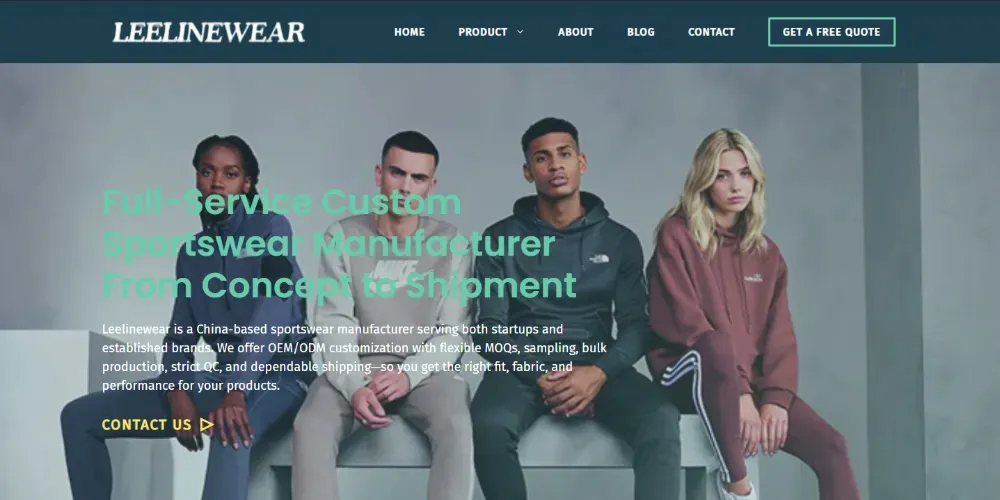
There is a distinct difference between hiring a trading company and working with a Factory-Direct partner like LeelineWear.
Trading companies add a layer of cost and communication delay. LeelineWear operates as a Factory-Direct + Service Layer model. We own the manufacturing assets (20,000 sqm facility in China), which gives us direct control over the production queue and quality. However, we also provide the English-speaking service layer of a consultancy.
Where Factory-Direct Wins:
-
Micro-MOQs: Because we own the lines, we can run small batches (50–100 units) that larger agents cannot book.
-
Direct QC: Our inline inspectors report to us, not a third party.
-
Speed: We skip the middleman negotiation phase entirely.
If you are looking to build a supply chain that scales from 50 units to 50,000, view our comparison on Sportswear Manufacturers: China vs Europe or learn How to Find Sportswear Manufacturers that fit your business model.
Ready to secure your supply chain? Contact LeelineWear today.
Exceptions: When Standard Advice Fails
General sourcing rules work for general products. They fail for specialized activewear.
In over a decade of managing production lines, we have seen generic advice destroy specific business models. A standard commission structure might work for a t-shirt drop, but it often bankrupts a startup trying to engineer a new compression fabric.
To survive, you must apply conditional logic. If you fit the profiles below, ignore the standard advice and follow these specific modifications.
Scenario 1: The “Influencer” Startup (No Tech Pack)
Condition: You have a large audience and a design idea, but no technical package.
⚠️ Warning: Do not hire a traditional sourcing agent yet. You will burn your budget shipping bad samples back and forth.
The Pitfall: Sourcing agents are finders, not designers. If you send a factory a sketch without a Tech Pack (specific measurements, grading rules, and fabric specs), they will guess. In our experience, 90% of these “guesses” result in samples that fit poorly. You end up paying courier fees for products that are fundamentally flawed.
The Fix: Hire a Technical Developer or a full-package partner first.
-
Don’t: Pay a commission on goods you haven’t defined.
-
Do: Pay a flat fee for a Tech Pack and Bill of Materials (BOM).
-
Why: We once saw a client spend six months “sourcing” a legging. Once they paid for a professional tech pack, they received a perfect sample in 14 days.
Scenario 2: Low MOQ vs. “True Custom”

Condition: You want under 300 pieces per style, but require a custom-knit fabric blend.
⚖️ The Trade-off: You cannot have both ultra-low volume and custom material engineering.
The Pitfall: Low Minimum Order Quantity (MOQ) manufacturing relies on speed and stock materials. If you demand a custom knit (e.g., a specific Nylon 6.6 weave), the material supplier—not the sewing factory—will demand a purchase of 1,000+ yards.
The Fix:
-
Accept Stock Fabric: Ask the agent for “available market greige.”
-
Customize the Cut: Differentiate your product through fit and print, not the base weave.
-
Split the Run: If you must have custom fabric, split the 1,000-yard material minimum across four different styles (e.g., leggings, sports bras, and shorts in the same color).
Scenario 3: The Scaling Retailer (50+ SKUs)
Condition: You are a mid-sized brand with a Supply Chain Manager.
The Pitfall: For startups, price is king. For scaling brands, reliability is king. We have seen brands lose an entire season because their “cheapest” factory was shut down for a week during a regional power audit.
The Fix: Shift your KPI from “Lowest Unit Cost” to “Redundancy.”
-
Split Production: Mandate that your agent allocates orders 70/30 between two different facilities.
-
Demand Visibility: Require a weekly critical path report. If the agent cannot tell you exactly where the zippers are physically located today, they are not managing your risk.
Scenario 4: The Sustainability-First Brand
Condition: Your brand marketing claims “100% Recycled” or “Ethical Labor.”
⚠️ Warning: A PDF sent via email proves nothing. Greenwashing is rampant.
The Pitfall: We frequently encounter factories that present a valid organic certificate belonging to a different factory. In other cases, they purchase 100 yards of organic cotton for the audit but use conventional cotton for your actual bulk order.
The Fix: Demand the Transaction Certificate (TC).
-
The Rule: A general certificate verifies the factory exists. A Transaction Certificate verifies the specific movement of fabric for your order.
-
The Check: If the agent cannot provide a TC linked to your specific Invoice Number, the material is likely not certified.
-
EU Compliance: If selling to Europe, demand a REACH test report to ensure no restricted chemicals (like azo dyes) are present.
Scenario 5: View from the Factory Floor — Audit Red Flags
Condition: You (or your agent) are physically auditing the factory.
Paperwork can be faked; physical floors cannot. During our walkthroughs, we look for these specific “silent” killers.
1. Dim Lighting on the Lines
-
The Sign: The sewing floor relies on natural light or has dim overheads.
-
The Risk: Operators cannot see skipped stitches or oil stains on black fabric.
-
The Ask: “Show me the Lux meter reading for the finishing station.” (Standard is 1000+ Lux).
2. The “Broken Needle” Void
-
The Sign: No logbook for broken needles.
-
The Risk: Consumer Liability. If a needle tip breaks off inside a legging and isn’t retrieved, it can injure a customer. In the US, this is a massive lawsuit risk.
-
The Ask: “Show me the broken needle replacement record for Line 4.” If they can’t find it, walk away.
3. Uncalibrated Detectors
-
The Sign: A metal detector is present, but there are no daily check logs.
-
The Risk: The machine is just furniture. It may be turned off to save power or calibrated incorrectly.
-
The Ask: “Please run the 1.0mm calibration card through the detector right now.”
4. Cutting Room Chaos
-
The Sign: Fabric rolls are stacked without ID tags; cut panels are mixed in piles.
-
The Risk: Shading. If panels from Roll A and Roll B are sewn together, your leggings will have two slightly different shades of black.
-
The Ask: “How do you number your plies to prevent shading?”
5. Chemical Storage Hazards
-
The Sign: Unlabeled plastic jugs of spot-remover solvent near the sewing line.
-
The Risk: This violates strict safety laws (OSHA/EU). It indicates poor management and high fire risk.
-
The Ask: “Where is your MSDS (Material Safety Data Sheet) binder?”
Practical Close: The Decision Matrix
Do not overcomplicate the choice. Use this grid to decide your path.
| Your Situation | Best Partner Model | Why? |
|---|---|---|
| Idea Phase / <100 Units | Factory-Direct (Agile) | You need development support and low MOQs, not a middleman fee. |
| Scaling / 1,000+ Units | Sourcing Agent | You need someone to manage logistics and fight for pennies on the unit cost. |
| Custom Tech Fabric | Textile Mill + CM | Go direct to the fabric mill first, then find a Cut & Make (CM) factory. |
Our Verdict: If you need the low MOQs of a startup but the quality control of a big brand, you likely need a hybrid partner. LeelineWear owns the factory floor, meaning we control the needle detectors, the lighting, and the schedule—no middleman required.
Stop guessing. Contact our team to start your production on the right track.
People Also Ask About Apparel Sourcing Agent
1. What’s the difference between a sourcing agent and a trading company?
Transparency. A sourcing agent charges a visible fee (3–10%) to manage your supply chain. A trading company acts as a reseller, often hiding a 15–30% markup within the unit price. In my experience, trading companies rarely disclose the actual factory identity, trapping you in their ecosystem.
2. What commission is ‘normal’ for apparel sourcing agents?
Expect 3% to 10% of the total order value. Rates depend on order volume—higher volume equals lower percentage. Warning: If an agent quotes below 3%, they are likely receiving undisclosed kickbacks from the factory, which compromises their ability to negotiate on your behalf.
3. Can an agent guarantee low MOQs for private label activewear?
Rarely. Most agents refuse orders under 500 units because their commission is too small to justify the work. For micro-runs (50–100 units), we find that working Factory-Direct with a manufacturer like LeelineWear is the only viable path to avoid rejection.
4. What is a factory audit and what should I receive afterward?
An audit is a physical health check of the facility. You must demand a Corrective and Preventive Action (CAPA) plan, not just a pass/fail grade. In our audits, we require photo evidence of specific machinery (like needle detectors) and copies of recent wage slips to verify labor compliance.
5. Do I still need an agent if I work with a factory-direct partner?
No, it is redundant. If your manufacturer offers English-speaking project management and logistics (like LeelineWear), hiring an agent just adds an unnecessary layer of cost and communication lag. Save the 10% fee and invest it in better fabric.
Suggested Reading: To decide which region suits your budget, compare Sportswear Manufacturers: China vs Europe. For a step-by-step sourcing roadmap, read our guide on How to Find Sportswear Manufacturers.
Ready to Cut Out the Middleman?
If you want factory-direct activewear manufacturing with low MOQs (starting at 50 pieces) and on-ground QC, contact LeelineWear. We own the production lines, so you don’t pay agent markups.
Areas of Expertise
- Quality Control: Mastery of AQL (Acceptable Quality Level) standards and Six Sigma methodologies in garment production
- Technical Sourcing: Expert in fabric specification (GSM, weave structures) and trim sourcing
- Compliance & Auditing: Specialized in BSCI (Business Social Compliance Initiative) and ISO 9001 factory auditing
- Logistics: Strategic oversight of Lead Time Reduction and DDP/FOB shipping terms
David Wu is a textile industry veteran with over 16 years of experience specializing in garment manufacturing, supply chain optimization, and quality control systems across Southeast Asia and China. His career is defined by implementing rigorous AQL 2.5/4.0 inspection protocols for mid-to-large-scale private label brands. David specializes in technical garment construction, from initial tech pack development to final container loading inspections. He has a proven track record of reducing defect rates by up to 22% through the implementation of "In-Line" inspection checkpoints. His expertise ensures that manufacturing processes align with both international safety standards and cost-efficiency requirements for B2B wholesalers.