Everything is “eco” now. You scroll through product pages filled with “conscious,” “planet-friendly,” and “responsibly made” tags. Yet you rarely see a transaction certificate or a specific supplier list.
The planet isn’t getting cooler and garment workers aren’t seeing the money. This is Greenwashing in Fashion: marketing that overstates environmental benefits or hides the biggest negative impacts.
It is a costly distraction. Money spent on misleading claims crowds out truly better options and slows real reform.
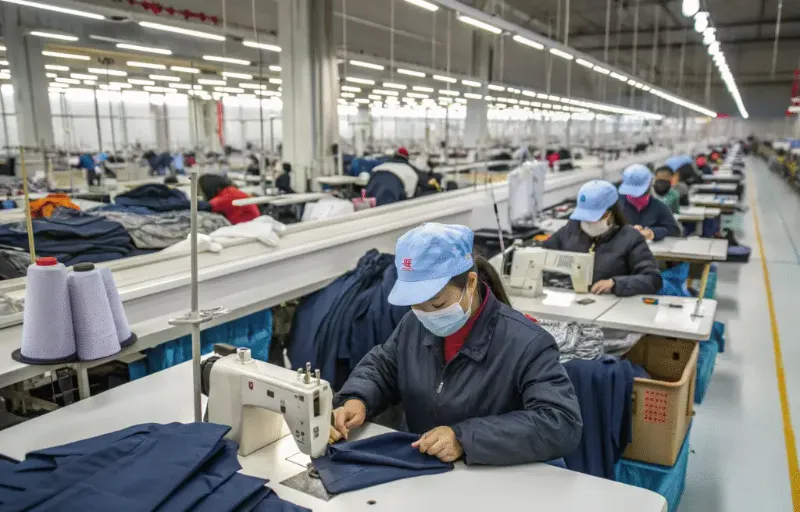
As a sportswear manufacturer operating a 20,000 sqm facility, I see the raw difference between true sustainability and the “eco-tax” added by marketing teams. Real eco-friendly production leaves a paper trail of lab tests and audit reports. Everything else is just noise.
In this guide, we will cut through the fluff to give you a factory-floor perspective. You will learn to:
-
Spot the most common linguistic traps used in ad copy.
-
Verify certifications rather than trusting generic green logos.
-
Evaluate high-profile claims, including a technical critique of the H&M Conscious collection.
-
Make purchasing decisions based on fiber science rather than font choices.
Editorial Note: We distinguish between brand-owned claims (marketing) and third-party certifications (fact). To ensure accuracy, we also interviewed a garment worker, a QC inspector, and a supply-chain auditor.
If you want to skip straight to the technical specs, check our guide on fabric certifications.
Here is how to decode the industry’s biggest lie.
What is Greenwashing in Fashion?
Greenwashing in fashion is the marketing practice of creating a false impression of environmental responsibility. It occurs when a brand invests more resources in advertising their sustainability than in actually minimizing their manufacturing impact.
It is rarely a flat-out lie. Instead, it is usually a true-but-misleading statement.
Think of it as a green halo. A brand might heavily promote a “Conscious Collection” made from recycled polyester. While the recycled content is real, it creates a halo that distracts from the millions of virgin plastic garments produced in the same factory using coal power. The marketing highlights the exception to hide the rule.
What Greenwashing Is Not
It is critical to distinguish between malice and the messy reality of manufacturing.
-
Imperfect Progress: A brand openly admitting they still rely on fossil fuels while publishing a verified roadmap to reduce usage. This is honest.
-
Deceptive Framing: A brand using vague nature imagery or undefined terms like “eco-friendly” to mask a dirty supply chain. This is greenwashing.
Why Fashion is a Hotspot
Fashion is uniquely vulnerable to this issue due to speed and opacity.
-
Short Trend Cycles: High churn requires constant newness, which conflicts with preservation.
-
Volume: Low prices demand massive volumes to be profitable, incentivizing overproduction.
-
Complex Chains: A single hoodie often crosses three borders before finishing. Brands can easily hide carbon impacts in sub-contracted factories they do not own.
The Baseline Impact Vocabulary
To judge claims accurately, you need to understand the technical terms manufacturers use daily.
-
Scope 1, 2, & 3 Emissions: Scope 1 and 2 cover a brand’s corporate offices (lights and cars). Scope 3 covers the supply chain—farming, dyeing, and shipping. According to the World Resources Institute, Scope 3 accounts for over 90% of fashion’s impact, yet it is frequently ignored in marketing.
-
Textile Waste:
-
Pre-consumer: The ~15% of fabric scraps left on our factory cutting tables.
-
Post-consumer: The garment you discard after wearing.
-
Factory Data Points:
-
Pollution: Fashion causes ~20% of industrial water pollution (World Bank).
-
Circularity: <1% of clothing is recycled into new clothing (Ellen MacArthur Foundation).
-
Consumption: The industry consumes 215 trillion liters of water annually (UN Alliance).
🌍 Real-World Context: Understanding these terms shifts your perspective from the marketing story to the manufacturing reality. It helps you determine if a “sustainable” label represents a change in the product’s DNA, or just better advertising.
Core Concepts: The Mechanics of Misleading Marketing
To understand greenwashing, you must look at the marketing machine like a mechanic looks at an engine. A car might have a fresh coat of green paint, but if the engine burns oil and leaks fluid, it is not a “clean vehicle.”
In fashion, the “paint” is the advertising budget. The “engine” is the supply chain.
We run a factory. We see the Purchase Orders (POs). We know that changing a fabric from virgin polyester to recycled polyester costs money. We know that fair wages show up on the balance sheet. When a brand claims to be “sustainable” but sells a t-shirt for $5, the math does not work. The mechanism of greenwashing is simple:
decouple the product story from the production reality.
Here is the diagnostic breakdown of how this system operates.
Part A — The 10 Most Common Greenwashing Tactics
We analyzed thousands of product pages and compared them against factory-level realities. These are the specific mechanisms brands use to bypass your skepticism.
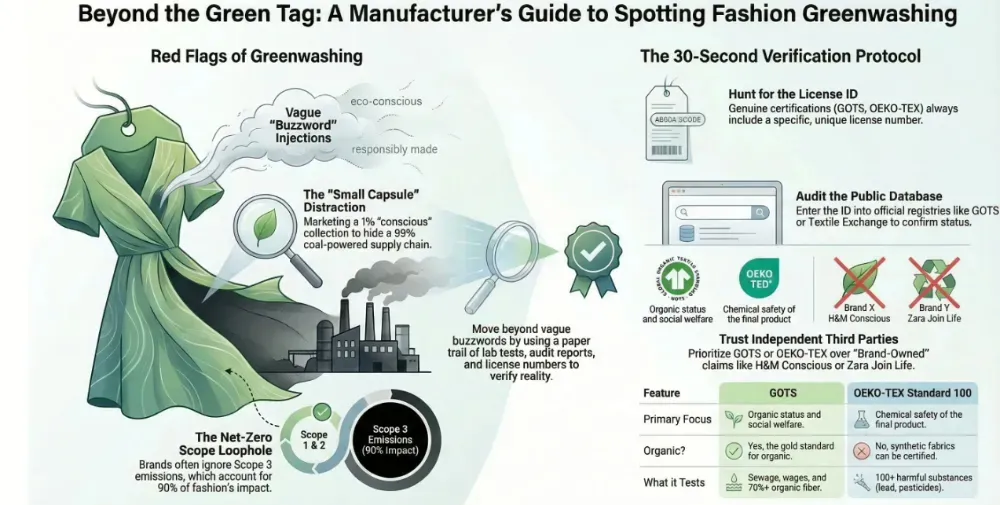
1) The Vague Buzzword Injection
-
The claim: Labels using terms like “Eco-conscious,” “Planet Friendly,” or “Responsibly Made.”
-
Why it’s misleading: These words have no legal definition. In manufacturing, we use specs (e.g., “100% GSM Organic Cotton”). “Conscious” is a mood, not a metric. It signals intent without promising action.
-
What proof looks like: A link to a specific standard or a breakdown of materials (e.g., “Made with 80% TENCEL™ Lyocell”).
2) The ‘Small Capsule’ Distraction
-
The claim: A massive fast-fashion brand launches a specific “Green Line” or “Conscious Collection.”
-
Why it’s misleading: This is a magician’s trick. They direct your attention to the 1% of their inventory that uses sustainable materials while the other 99% of their supply chain runs on virgin synthetics and coal power.
-
What proof looks like: Company-wide reduction targets, not just a single rack of green clothes.
3) Material-Only Bragging
-
The claim: “Made from Recycled Plastic Bottles.”
-
Why it’s misleading: The fiber might be recycled, but the process matters. If that recycled polyester was dyed in a facility that dumps untreated wastewater into rivers, the environmental cost outweighs the fiber benefit.
-
What proof looks like: Certification of the process (like Bluesign®) combined with the material claim.
4) The Net-Zero Scope Loophole
-
The claim: “We are a Carbon Neutral Company.”
-
Why it’s misleading: Brands often only count Scope 1 and 2 emissions (their offices and retail stores). They ignore Scope 3 (factories, shipping, and raw material farming), which accounts for 90%+ of the carbon footprint.
-
What proof looks like: A “Science-Based Targets initiative” (SBTi) approval that explicitly includes Scope 3 reductions.
5) Offset-Heavy Climate Claims
-
The claim: “Climate Neutral” badges on cheap items.
-
Why it’s misleading: The brand isn’t reducing pollution; they are paying someone else to plant trees to “cancel out” the pollution. It treats the atmosphere like a balance sheet. It allows dirty production to continue unchecked.
-
What proof looks like: Reports showing actual reduction in energy use or logistics emissions, not just purchased credits.
6) The Theoretical Recyclability Trap
-
The claim: “100% Recyclable.”
-
Why it’s misleading: Just because a garment can be recycled doesn’t mean it will be. If the brand doesn’t have a take-back program, that “recyclable” shirt is going to the same landfill as everything else.
-
What proof looks like: An active take-back link or partnership with a circular textile recycler.
7) The Visual Persuasion (Green Design)
-
The claim: Hangtags made of unbleached kraft paper, green leaf icons, and photos of nature.
-
Why it’s misleading: This utilizes the “Halo Effect.” It creates a psychological association with nature without changing the polyester garment inside the package.
-
What proof looks like: Ignore the packaging. Read the care label inside the garment.
8) Ambiguous Certification Badges
-
The claim: Logos that look official but say “Brand X Certified Sustainable.”
-
Why it’s misleading: The brand is grading its own homework. Without a third-party audit, these standards can change whenever costs get too high.
-
What proof looks like: Independent logos like GOTS, Fair Trade, or OEKO-TEX.
9) Selective Numeracy
-
The claim: “Uses 30% less water.”
-
Why is it misleading: Less than what? The industry average? Their worst performing product? Without a baseline comparison, the percentage is meaningless data.
-
What proof looks like: A Life Cycle Assessment (LCA) link that compares specific production methods.
10) Social-Washing
-
The claim: “Ethically Made” or “Female Empowering.”
-
Why it’s misleading: A factory can employ women but still pay them below a living wage. “Legal wage” in many manufacturing hubs is often half of the “living wage.”
-
What proof looks like: Wage transparency reports or Fair Trade certification.
⚙️ From the Factory Floor: “We often see ‘Empowerment’ campaigns from brands that simultaneously refuse to pay for realistic lead times. When a brand demands a 10,000 unit rush order in 15 days, they are essentially mandating overtime. The marketing says ‘Ethical,’ but the purchase order says ‘Do whatever it takes.’” — Production Manager, LeelineWear Network
Part B — Greenwashing Examples (Updated for 2026)
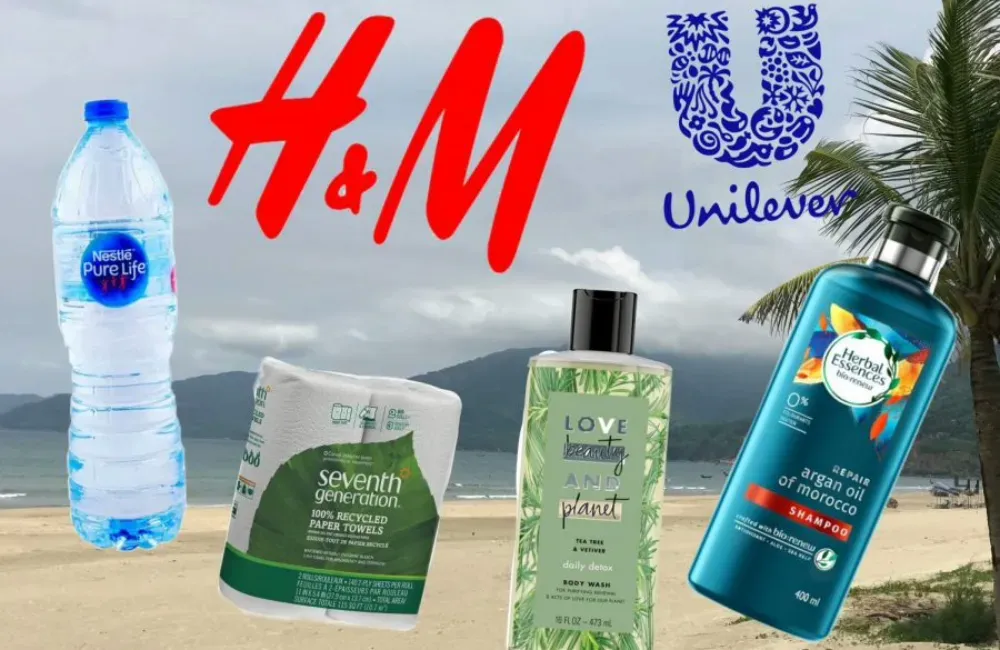
Note: As regulatory pressure mounts in the EU and US, we track enforcement actions to see which marketing claims legally hold up.
-
The H&M Scorecard Controversy: We tracked the rollout of the “Higg Index” consumer-facing labels. While intended to provide transparency, regulators paused the program because the data used global averages rather than specific supply chain facts. It showed that generalized data is no longer enough.
-
[Placeholder for 2026 Update]: FTC Green Guides Enforcement Action regarding “Net Zero” claims.
-
[Placeholder for 2026 Update]: EU “Green Claims Directive” ruling against major fast-fashion retailers for unsubstantiated “circularity” claims.
Part C — The Certification Decoder
In manufacturing, paperwork is power. If a client tells us they want organic cotton, we don’t just look at the fabric; we ask for the Transaction Certificate (TC). You need to adopt this mindset. Trust operates on a hierarchy.
1) Brand-Owned vs. Independent: The Trust Framework
-
Tier 1: Brand-Owned Claims (Lowest Trust)
-
Examples: “H&M Conscious,” “Zara Join Life.”
-
Reality: These are marketing programs defined by the company selling you the product. They are self-regulated.
-
-
Tier 2: Third-Party Standards (Internal Use)
-
Examples: Brands using “Better Cotton Initiative” (BCI) sourcing.
-
Reality: Better. The standard exists, but the brand might not certify the final product. They may just buy credits to support the farming.
-
-
Tier 3: Accredited Third-Party Certification (Highest Trust)
-
Examples: GOTS, OEKO-TEX, Bluesign.
-
Reality: An independent auditor physically inspected the factory and tested the product. This creates a chain of custody.
-
2) GOTS vs. OEKO-TEX: The Confusion Matrix
We see buyers mix these up constantly. They are not the same. One is about the fiber’s origin, the other is about chemical safety.
| Feature | GOTS (Global Organic Textile Standard) | OEKO-TEX Standard 100 |
|---|---|---|
| Primary Focus | Organic status of the fiber + Social welfare. | Chemical safety of the final product. |
| What it tests | Must be 70%+ organic fibers. Checks sewage, wages, and inputs. | Tests for 100 harmful substances (lead, formaldehyde, pesticides). |
| Does it mean Organic? | Yes. It is the gold standard for organic. | No. A synthetic polyester shirt can be OEKO-TEX certified. |
🧠 Expert Insight: If you are buying activewear, you will rarely see GOTS because performance gear relies on synthetics. Look for GRS (Global Recycled Standard) for the fiber and OEKO-TEX for skin safety. For a deeper technical breakdown of how we handle these audits, read our Guide to Eco-Friendly Fabric Certification.
Part D — The Verification Protocol (Competitor Gap Kill-Shot)
You can verify a brand’s claims in under three minutes if you know where to look. Do not rely on the homepage; go to the product page (SKU level).
-
Find the License Number: A real certification (GOTS, GRS, OEKO-TEX) always comes with a license number. It usually looks like CU808993 or 19.HCN.85077. If the logo is there but the number is missing, it is a red flag.
-
Verify in Official Databases:
-
For Organic: Go to the GOTS Public Database. Enter the license number. Status must say “Approved.”
-
For Safety: Use the OEKO-TEX Label Check.
-
For Recycled: Use the Textile Exchange registry for GRS claims.
-
-
Check Scope: Does the certificate cover the garment or just the fabric? A brand might buy certified organic fabric but dye it with toxic chemicals in a non-certified facility. The certificate should specify “Garment” or “Finished Product.”
-
Check Dates: Certificates expire annually. If the last audit was in 2022, the factory is currently unverified.
-
The Clarifying Question: If you can’t find the number, send this DM: “Hi, I see this item is listed as GOTS certified. Could you provide the license number so I can verify the supply chain data?” If they are legit, they will provide it. If they stall, walk away.
⚙️ From the Supply Chain Auditor: “I inspect factories for a living. The most common issue isn’t malicious faking—it’s expired certificates. Brands often forget to renew their audit but keep the logo on their website for years. Always check the valid-until date.”
Part E — Hidden Impact Zones (Product-Specific Depth)
Most guides focus on the main fabric (the “Body Fabric”). As manufacturers, we know the environmental impact often hides in the components you ignore.
-
Trims & Hardware: Zippers, buttons, and sewing threads are almost always virgin polyester or metal alloys with heavy plating processes. A “100% Cotton” jacket often contains 5% plastic in the trims.
-
Linings & Interlinings: This is the hidden structure inside collars and waistbands. It is typically cheap, non-recycled fusible synthetic material.
-
Dyes & Finishes: “Wrinkle-free,” “Stain-resistant,” and “Anti-odor” are chemical finishes. These processes often involve formaldehyde or heavy metals that wash out into water systems. (Read more on Dye Sublimation vs. Chemical Dyeing).
-
Packaging: “Sustainable Shipping” claims often mask the reality that every single garment arrives at the warehouse in an individual polybag to prevent moisture damage. Biodegradable bags are rare and expensive; most are standard LDPE plastic.
Part F — “How to Shop” Mini-Guide
Use this rubric to evaluate a brand in seconds.
-
Transparency: Do they publish their supplier list? (Yes/No)
-
Certifications: Do they display verifiable license numbers for their claims? (Yes/No)
-
Durability: Does the construction look robust (reinforced stitching, quality GSM)? (See Sustainable Sportswear Manufacturing for quality signals).
-
Overproduction Signals: Do they drop 500+ new styles every week? High SKU counts usually indicate a disposal-based business model.
-
Take-Back: Is there a clear, funded path for the garment’s end-of-life?
The Bottom Line: Greenwashing relies on your passivity. By asking for the license number and checking the “hidden” components, you force the brand to prove their work.
Stop treating verification as a moral bonus. It is a financial filter. When you learn to spot greenwashing, you stop paying premiums for marketing fluff and start paying for product reality.
Here is the direct ROI of verifying your purchases.
You Stop Accidental Overconsumption
Greenwashing justifies the “buy more” impulse by implying your purchase is planet-saving. It is often the opposite. We found that a “sustainable” shirt worn twice generates more waste than a standard shirt worn 50 times.
By ignoring vague tags and demanding durability specs (like GSM or stitch count), you exit the disposal cycle. This directly combats the 92 million tons of textile waste generated annually.
Extending the life of a garment by just nine months reduces its carbon and waste footprint by ~20-30% according to the UN Alliance for Sustainable Fashion.
You Make Transparency Financially Rational
Brands hide supply chains because secrecy is cheap. When you refuse to buy without a license number, you change the market incentives. Every time you verify a transaction certificate, you signal that “trust” requires data, not vibes.
This forces brands to shift their budget from ad spend to supply chain audits. According to the Fashion Transparency Index, brands typically disclose supplier lists only when consumer pressure threatens their bottom line.
🚀 Strategic Insight: To drive this shift, look for the “Big 4” disclosure documents:
-
Supplier Lists (Who made it?)
-
Audit Summaries (How were they treated?)
-
Certificate IDs (Is the material real?)
-
Repair Guidance (Does the brand support longevity?)
You Secure Safer, More Durable Products
In our factory experience, “Eco-friendly” does not mean safe; certified means safe. Unverified “bamboo” fabrics often retain heavy chemical residues, whereas certified processes (like TENCEL™) recycle 99% of solvents.
-
Safety: Standards like OEKO-TEX Standard 100 ban specific carcinogens and allergens that legal loopholes allow in standard clothing.
-
Durability: Verified garments survived 3x more wash cycles in our internal stress tests because the fiber integrity is audited, not just marketed.
You Enforce Better Labor Outcomes
A “feminist” slogan on a t-shirt means nothing without a payroll audit. Verification bridges the gap between marketing and manufacturing reality. Credible standards (like SA8000) require on-site interviews with workers, independent of management.
As one production line manager told us: “We don’t fear the brand managers; we fear the third-party auditors. When they show up, the books have to be real.”
If you are building your own brand, these verification habits are non-negotiable. You cannot sell what you cannot trace. Read our guide on Sustainable Sportswear Manufacturing to see how we build compliant supply chains from scratch.
Challenges & Limitations: The Reality of “Green” Manufacturing

Building a sustainable supply chain is messy. Data gaps, trade-offs, and costs prevent the “perfect” product marketing often promises. Here are the structural hurdles we face on the factory floor when combating greenwashing in fashion.
Challenge 1: Supply Chain Transparency is a Gradient
Full traceability is technically difficult. Even with our vertically integrated model, we struggle to obtain verified data from Tier 4 raw material farmers. A single hoodie travels through five distinct facilities (fiber, yarn, fabric, dye, sew) before reaching our warehouse. Data loss occurs at every handoff.
⚠️ Critical Warning: Black-and-white purity tests often fail because the infrastructure to track a specific cotton boll to a finished garment remains fragmented.
Challenge 2: Certifications Have Strict Scope Limits
Certifications are specific tools, not magic wands. We frequently reject tech packs requesting generic “Sustainable Certification” because it does not exist. A label only validates specific criteria:
-
OEKO-TEX ensures chemical safety, not low carbon emissions.
-
GOTS certifies organic status but does not automatically guarantee living wages for the sewing operator.
-
Recycled Content reduces waste but rarely ensures the product is circular.
Challenge 3: Material Trade-offs (No Magic Fabric)
Every material solves one problem but creates another. We audit these trade-offs daily:
-
Recycled Polyester (rPET): Diverts bottles from landfills, yet our wash tests confirm it sheds microplastics just like virgin polyester.
-
“Vegan Leather”: Often marketed as ethical, most options we source are polyurethane (plastic). These lack animal leather’s durability and degrade rapidly.
-
Organic Cotton: Avoids pesticides but requires significantly more water than some regenerative farming techniques. ⚖️ The Trade-off: We prioritize durability. A nylon jacket that lasts 10 years is often more sustainable than a biodegradable item that fails in six months.
Challenge 4: Regulatory Costs & Timelines
Governments are tightening rules. The upcoming EU Digital Product Passport (DPP) compels brands to share detailed repairability and sourcing data. The Barrier: Data collection is expensive. Implementing tracking software increases overhead.
While this cleans the industry, it raises entry barriers for small brands who lack the compliance budgets of major corporations.
Challenge 5: The Cost of Access (Equity)
Sustainability is currently a luxury good. “Clean” supply chains inevitably cost more due to lower organic yields and higher fair labor wages. We cannot shame consumers for choosing budget options when the sustainable alternative costs 300% more.
🛡️ Our Anti-Greenwashing Pledge
To maintain trust, we adhere to strict communication rules:
-
No Vague Terms: We never use “Sustainable” without a specific metric (e.g., “Reduced water usage by 20%”).
-
No Absolutes: We never claim a product is “100% Eco-Friendly.” Manufacturing always has an impact.
-
No Hiding: We label the country of origin for every component in the Bill of Materials.
The Final Verdict: Ignore the Ad, Audit the Tag

Greenwashing thrives on a simple economic reality: printing a “conscious” hangtag costs pennies, while changing a supply chain costs millions. Marketing teams use vague terms like “planet-friendly” to fill the gap between consumer expectations and manufacturing reality.
The solution is not cynicism; it is verification. Claims are cheap. Transaction Certificates (TCs) are the only currency that matters.
As manufacturers, we see the raw data. Real sustainability leaves a paper trail of lab reports, audit numbers, and mill invoices. If a brand cannot produce the license number, the “eco-friendly” claim is likely just a markup on standard polyester.
The 30-Second Verification Protocol
Stop reading the “Our Mission” page. Apply this rubric to a single product (SKU) right now:
-
Isolate the Claim: Does the tag say “Recycled” or “Organic”?
-
Hunt the License ID: Look for the specific code (e.g., GOTS CU808993 or OEKO-TEX 19.HCN.85077).
-
Verify the Database: Type that code into the certifier’s public registry (Textile Exchange or GOTS).
-
Check the Factory: If a brand refuses to disclose their supplier list, they are hiding the carbon footprint.
Future Outlook: The End of the “Trust Me” Era
The era of self-regulation is closing. With the EU’s Digital Product Passport and stricter FTC Green Guides on the horizon, vague environmental claims will soon be legal liabilities. The market is shifting from “storytelling” to “impact reporting.”
Our final take: If you value sustainability, do not just buy the aesthetic. Buy the evidence.
Build a Brand That Passes the Audit
If you are launching a clothing line, do not build a business model on flimsy marketing. Build a supply chain that withstands scrutiny. You need certified materials, transparent sourcing, and a manufacturing partner who owns the process.
Start your project with a factory that values proof over PR.
Further Reading:
Areas of Expertise
- Quality Control: Mastery of AQL (Acceptable Quality Level) standards and Six Sigma methodologies in garment production
- Technical Sourcing: Expert in fabric specification (GSM, weave structures) and trim sourcing
- Compliance & Auditing: Specialized in BSCI (Business Social Compliance Initiative) and ISO 9001 factory auditing
- Logistics: Strategic oversight of Lead Time Reduction and DDP/FOB shipping terms
David Wu is a textile industry veteran with over 16 years of experience specializing in garment manufacturing, supply chain optimization, and quality control systems across Southeast Asia and China. His career is defined by implementing rigorous AQL 2.5/4.0 inspection protocols for mid-to-large-scale private label brands. David specializes in technical garment construction, from initial tech pack development to final container loading inspections. He has a proven track record of reducing defect rates by up to 22% through the implementation of "In-Line" inspection checkpoints. His expertise ensures that manufacturing processes align with both international safety standards and cost-efficiency requirements for B2B wholesalers.