OEM vs ODM: Which Manufacturing Model Wins for Your Activewear Launch?
 David Wu QA Consultant
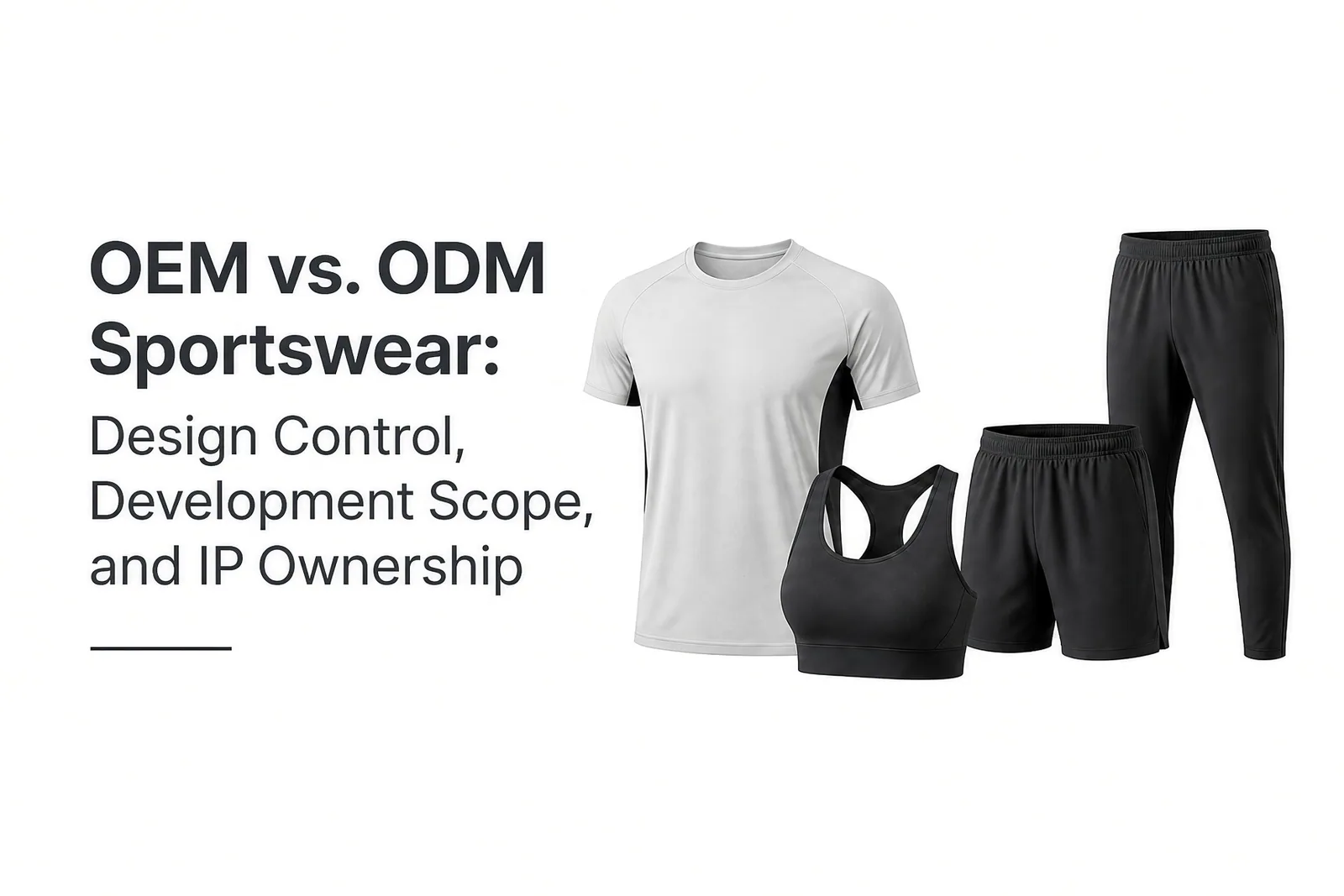
 ODM wins most first launches. OEM wins validated hero SKUs. That verdict is the output of LeelineWear’s model-selection checklist, anonymized data from 50 activewear orders, and an interview with the factory’s Lead Technical Pattern Maker.
The trade-off is narrow and mechanical: ODM buys speed and a lower upfront spend, while OEM buys ownership and precision control. Five factors settle it — design control, tech-pack burden, MOQ and cost, lead time, and performance risk.
Both models were timed on the same floor, and one wash test separates them. After 15 cold washes, the ODM fabric had pilled under the arm by wash 9, while the OEM compression fabric held its shape through all 15.
The ODM risk is rarely branding. It is that a shared silhouette invites copycats and a costlier redesign later. OEM requires a tech pack: no spec sheet, no sample.
Every sampling time and QC figure below comes from 50 anonymized activewear orders produced in this factory and checked against final AQL reports — first-party production records, not a third-party survey.
| Factor | OEM | ODM | Buyer consequence |
|---|---|---|---|
| Design ownership | Brand owns tech pack, pattern, and IP | Factory owns the base style | Only OEM enforces exclusivity |
| Tech pack | Brand supplies the full pack | Factory’s internal spec | No tech pack, no OEM sample |
| Pattern and grading | Brand owns the graded file | Factory owns base grading | Fit control follows ownership |
| Sample rounds | 2–3 | 1–2 | ODM cuts development spend |
| First sample | 7–15 days | 7 days on stock blocks | ODM is first to a physical sample |
| Bulk production | 25–35 days | 18–28 days | OEM’s custom work adds roughly a week |
| MOQ per style/color | 100–200 pcs | 50–100 pcs | ODM spreads across more colorways |
| Custom fabric MOQ | 300–500 kg per color | 200–300 kg, or stock | OEM needs deeper dye lots |
| Upfront development | $500–$2,000 | $100–$500 | ODM protects month-one cash |
| Unit cost at low volume | Higher | Lower, from a shared base | On a 100-unit order, OEM can run 30–40% higher |
| Unit cost at scale | Falls to $7.10–$9.50 at 500 pcs | Flat, near $6.50–$9.80 | Past 500 units a month, OEM wins margin |
| IP exposure | Low; the brand owns the spec | High; shared base | A rival can buy the same ODM block |
| Testing burden | Brand drives lab dips and testing | Factory supplies existing certs | Only OEM certifies a proprietary fabric |
| Best fit by stage | Proven SKUs, 500+ units/month | First launch, under 200 units | Match the model to the stage, not the preference |
A 50-unit pilot is available to first-time brands, so your ODM minimum can start at 50 pieces.
Five Factors That Decide the Model
1. Design Ownership and Technical Workload
OEM puts product definition on the brand’s desk: flat sketches, BOM, graded spec sheets, seam callouts, tolerance tables, artwork placement, trim approvals, wash and care labels, and packaging specs. ODM transfers that load to the factory, leaving you to approve logo, color, label, and box.
Quality managers run this checklist when an OEM tech pack or an ODM modification request arrives:
| Review point | OEM tech pack | ODM modification request |
|---|---|---|
| Base pattern source | Brand-owned flat sketch + graded spec | Factory-owned block |
| BOM completeness | Full fabric, trim, thread BOM | Changed components only |
| Seam callouts | Required, with ±1/8 in tolerance | Only if the change affects assembly |
| Artwork placement | Exact print file and location | Logo mockup or Pantone reference |
| Wash/care label | Brand-supplied or approved | Factory default, may need editing |
A founder without a tech pack stalls on OEM and ships on ODM. But ODM cannot repair a bad block: if the base style pulls at the hip, no logo change fixes it. A complete spec is the subject of the sportswear tech pack guide, and the component list is covered in the bill of materials guide.
2. Lead Time and Sample-Cycle Compression
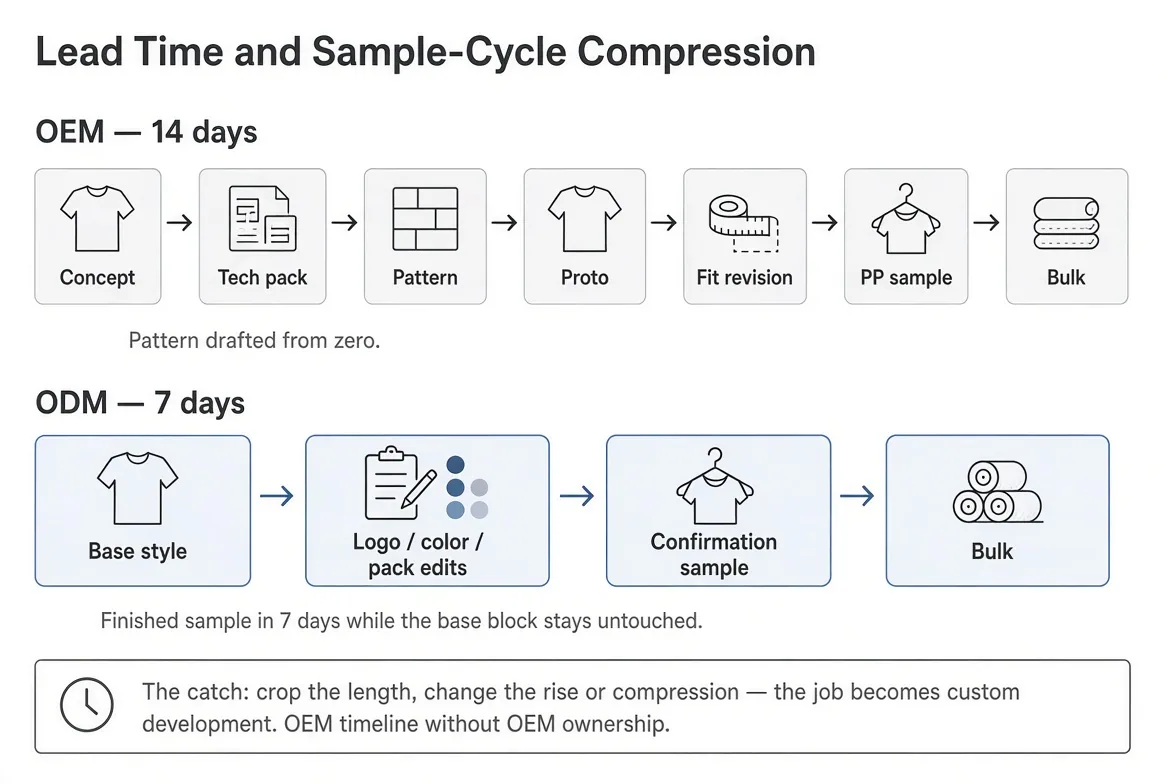
The two paths diverge at the first step:
OEM: concept → tech pack → pattern → proto → fit revision → PP sample → bulk
ODM: base style → logo, color, and package edits → confirmation sample → bulk
The ODM path produced a finished sample in 7 days. The OEM path took 14 because the pattern was drafted from zero. Clothing sample stages breaks down the whole sequence.
The catch is that ODM stays fast only while the base block stays untouched. Crop the length, adjust the rise, or change the compression, and your job becomes custom development — the OEM timeline without the OEM ownership.
3. MOQ, Tooling, and Cost Structure
Development spend lands before a single unit ships.
OEM:
- Tech pack, pattern, and grading: $500–$1,200
- Proto samples: $80–$200 each
- Pre-production sample: $80–$150
- Custom fabric lab dips: $300–$900
- Trims, labels, and packaging: $100–$300
- Tooling and setup: $0–$2,500
- Inspection: $200–$400
- Freight and duties: 12–20% of order value
- Contingency: 5–10%
ODM:
- Base style sample: $30–$80, or free
- Logo, color, and package edits: $50–$250
- Confirmation sample: $50–$120
- Fabric: stock, so no lab dips
- Trims and labels: lower, drawn from stock specifications
- Tooling: usually none, unless branded hardware or heat-transfer plates are added
- Inspection: $150–$300
- Freight and duties: identical to OEM
Unit economics then separate by volume. A basic legging runs $6.50–$9.80 in ODM stock fabric and $9.20–$13.10 in OEM custom fabric at 100 pieces. At 500 pieces, OEM falls to $7.10–$9.50 while ODM holds near $6.50–$9.80. Clothing sample cost details the sampling line items.
That per-unit advantage is conditional. OEM only reaches its lower scaled price after the brand’s own tech pack and grading are funded, which is why ODM usually wins the all-in comparison on a first order.
Tooling in sportswear is not only hard molds. It covers custom jacquard elastic, molded cups, heat-transfer plates, branded hardware, and dedicated seamless or knit setups.
That investment drives the paradox: ODM lowers upfront spend but caps differentiation, while OEM raises development cost and improves repeat-order economics once volume is proven. Pricing pressure on the ODM route is negotiated in MOQ negotiation.
4. Where Do ODM Modifications Fail in Performance Testing?
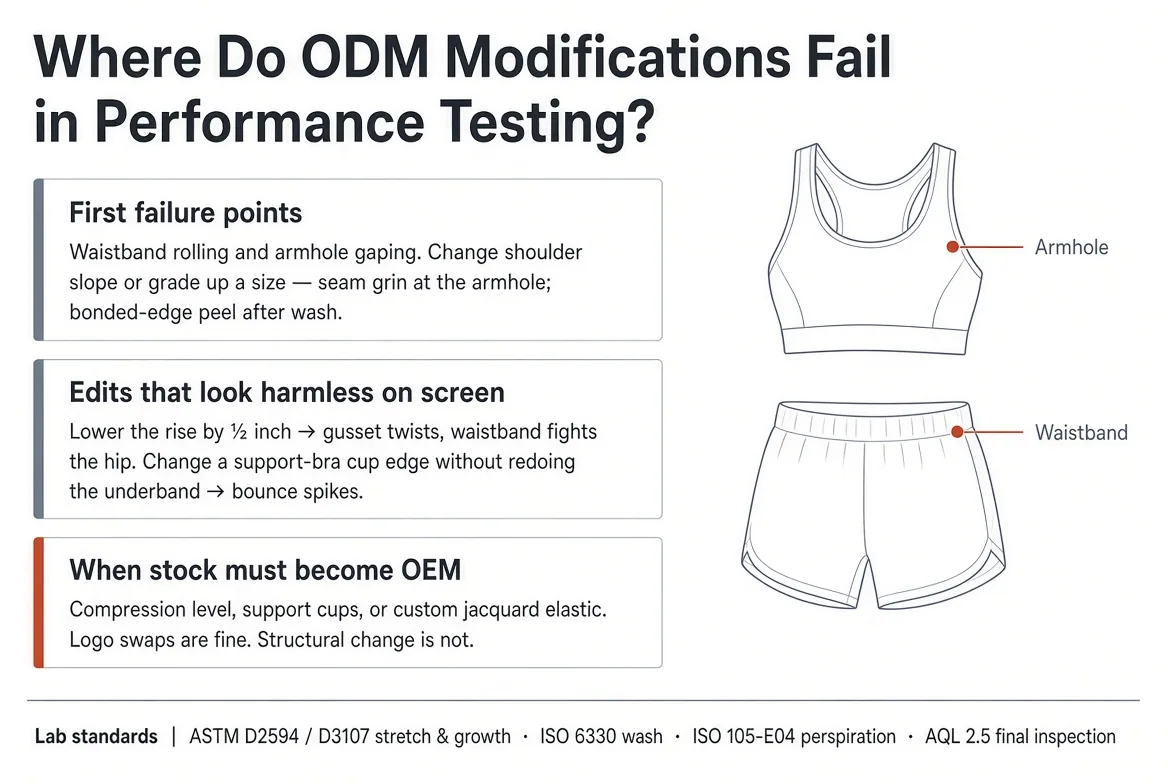
The factory’s Lead Technical Pattern Maker, reviewing stress-test failures on modified ODM blocks:
Q: Where do modified blocks fail first?
“Waistband rolling and armhole gaping. The factory already tuned the seam allowance and elastic tension. Change the shoulder slope or grade up a size and seam grin appears at the armhole; bonded-edge peel appears after repeated washing.”
Q: Which edits look harmless on screen but break the fit in wear?
“Lowering a rise by half an inch. On screen it reads as a simple crop. In wear the gusset twists and the waistband fights the hip. Change a support-bra cup edge without redoing the underband and bounce spikes.”
Q: When does a stock style have to become a ground-up OEM pattern?
“Whenever compression level, support cups, or custom jacquard elastic are involved. Logo swaps are fine. Structural change is not.”
Lab standards govern that work: ASTM D2594 and D3107 for stretch and growth, ISO 6330 for wash stability, ISO 105-E04 for perspiration fastness, and final inspection at AQL 2.5. The methods are set out in the stretch-testing guide and the AQL inspection guide.
5. IP Protection, Compliance, and Landed-Risk Control
OEM leans on paperwork: an NNN agreement (non-disclosure, non-use, non-circumvention), a pattern ownership clause, design file custody, sample confidentiality, and resale restrictions. Without them, tech packs and grading files travel.
ODM raises a different question — can the factory sell the same base to another buyer? If yes, the logo is the only differentiator.
Compliance fails under either model for the same reason: weak documentation. The checklist covers fiber content, care-label accuracy, OEKO-TEX Standard 100, CPSIA and REACH screening, HTS classification, and Incoterm choice.
FOB can look cheaper than DDP until a shipment stalls at customs or fails a perspiration test. After relabeling, re-testing, and expedited freight, the lower ex-factory quote becomes the higher landed cost. See Incoterms for clothing shipments, care and content labeling, and the sustainable sportswear manufacturing guide.
When Each Model Wins
| Factor | Choose OEM when | Choose ODM when | Who owns the call |
|---|---|---|---|
| Design control | There is a pattern team, and the SKU will be reordered | There is no pattern team, and speed matters most | Founder, VP Product |
| Lead time | Fit revisions are expected | The launch is logo, color, and packaging only | Founder, product |
| Cost | Volume is proven at 500+ units a month | The first batch tests demand under 200 units | Founder, procurement |
| Performance | Compression, support cups, or custom elastic are in play | The base block already matches the use case | Pattern team, QC lead |
| IP and compliance | Proprietary fabric or construction needs protecting | Factory-held certs and stock materials are enough | Procurement, compliance |
First-order budget, per style:
- Under $2,000 — ODM, or private label on a stock style. Development fees would consume most of the budget before a single unit is made.
- $2,000–$10,000 — ODM for the first test, then OEM on whichever SKU sells. This is the band where the hybrid pays for itself.
- Above $10,000 — OEM, if the brand can fund pattern, grading, and lab dips inside one cycle.
A proprietary build is also the point at which private-label branding stops being sufficient and the route to private-label manufacturing should be reviewed against full OEM. OEM sportswear manufacturing services set out what the factory takes on at each stage.
Where OEM, ODM, and OBM Sit
The three labels describe the factory, not the buyer. OEM means the factory builds only to a brand’s design. ODM means it owns a design library as well. OBM means it has climbed the whole ladder and now sells a brand of its own.
| Factory rung | Who owns the design | What the buyer gains | Where the risk sits |
|---|---|---|---|
| OEM | The brand | Exclusivity and pattern ownership | The factory brings no design input of its own |
| ODM | The factory | Speed, on a base block already proven in production | Differentiation has to sit outside the pattern |
| OBM | The factory, plus its own brand | Deeper design and engineering capability | The factory sells into the same market as the brands it serves |
Factories tend to climb this ladder rather than pick a rung: OEM work and ODM licensing both fund the OBM label.
Reaching a supplier that has already climbed it usually means stronger engineering. It also means the NNN agreement and pattern ownership clause from factor 5 carry more weight, because the design muscle that serves a client also serves the factory’s own line.
🧠 Expert Take: These models are stages, not rivals. Test in ODM, then move the proven SKU to OEM.
Frequently Asked Questions About OEM vs ODM Sportswear
Which is cheaper: ODM or OEM?
ODM, decisively, at low volume. Development starts around $100–$500 against $500–$2,000 for OEM, and a 100-unit OEM order can carry a 30–40% higher unit cost. The gap reverses once volume is proven.
Do I need a tech pack for ODM?
No. The factory’s internal spec and base block replace it, and you approve logo, color, label, and packaging only. No tech pack also means no pattern ownership, so a later move to OEM starts from scratch. The sportswear tech pack guide covers the build.
Can I switch from ODM to OEM later?
Yes, and most brands should. The hidden cost is paying twice: once for ODM edits, then again for ground-up OEM pattern work. Ask which base styles convert cleanly before the first order.
Which model is faster for a first launch?
ODM, by roughly a week. A stock block reached a finished sample in 7 days against 14 for a pattern built from zero. That advantage disappears the moment the silhouette changes, because a cropped length or an adjusted rise becomes custom development.
Do I own the design with ODM?
No. The factory owns the base style, grading, and pattern. The logo and colorway are the only differentiators, and a competitor can buy the same block. Exclusivity is the reason to move to OEM, and it requires a full tech pack.
Which model wins for a first activewear launch?
ODM, for most launches under 200 units. It protects cash and validates demand before pattern work is funded. Once sell-through holds at 500+ units a month, OEM returns more margin and more control. Fabric choice shifts those economics either way — see the sportswear fabrics guide.
⚡ Power Move: Launch two or three colorways in ODM, track your sell-through for 60 days, then convert the best performer to OEM with a full tech pack and graded spec. Validation before investment.
Ready to map the model to a stage? Talk to the team.
Bring three things to that conversation: your category, your first-batch volume, and whether the silhouette is already locked. Those three answers usually settle the OEM-or-ODM question in a single exchange, because each one points at a different row of the tables above — cost at low volume, pattern ownership, and where the performance risk sits.
If the answer lands in the middle, the split is straightforward: ODM on the launch colorway, OEM on the style that earns a reorder. First-time brands can open on a 50-unit pilot and fund the tech pack out of proven sell-through, rather than betting a full development budget on an untested silhouette.
Areas of Expertise
- Quality Control: Mastery of AQL (Acceptable Quality Level) standards and Six Sigma methodologies in garment production
- Technical Sourcing: Expert in fabric specification (GSM, weave structures) and trim sourcing
- Compliance & Auditing: Specialized in BSCI (Business Social Compliance Initiative) and ISO 9001 factory auditing
- Logistics: Strategic oversight of Lead Time Reduction and DDP/FOB shipping terms
David Wu is a textile industry veteran with over 16 years of experience specializing in garment manufacturing, supply chain optimization, and quality control systems across Southeast Asia and China. His career is defined by implementing rigorous AQL 2.5/4.0 inspection protocols for mid-to-large-scale private label brands. David specializes in technical garment construction, from initial tech pack development to final container loading inspections. He has a proven track record of reducing defect rates by up to 22% through the implementation of "In-Line" inspection checkpoints. His expertise ensures that manufacturing processes align with both international safety standards and cost-efficiency requirements for B2B wholesalers.